
Continues from here.
Ice pain and scarcity
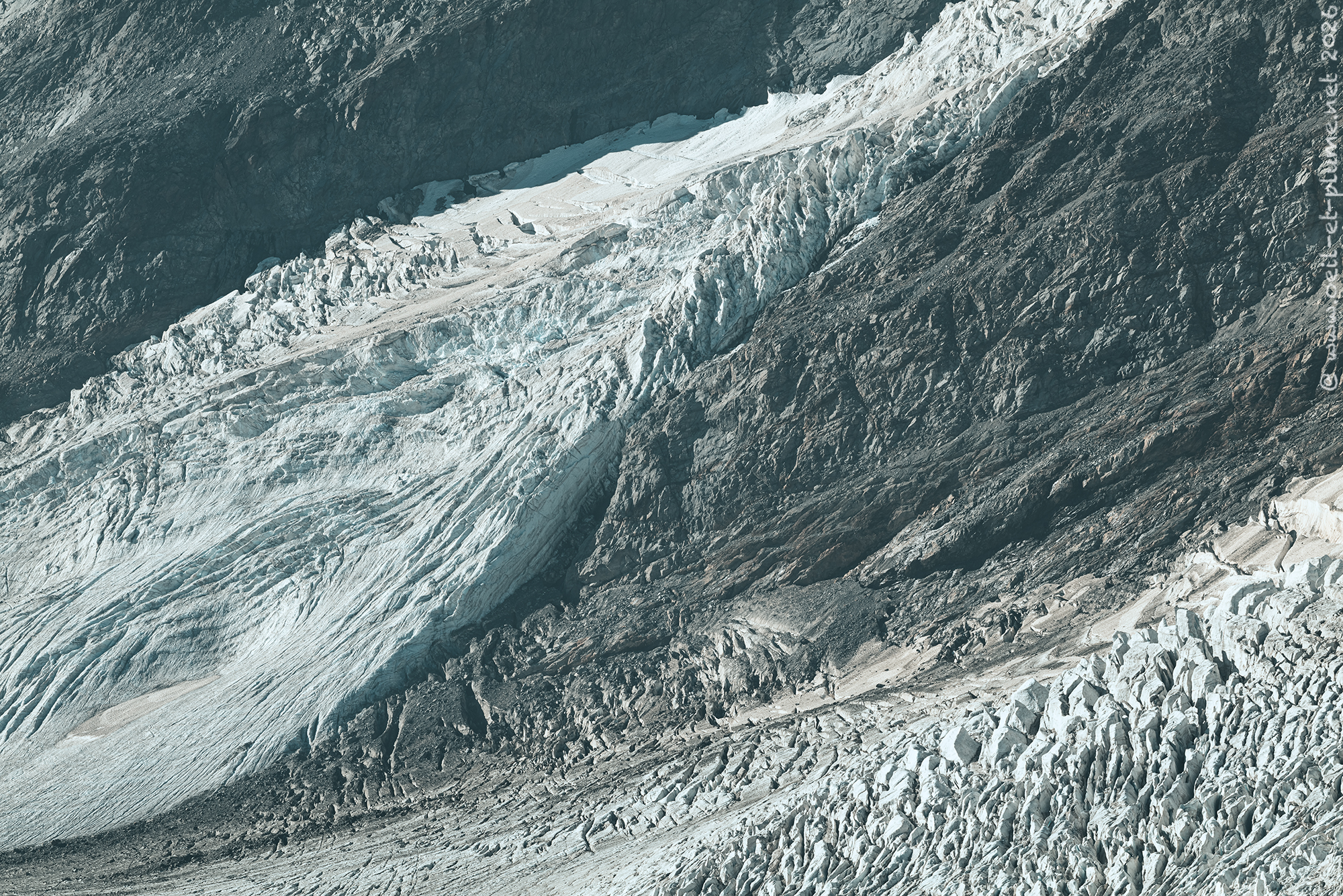
It is early morning in the Grindelwald heights, in the Bernese Alps. I am on my way to the Jungfraujoch, aboard a rack railway that runs through a seven-kilometre-long tunnel beneath the Eiger and the Mönch mountains. During a stopover, a glimpse of the Eiger Glacier leaves me cold: the ice and rock landscape looks so wild and tormented, as thought it were suffering some great pain.
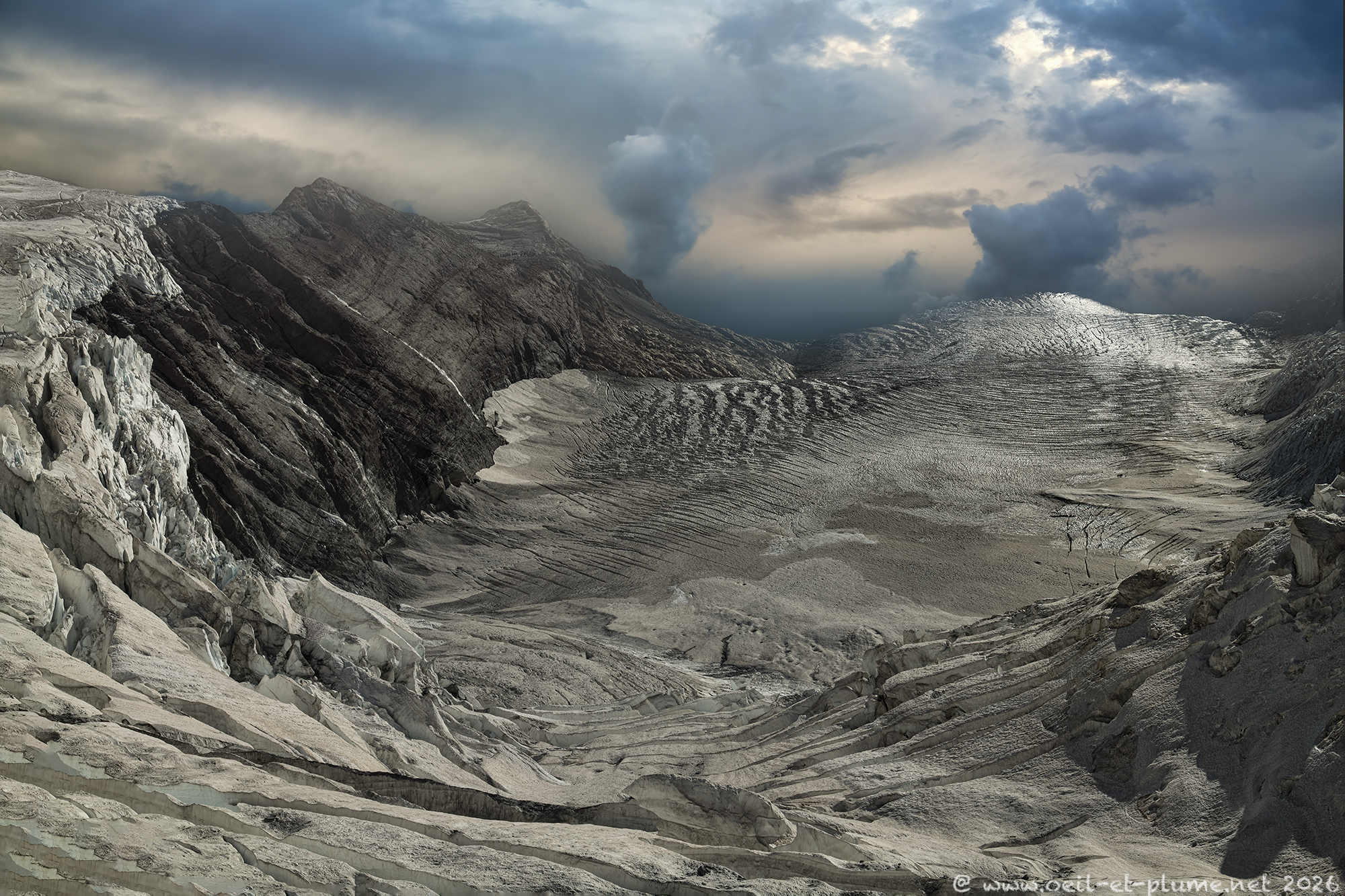
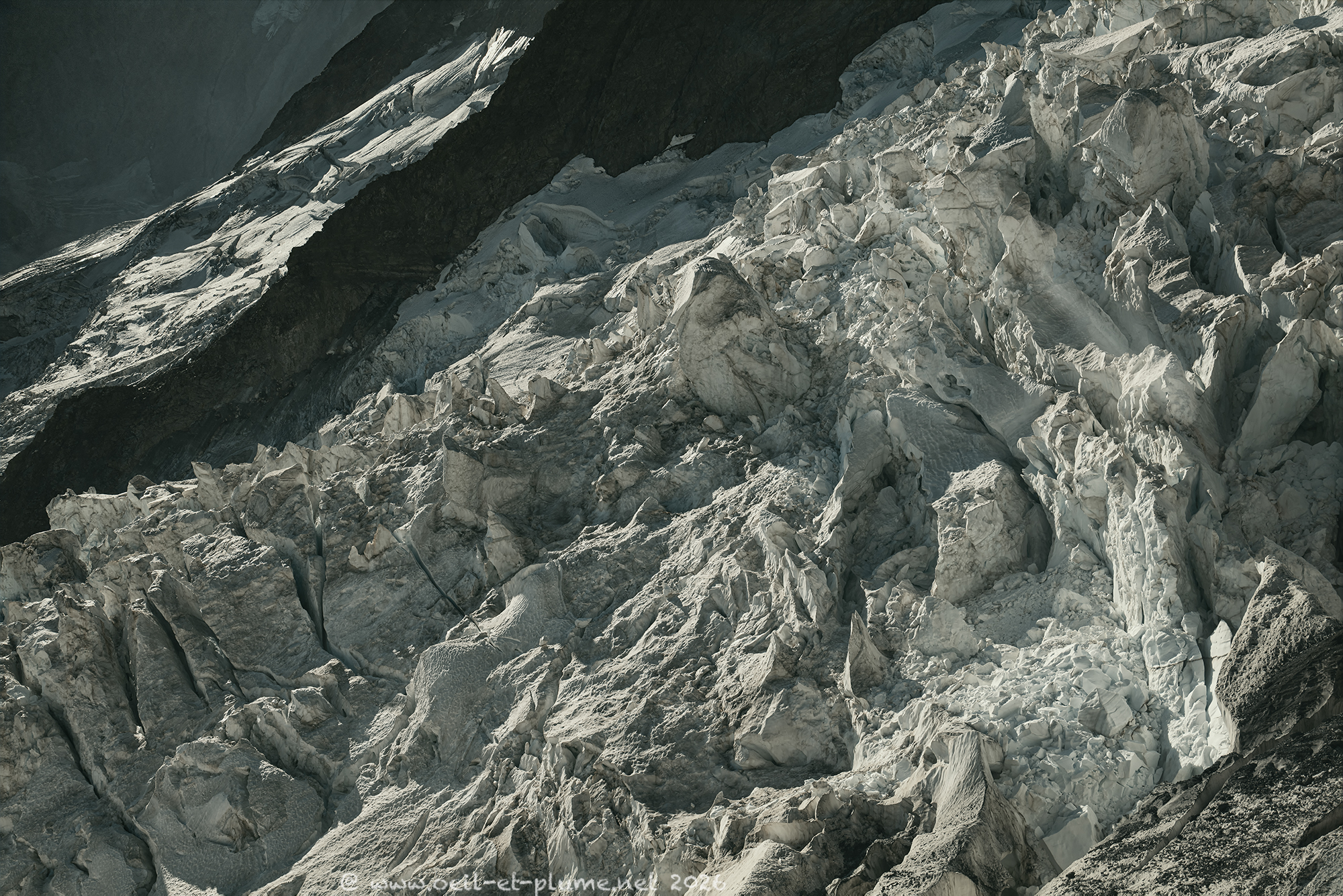
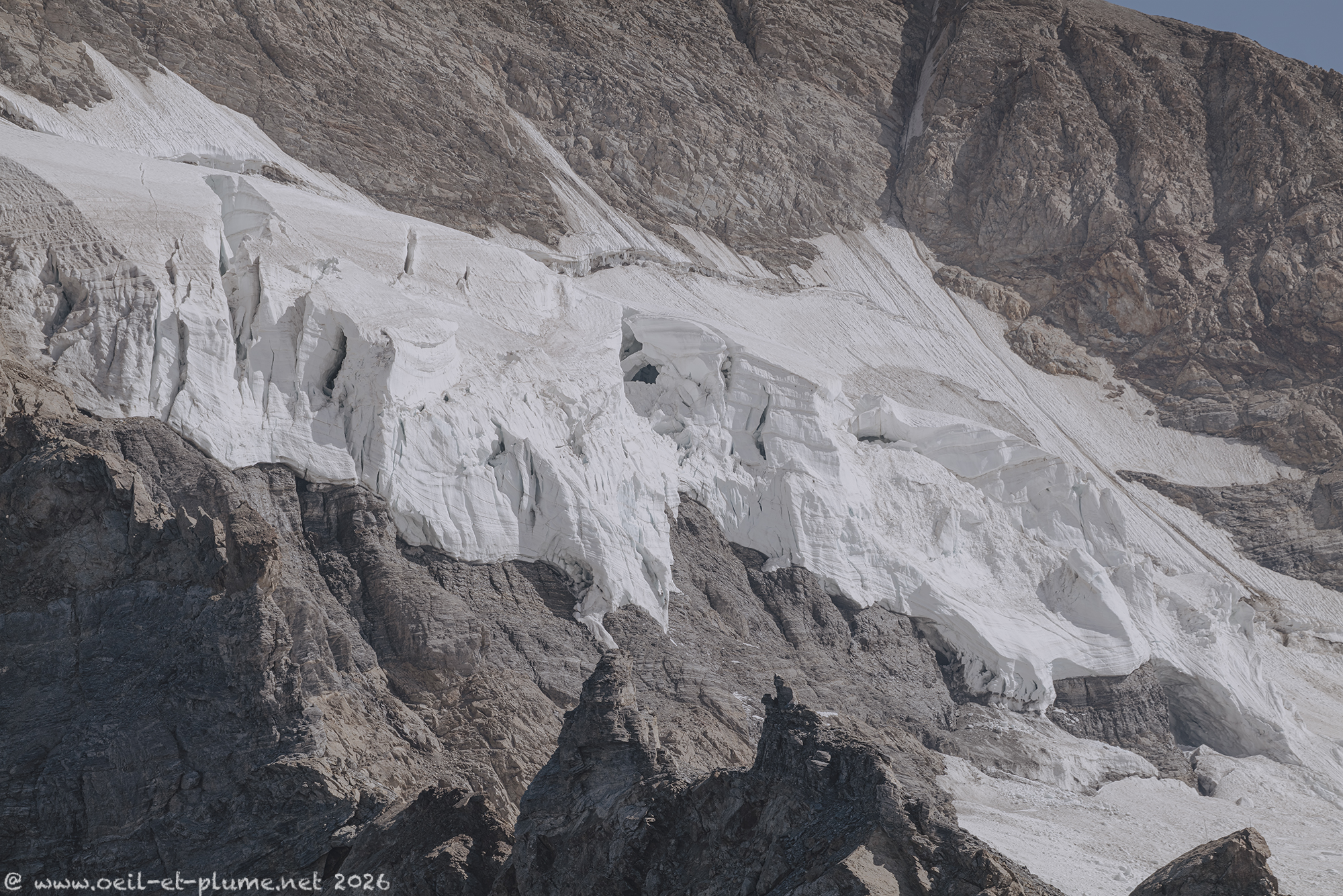
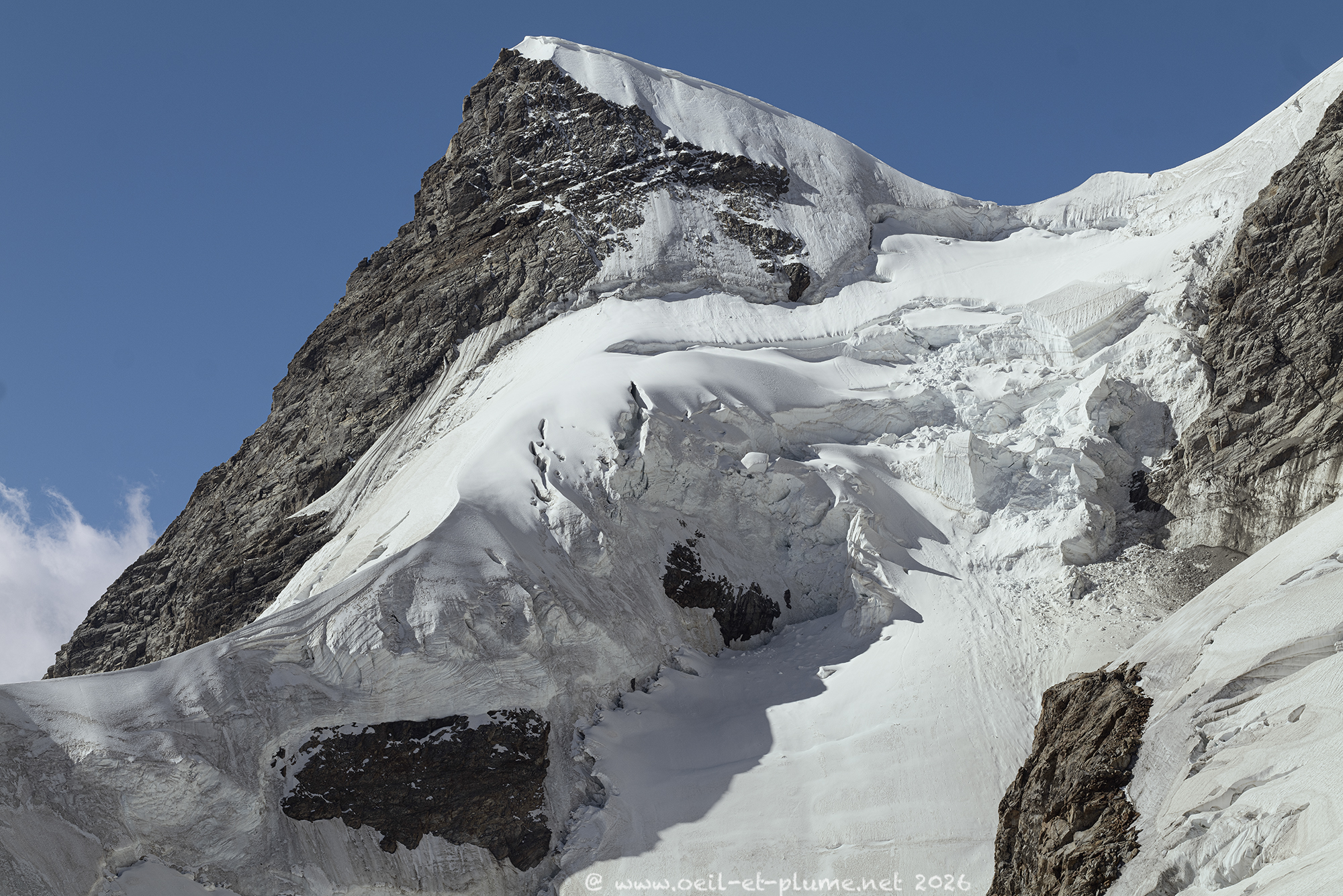
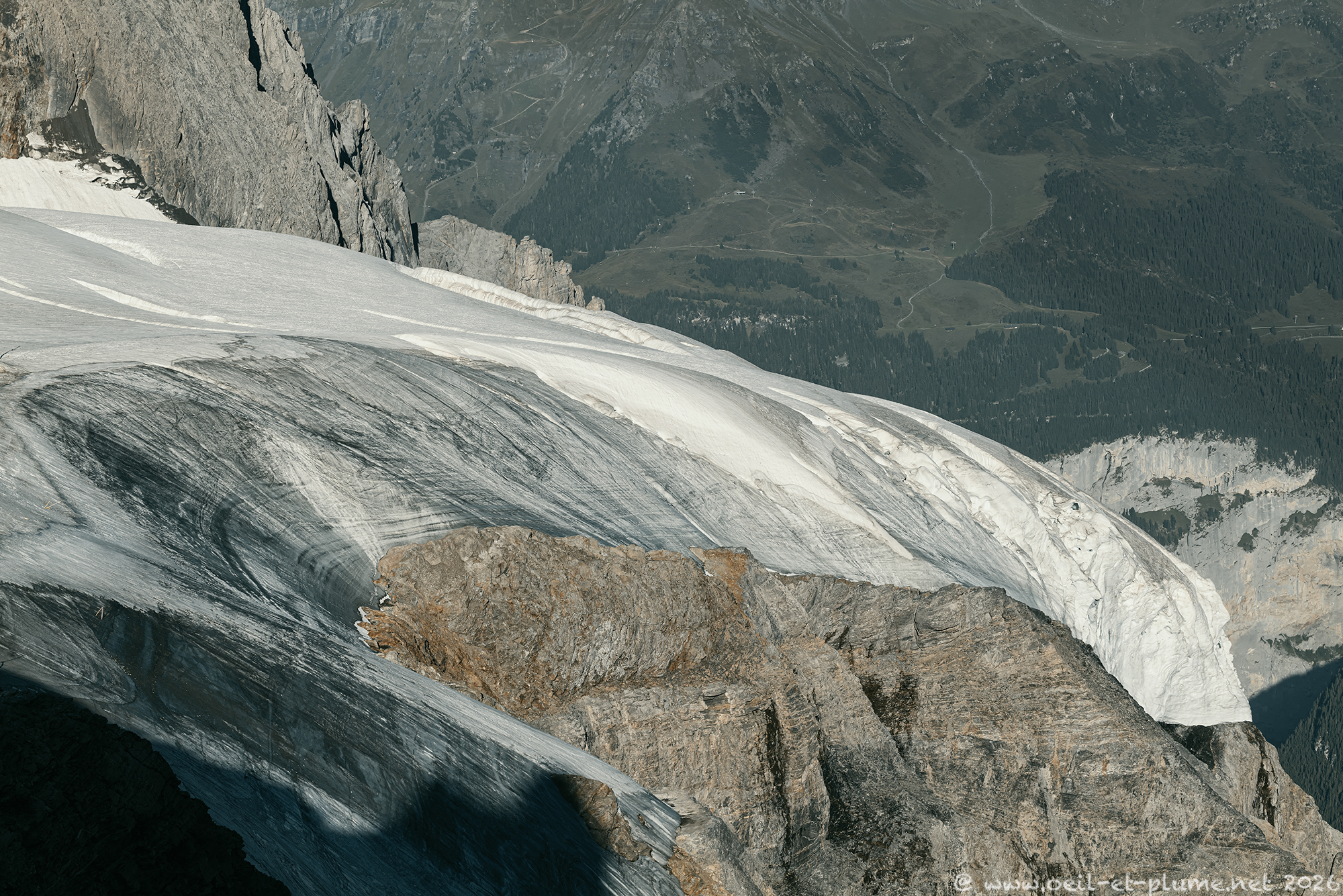
Upon arriving at the Jungfraujoch at around 3,500 metres of altitude, the impression of pain endured by the ice is less acute—lines, shapes and surfaces are more fluid. Yet there is rather less ice and snow than I would have expected and liked.
Considering such pain and scarcity, the mountain scape in this part of the Bernese Alps displays obvious signs of climatic warming. A worrying news that is unfortunately not a breaking news.
Aletsch Glacier cradle
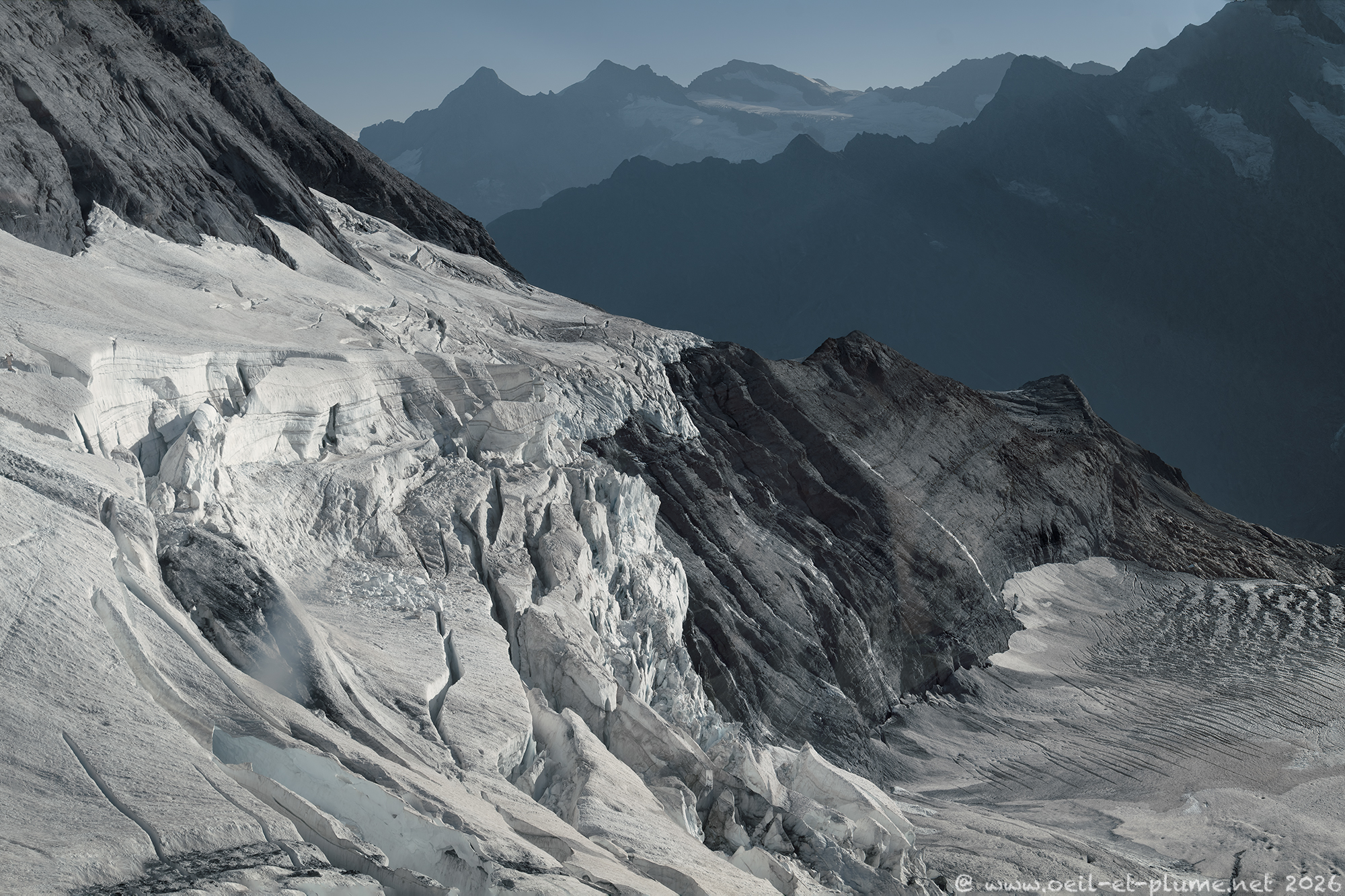
The Jungfraujoch is a mineral saddle connecting two major peaks of the Bernese Alps, the Jungfrau and the Mönch. Owing to its central location, it constitutes the cradle of the Aletsch Glacier.
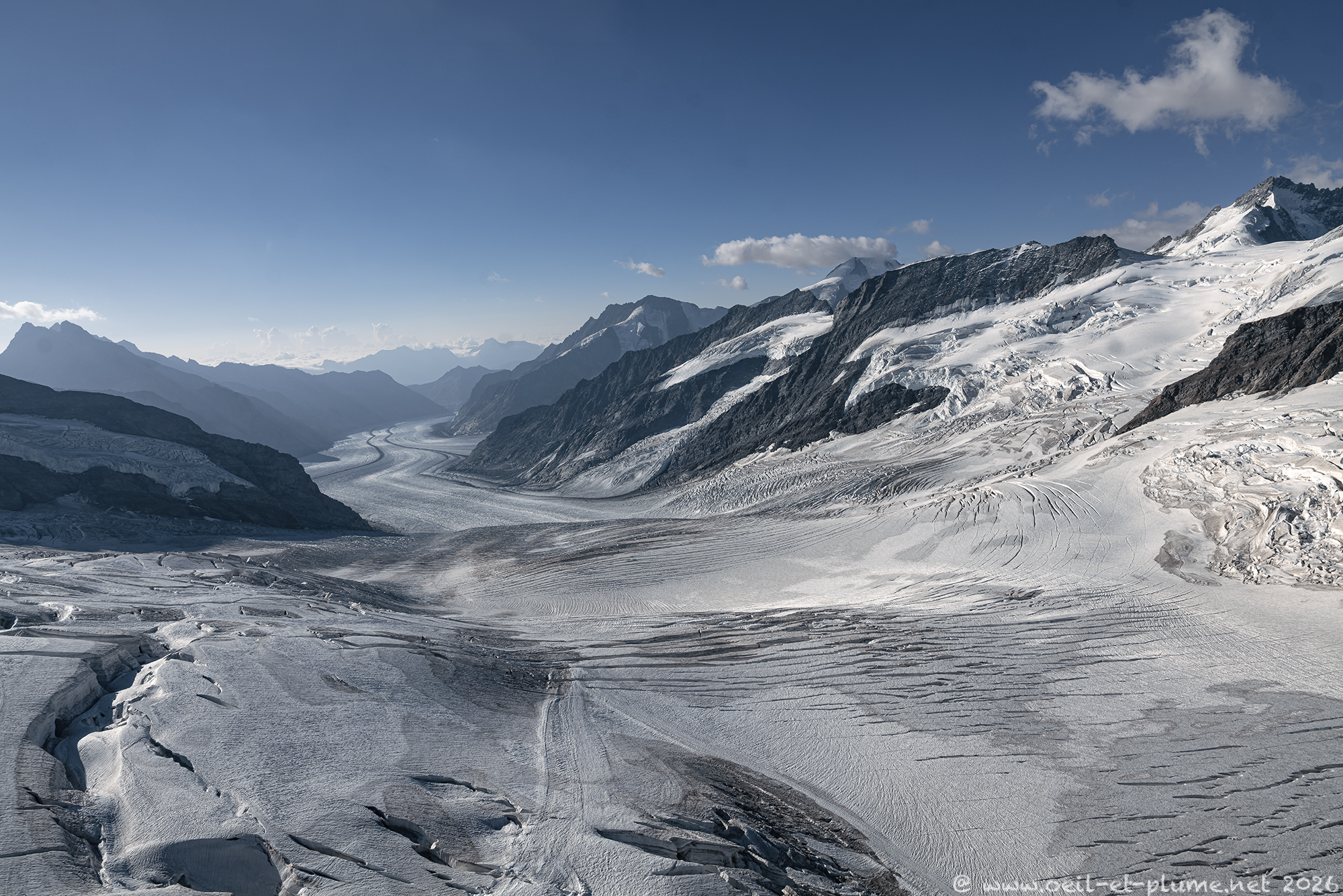
The Jungfraujoch is home not only to Europe’s highest railway station, but also to the Sphinx – a high-altitude scientific research and observation station. The site also offers a superb vantage point over the Jungfraufirn and more widely over the upper part of the Aletsch Glacier. This should be useful to my search of the Rollibock.
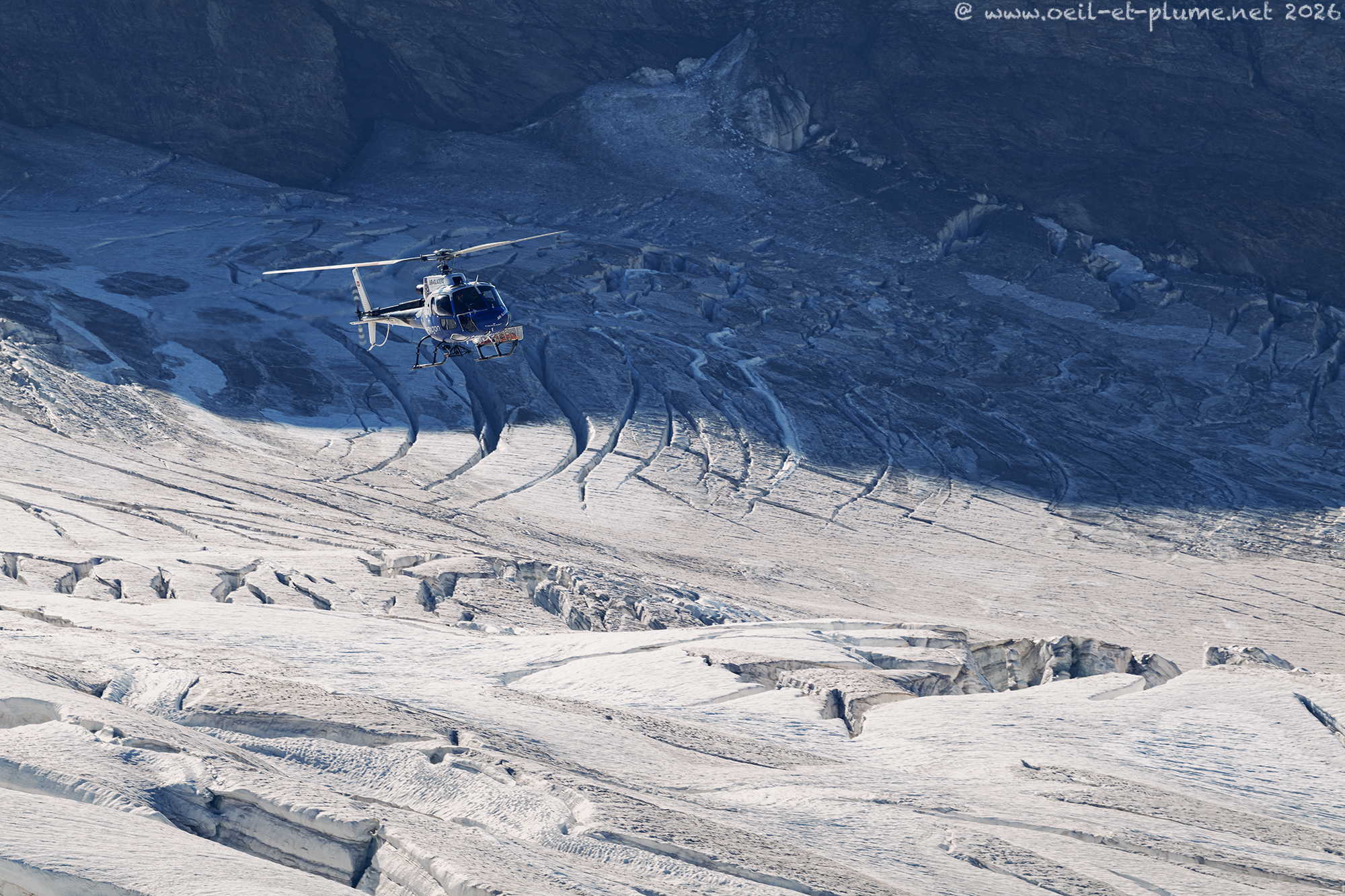
As the Jungfraujoch is much visited by people from all over the world, I can hardly expect the Rollibock to roam around openly. I rather look for subtler signs of its presence that might guide me to its hiding place.
For now, however, my attention is captivated by the majestic landscape. The upper reaches of the Aletsch Glacier, including the Konkordiaplatz, appear both mighty and elegant, cradled in their austere mineral surroundings. A ribbon of ice and snow winds in graceful curves towards the horizon, descending all the way to the Eggishorn. My imagination runs and runs, interprets those natural shapes with much delectation and fantasy.
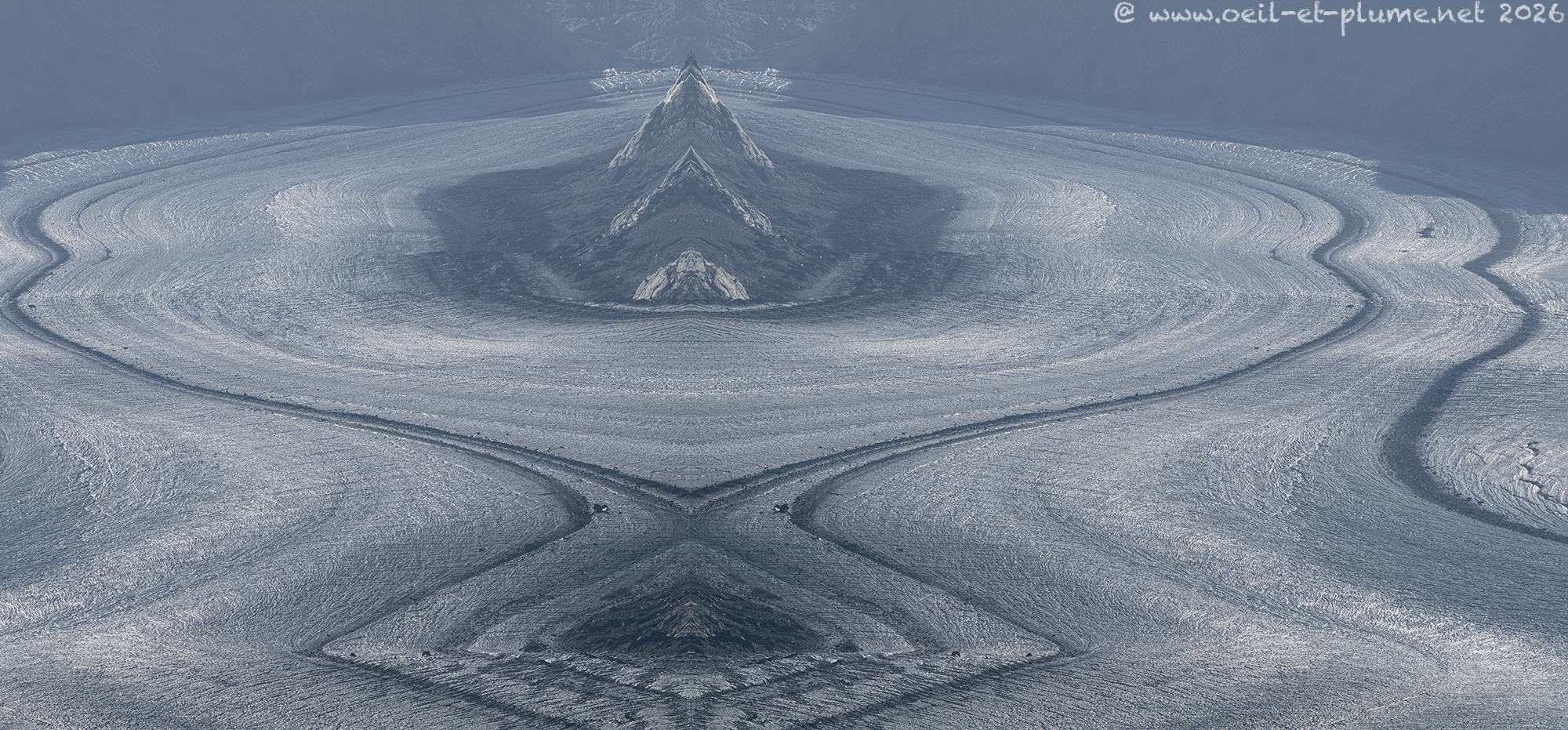
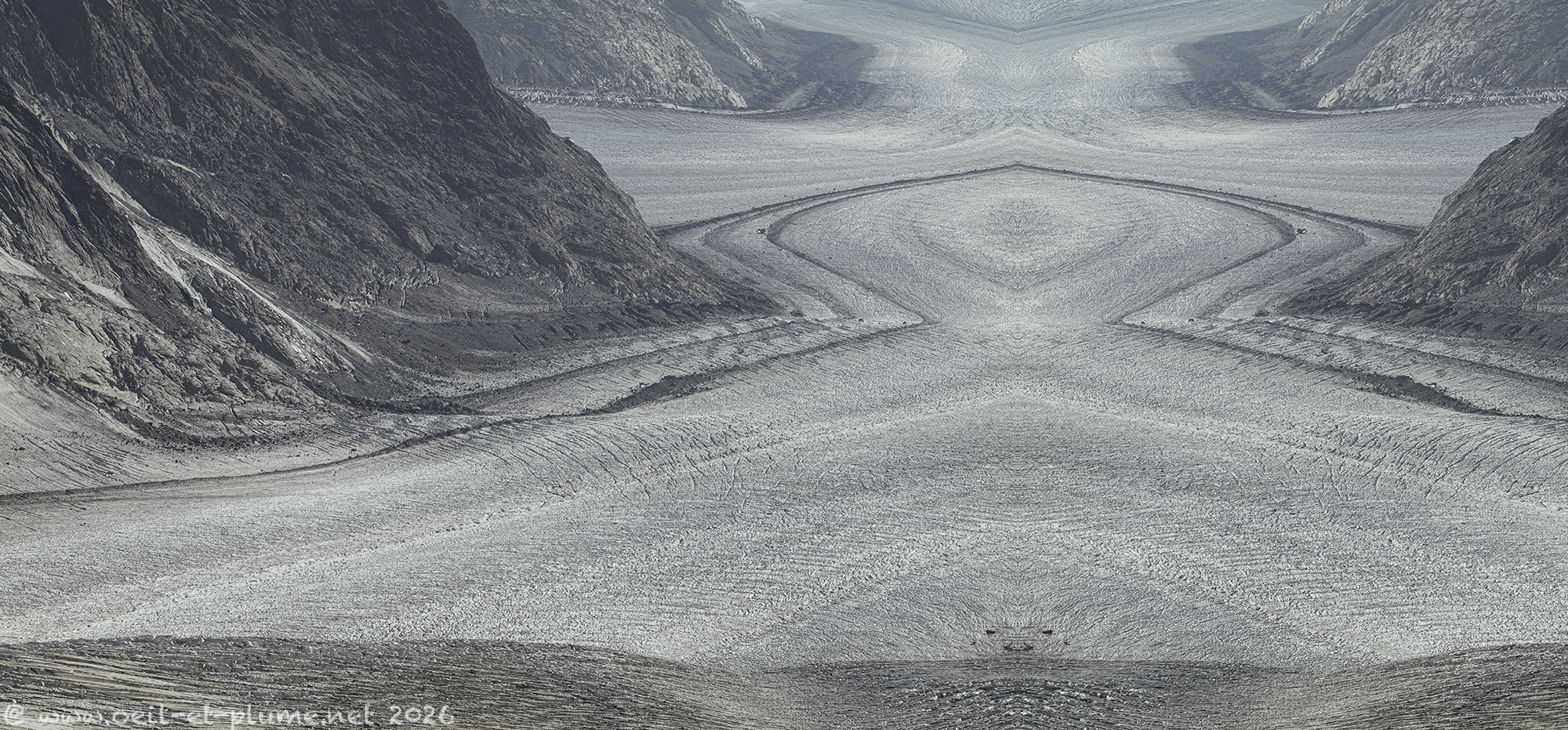
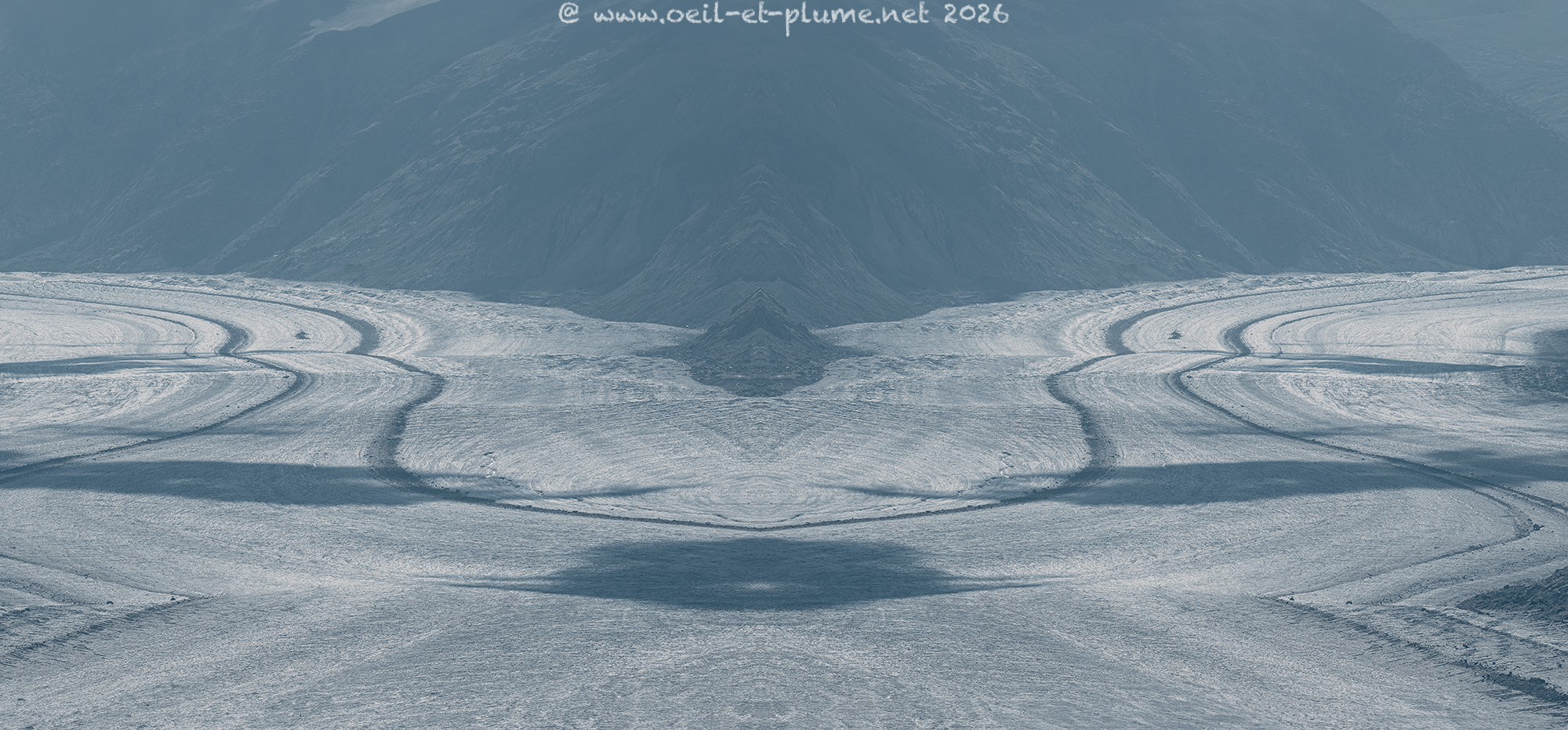
It is easy to imagine how local people might once have been tempted to follow this frozen passage. There is historical evidence that, in the late medieval period, a pass existed between Grindelwald in Bern and Fiesch in Valais—a route that was eventually lost beneath the advancing glaciers in the region.
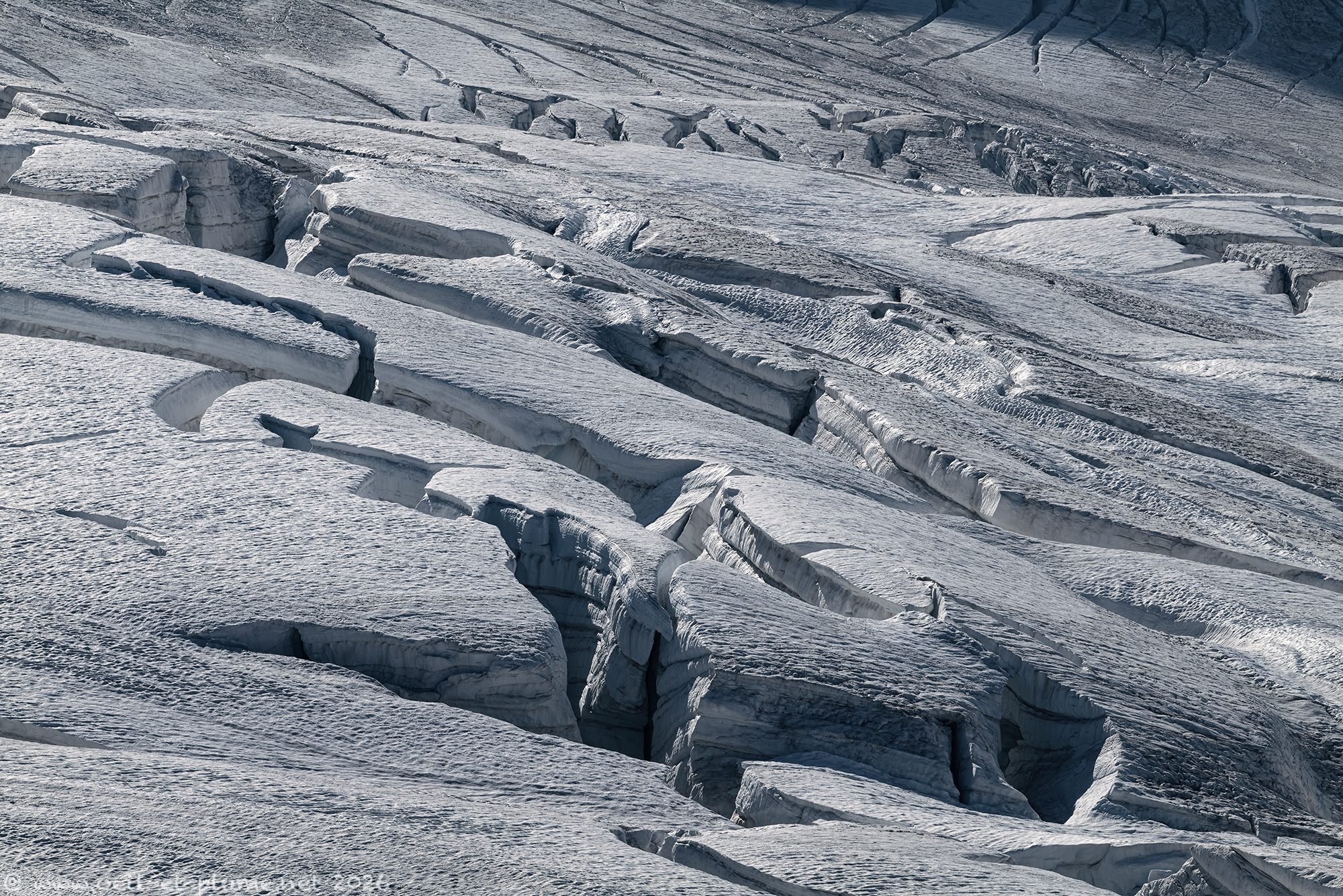
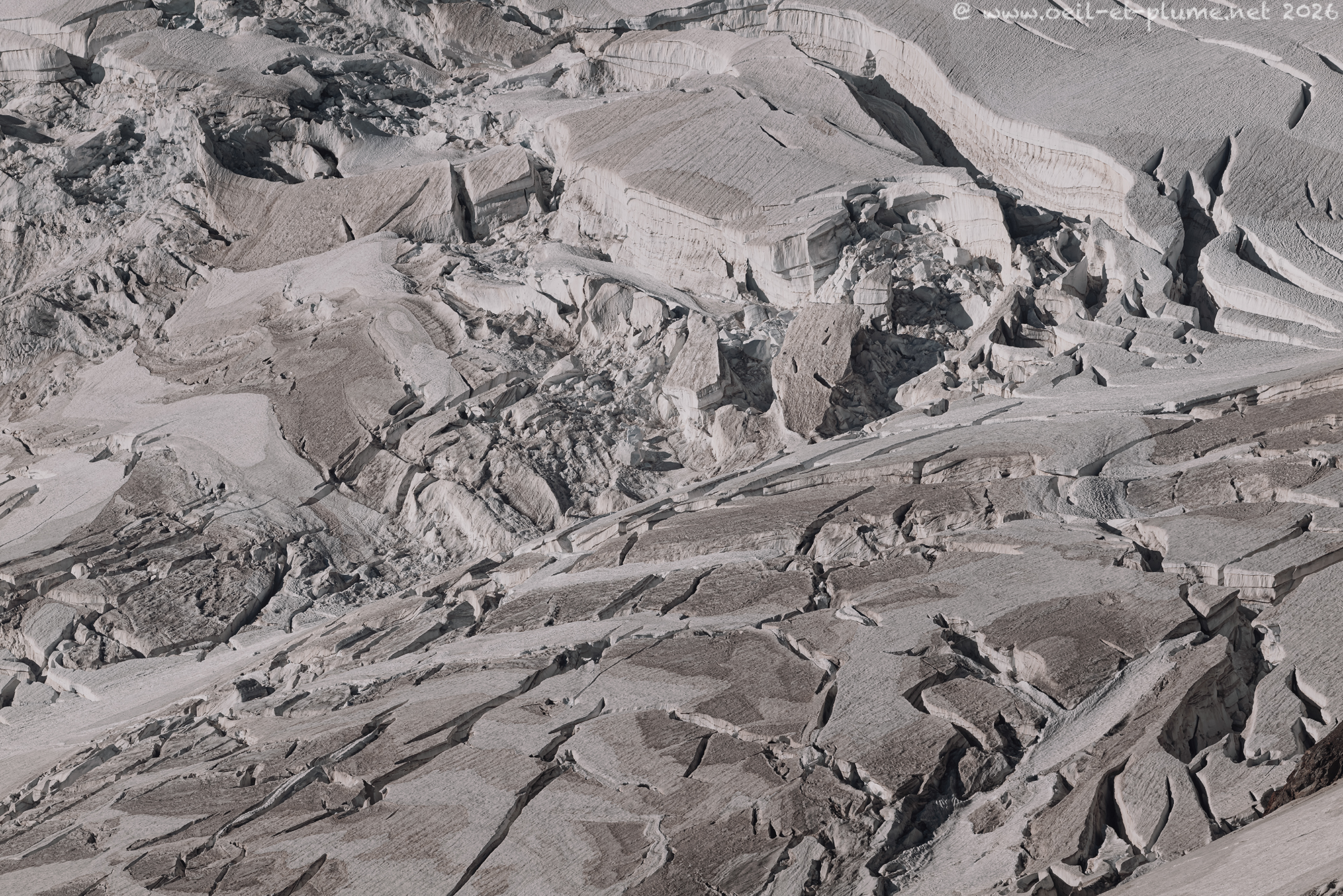
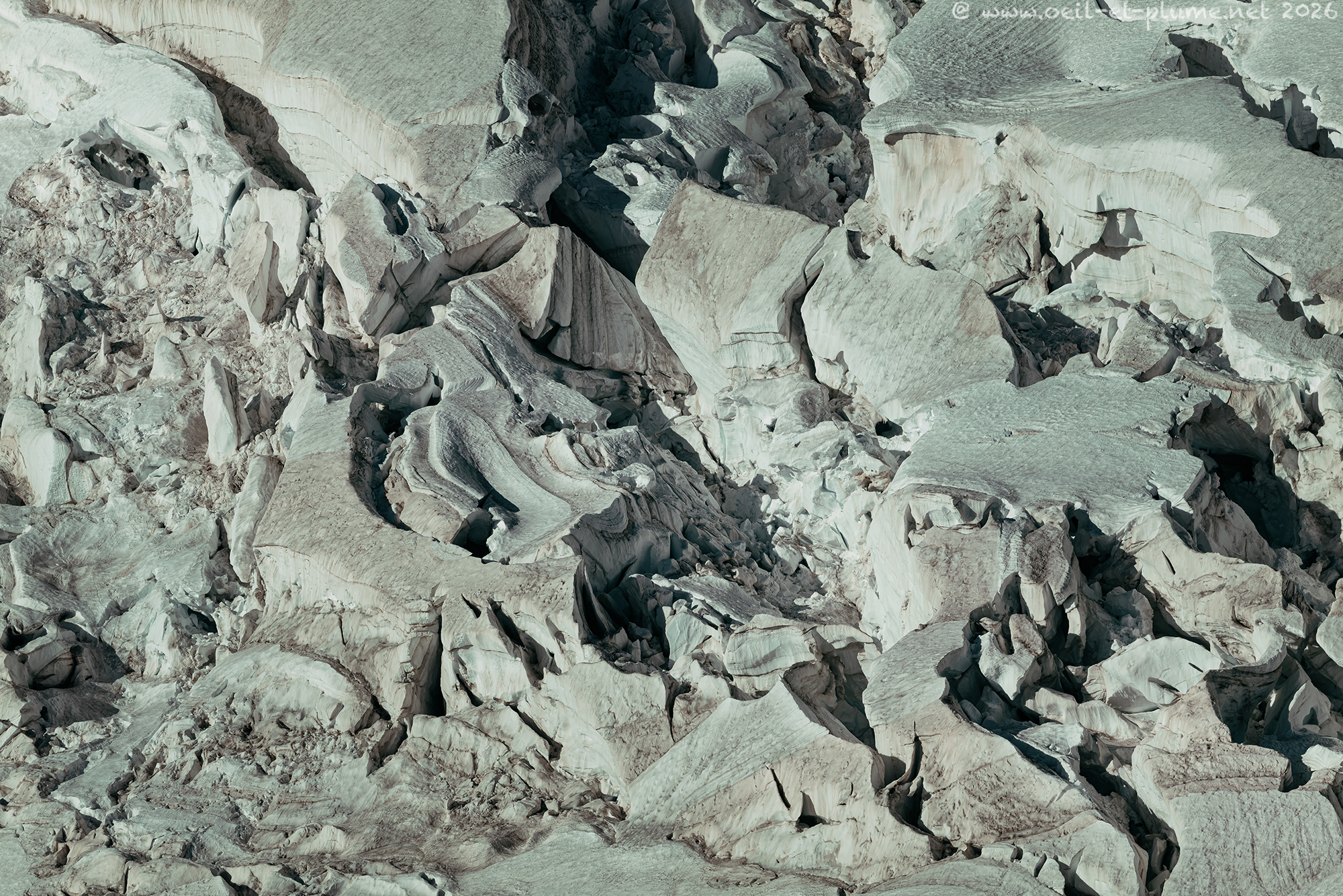
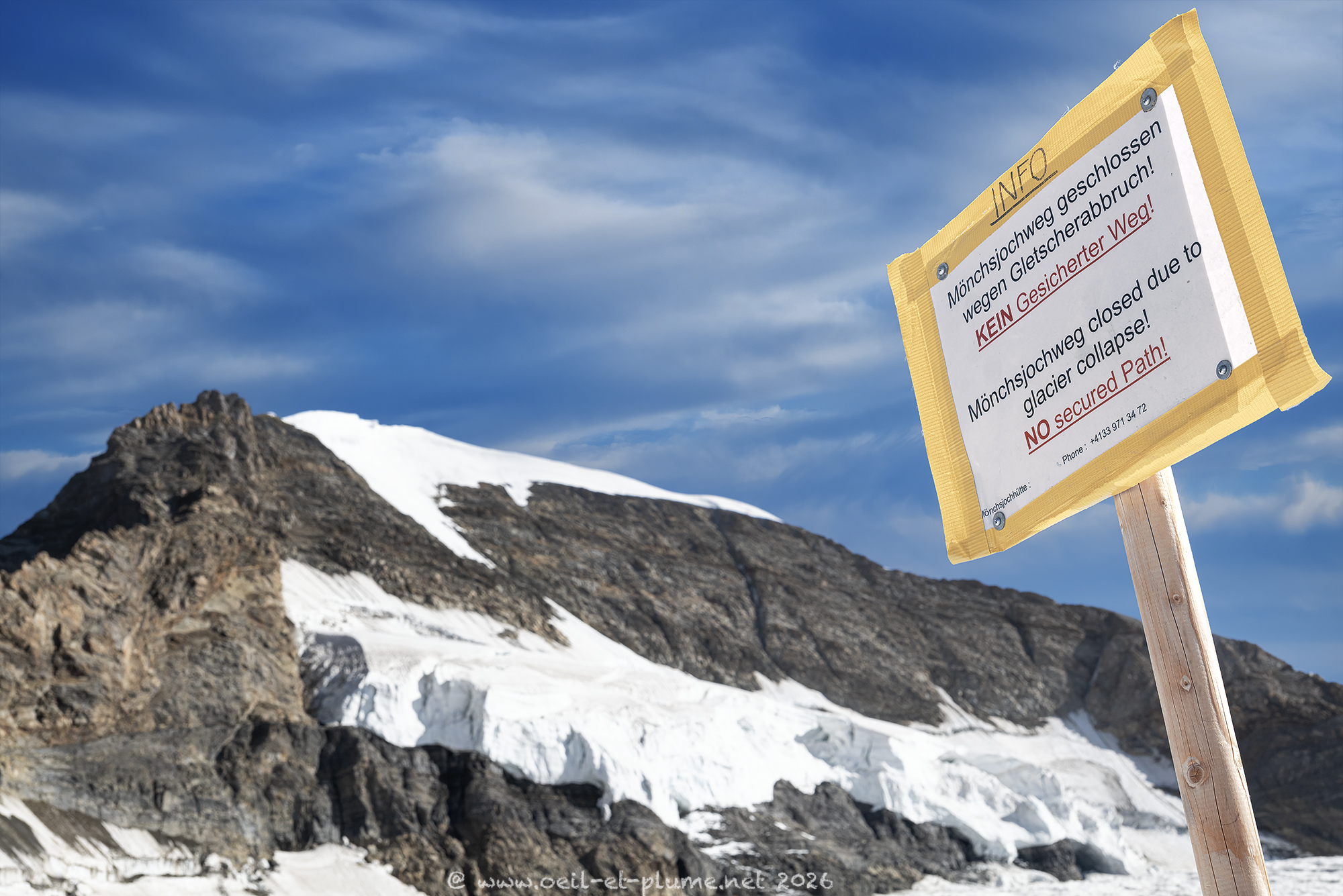
Nowadays, the surface of the upper Glacier is deeply riven with crevasses, making any trek across it hazardous. At the time of my visit, the routes from Jungfraujoch to the Mönchsjoch Hut and the Konkordia Hut were impassable.
Meeting the Rollibock
As the guardian of the serenity of the Aletsch Glacier, the Rollibock must be pleased by the current limited human presence on the ice, and content to remain hidden away in its icy lair. If I am to meet with the beast, I must first trace its whereabouts.
I scan the foot of the Jungfraujoch’s mineral saddle carefully, searching for any sign of an entrance. Then I spot a narrow tunnel disappearing into the ice. This way could lead to the Rollibock’s lair.
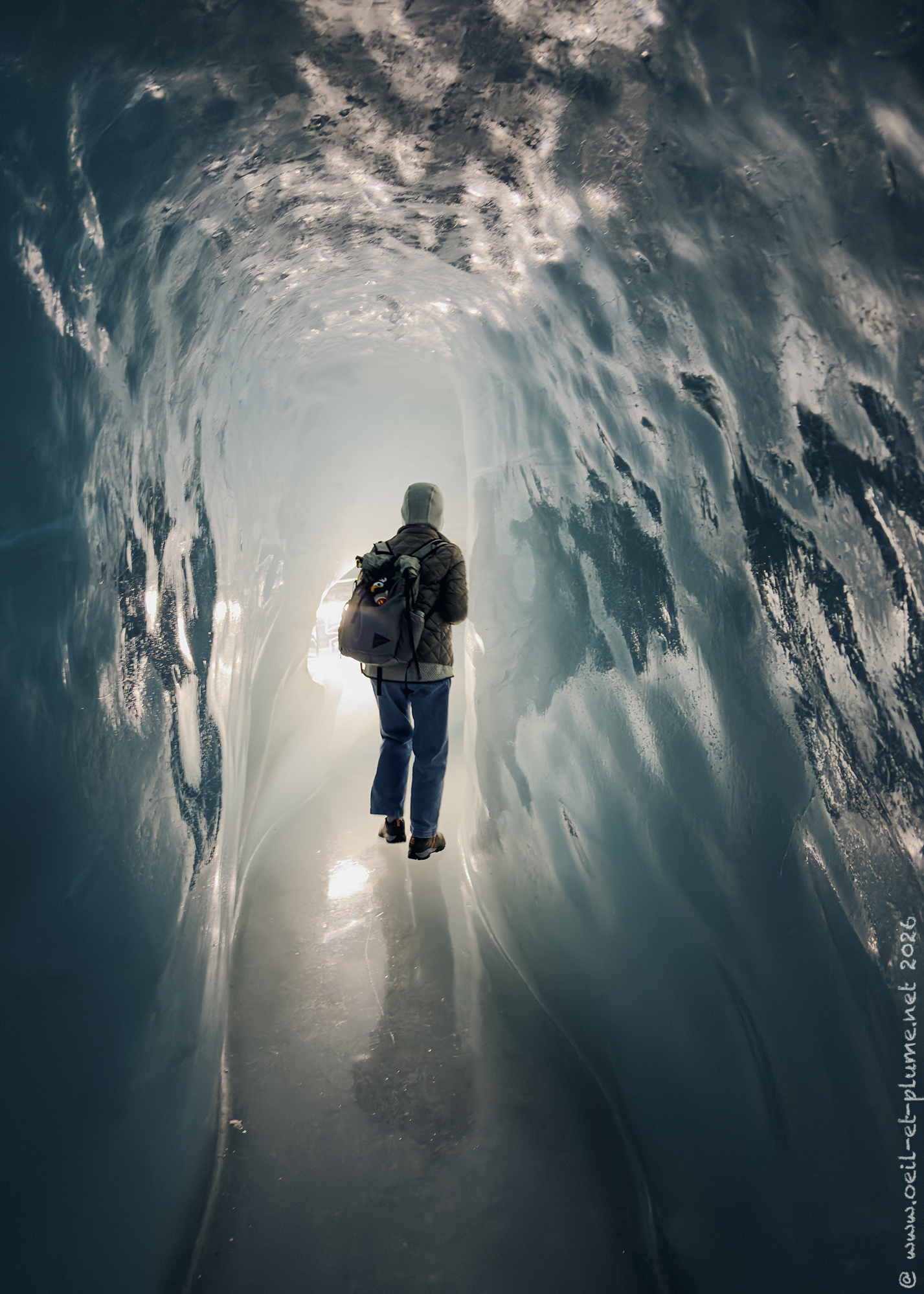
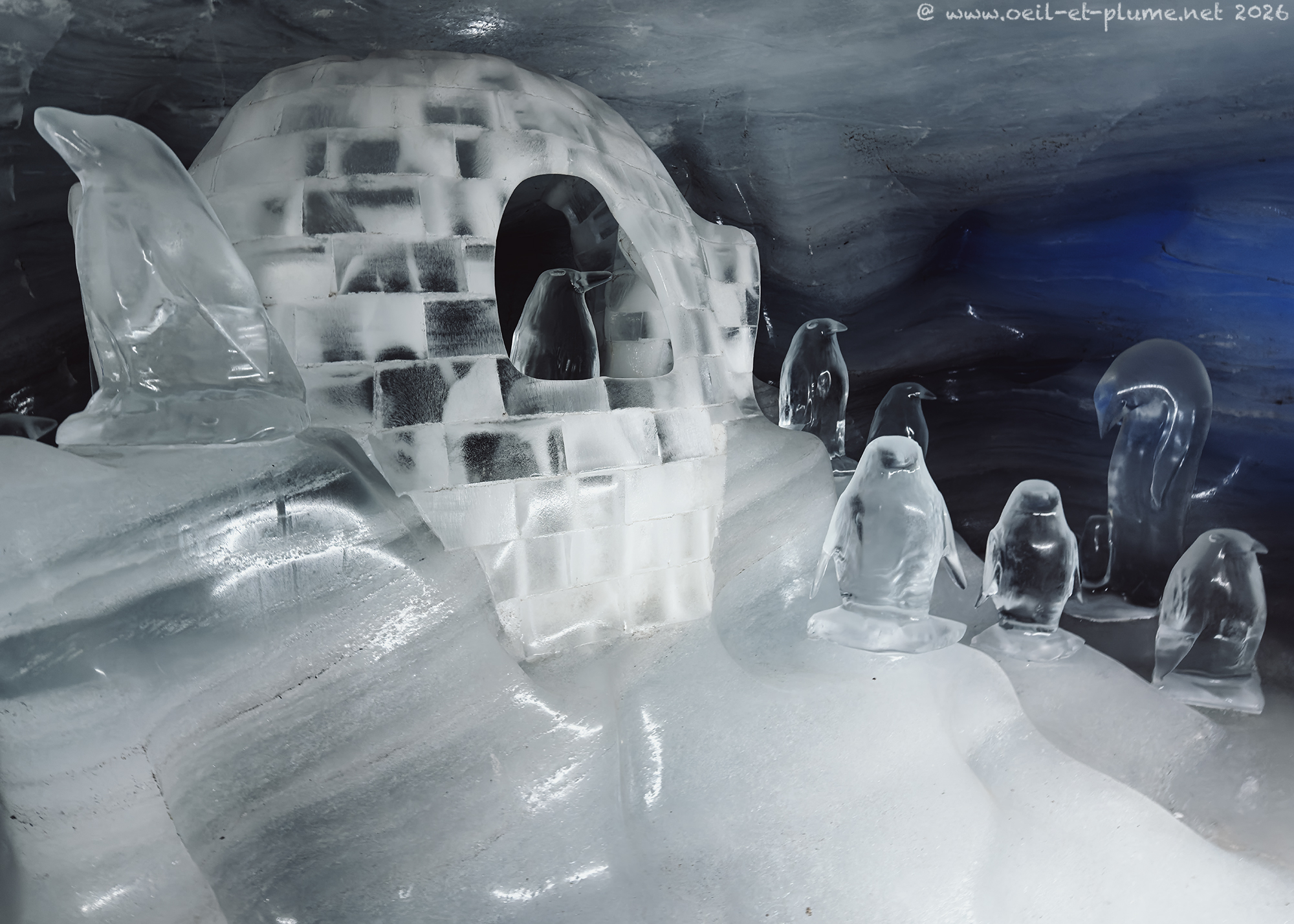
I venture with utmost precaution into the ice tunnel, alert of any sound or scent that could betray the presence of the Rollibock. Before long, I reach a larger chamber inhabited by a colony of penguins. Their leader greets my enquiry with an oddly smile: “You’re looking for the Rollibock’s home? Follow that ice passage, if you dare…”
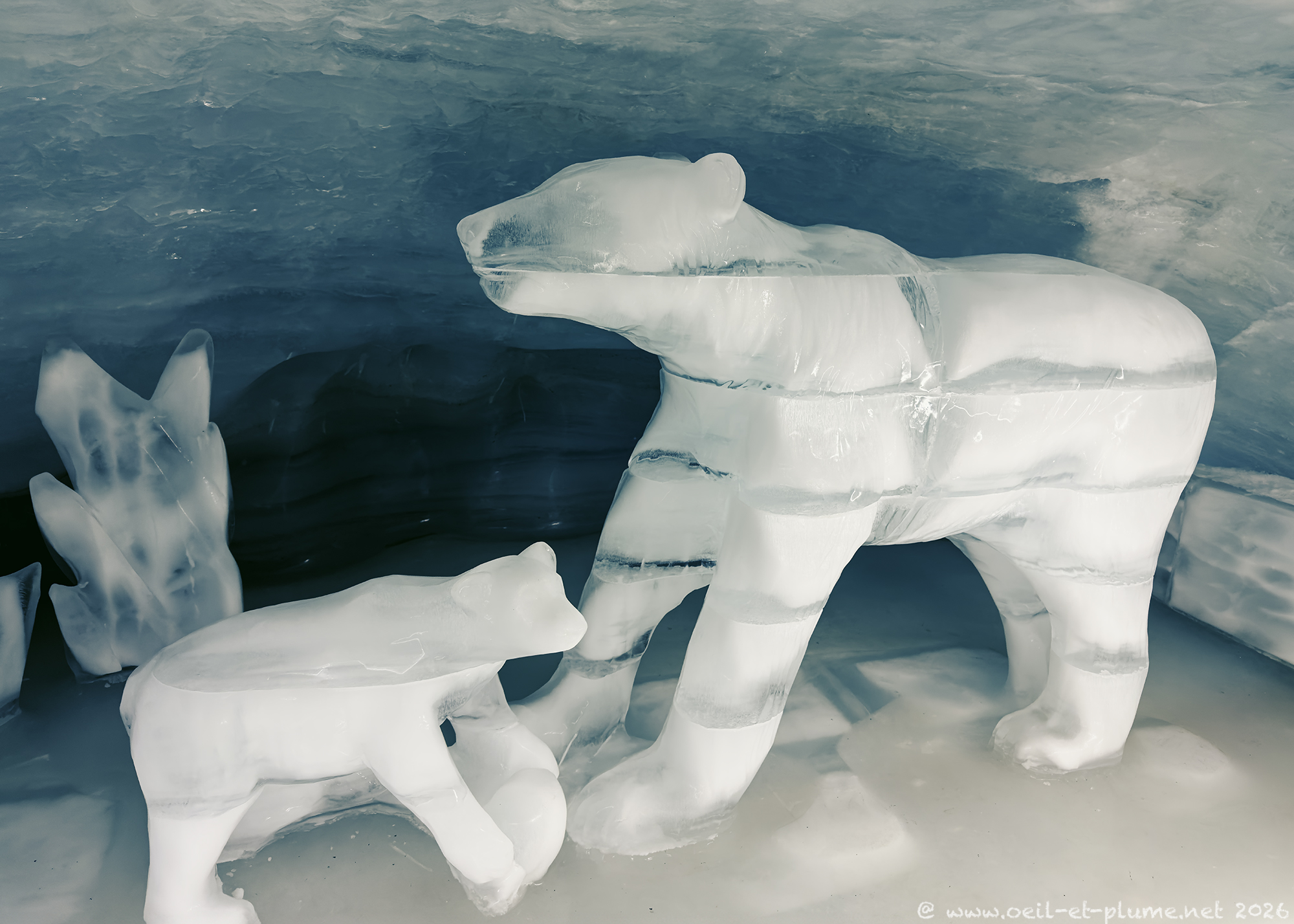
Deeper inside the ice, I come upon a female bear and her cub. The mother rises abruptly at my approach, placing herself protectively between me and her young. Gradually, however, she relaxes when I explain the purpose of my visit. “You’re a courageous folk, good luck!”.
A little farther on, I encounter a powerful horse. It rises onto its hind legs and attempts to block my way. “Don’t go beyond that point. You know why!”
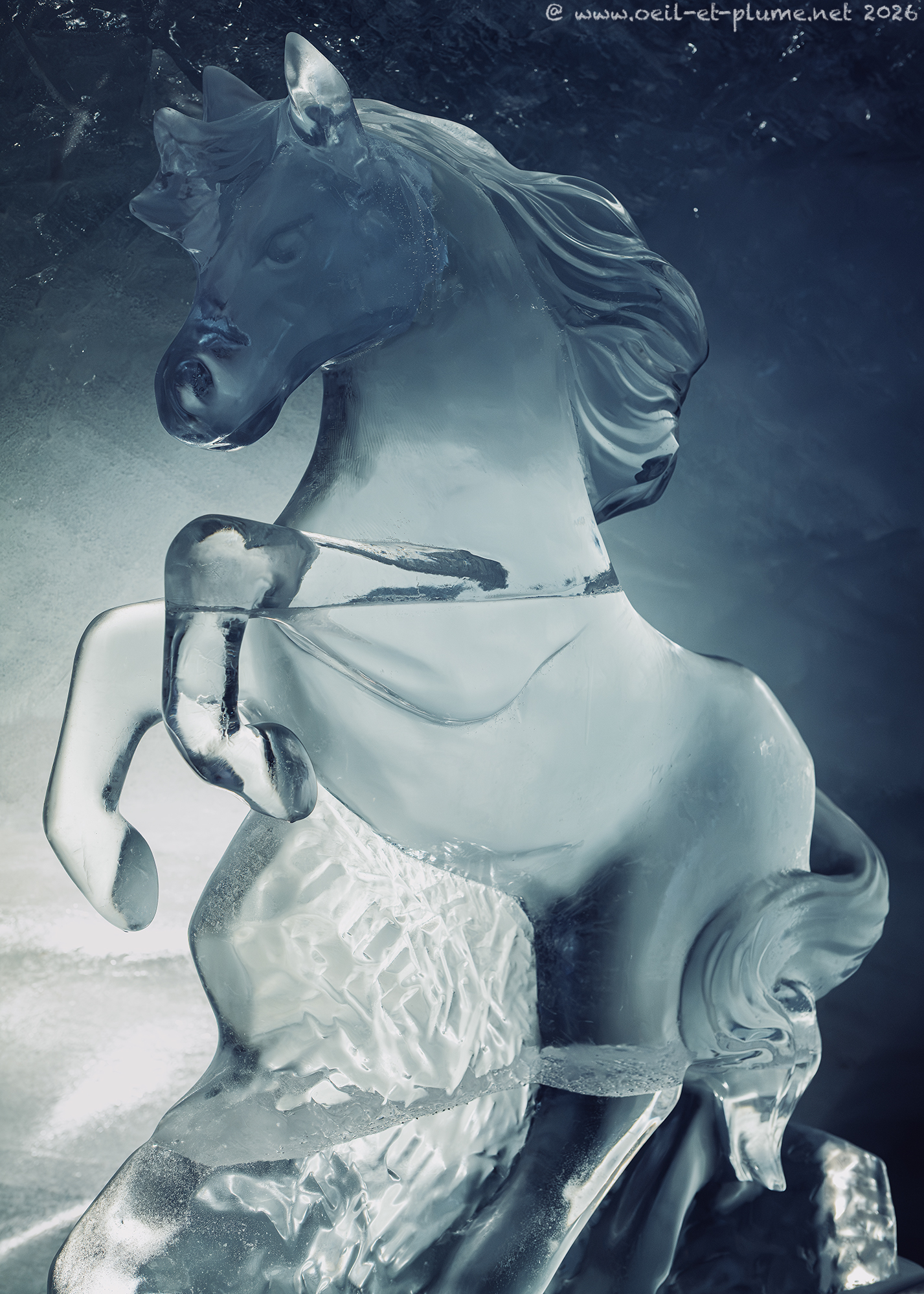
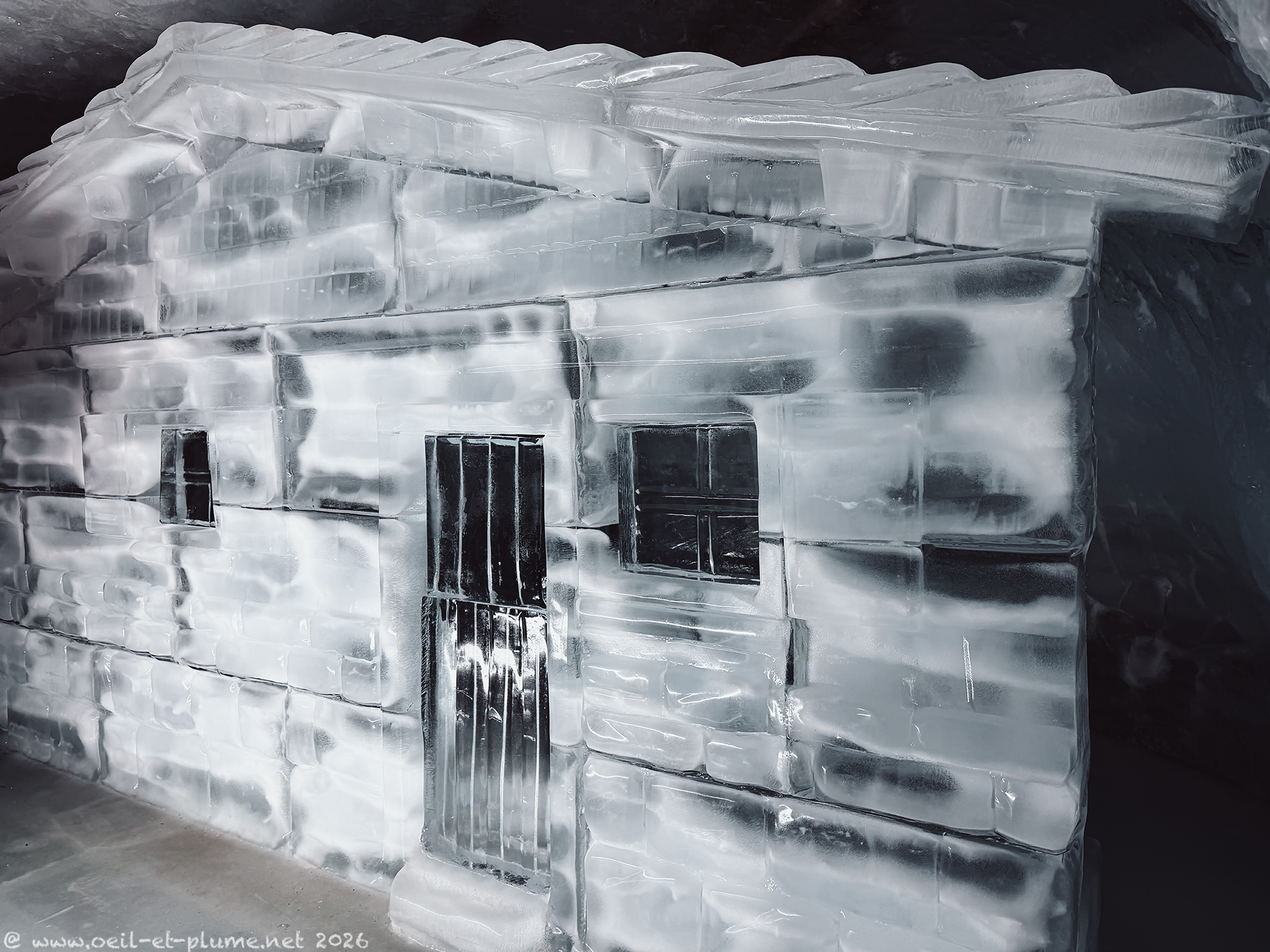
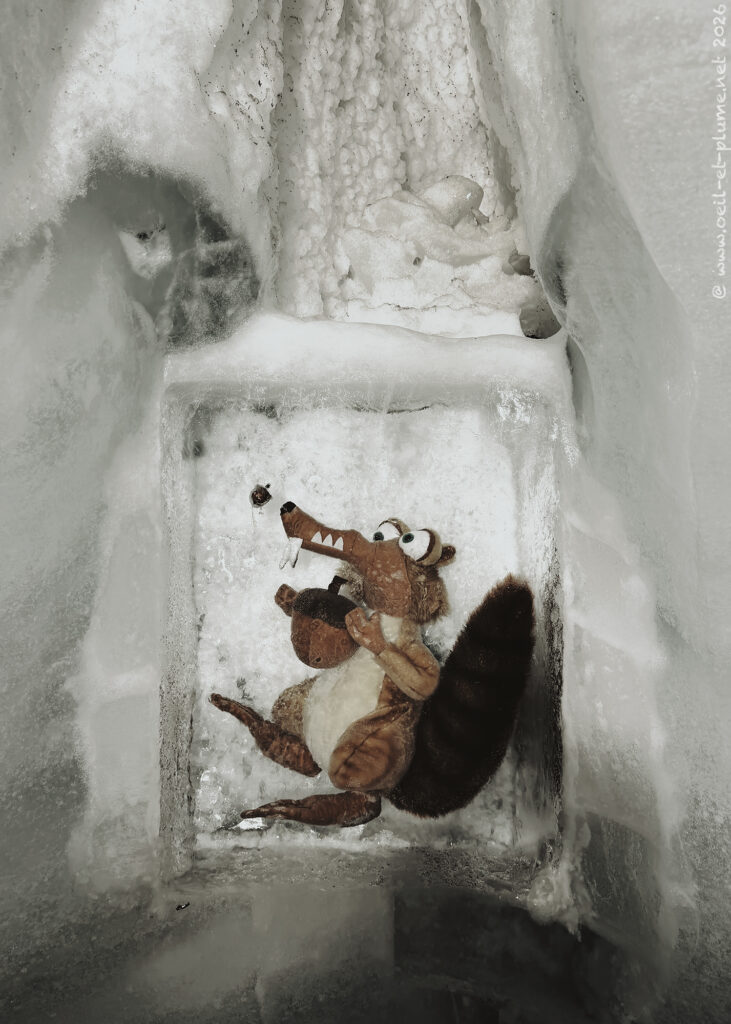
Intrepid or stubborn, or probably both, I pursue my progression until a beautiful and spacious ice house. The structure must be the Rollibock’s lair. Nobody seems around, except for Scrat.
Made famous worldwide by the 2002 film Ice Age, the acorn-obsessed squirrel appears to have been frozen solid in the ice. My guess is that the unfortunate Scrat met the Rollibock unexpectedly and was so terrified by the encounter that it remained motionless until it was trapped within the ice mass.
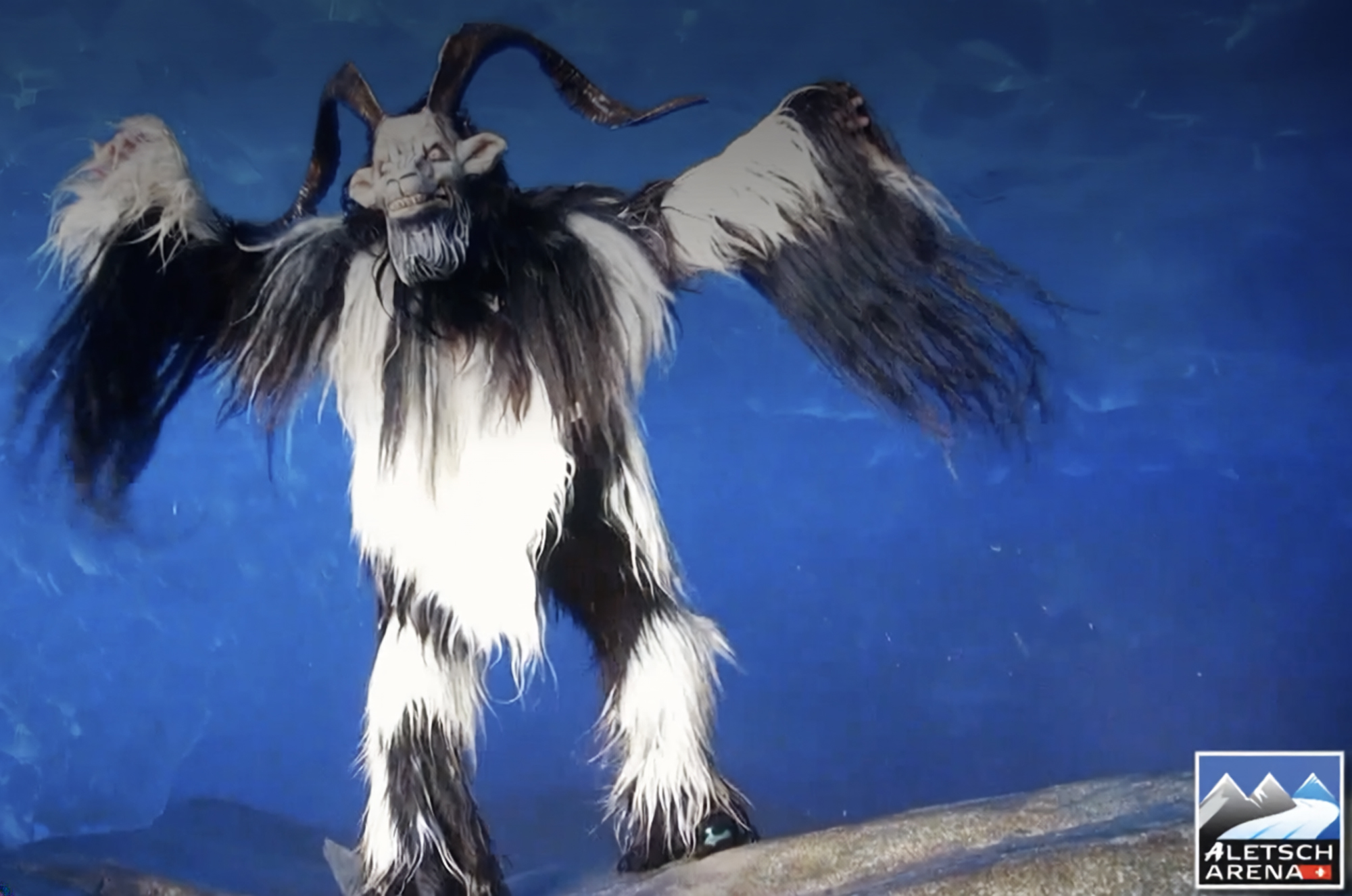
Suddenly, a formidable roar fills the space: “Who is foolish enough to venture into my home?” The Rollibock surges from nowhere, looming before me, shouting angrily and threatening.
It takes me all my self-control to keep my composure and explain that my visit aims at no harm nor provocation. I wish to meet with the guardian of the Aletsch Glacier and hear his invaluable opinion on the ongoing melting of the majestic river of ice.
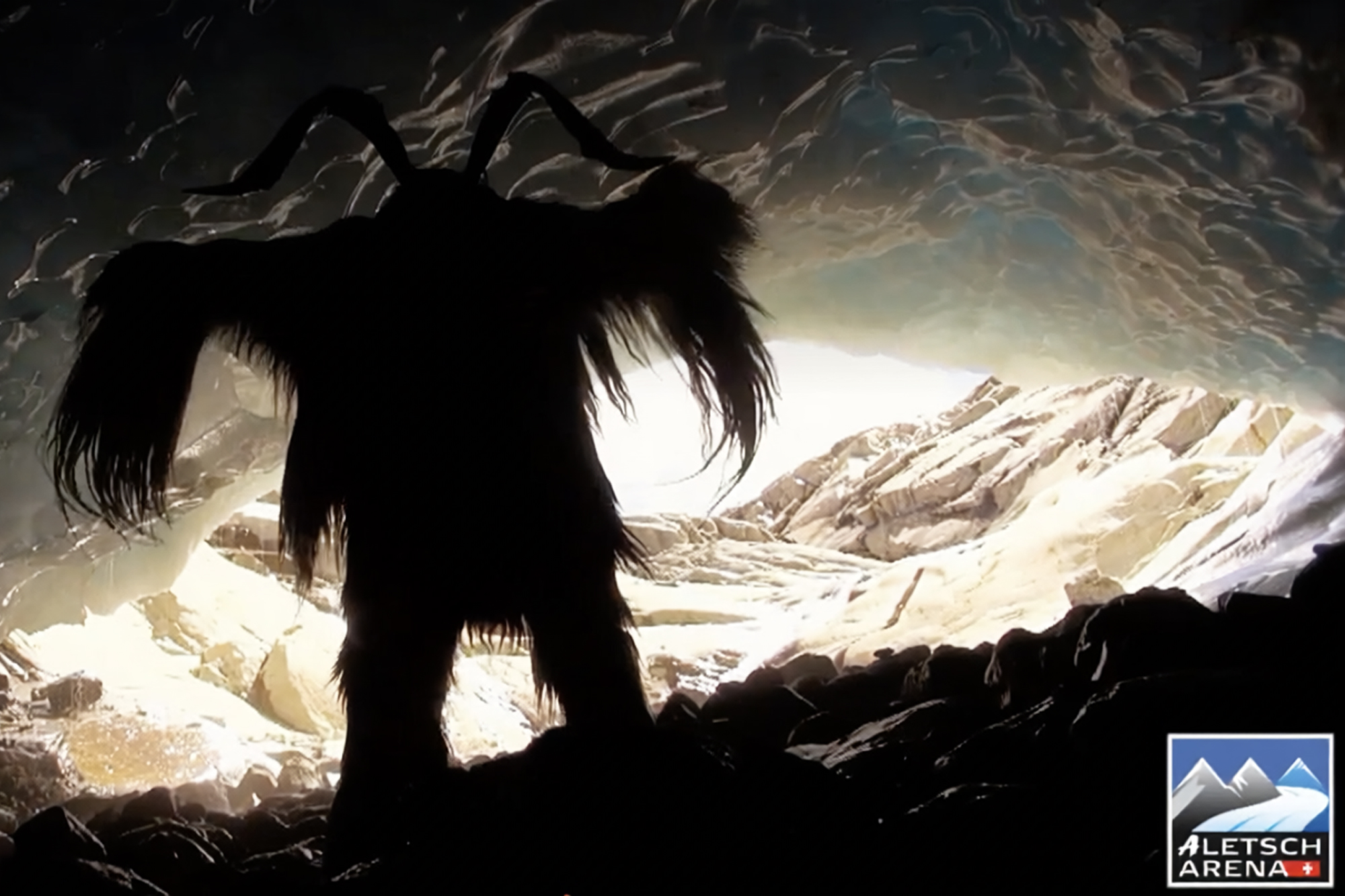
Dubious, the Rollibock replies bluntly that the best way for humans to protect the Aletsch Glacier is simply to stay away from it. “Perhaps. But humans can probably do more than that.” The bock nods, his anger subsiding. “I will share my recommendations with you soon. But for now, you must leave this place. And do not tell anyone the exact location of my home.”
I thank him for our brief but fruitful conversation, promise to keep the location secret, and look forward to hearing his recommendations for protecting the Aletsch Glacier. The Rollibock grumbles his approval and promptly disappears.
Back to humans’ world
Still trembling with emotion, I make my way back towards the open air. On my way back down to the valley, I feel drawn to one final trek: from the Eiger Glacier station, near Kleine Scheidegg, down to Grindelwald along the Eiger Trail.
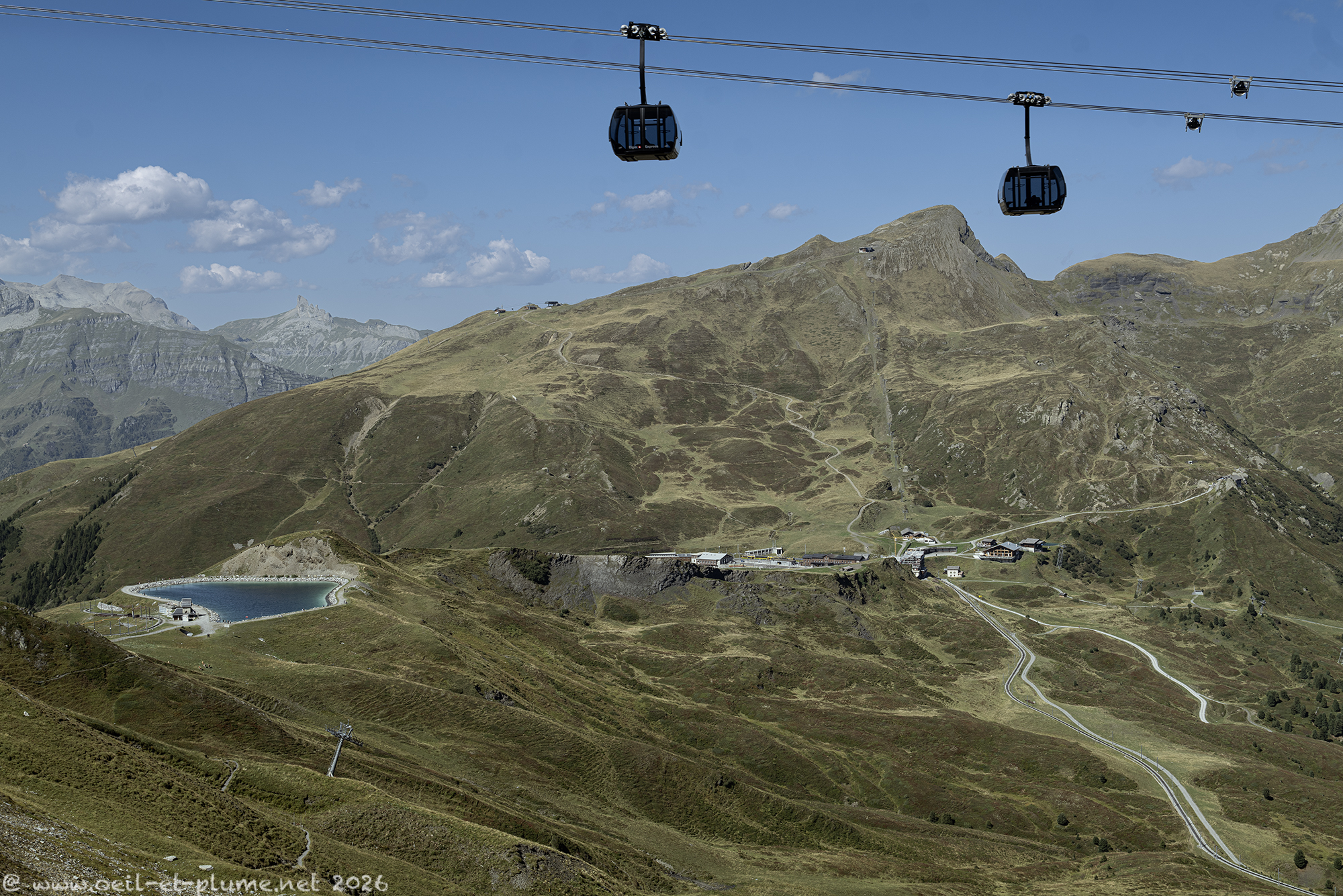
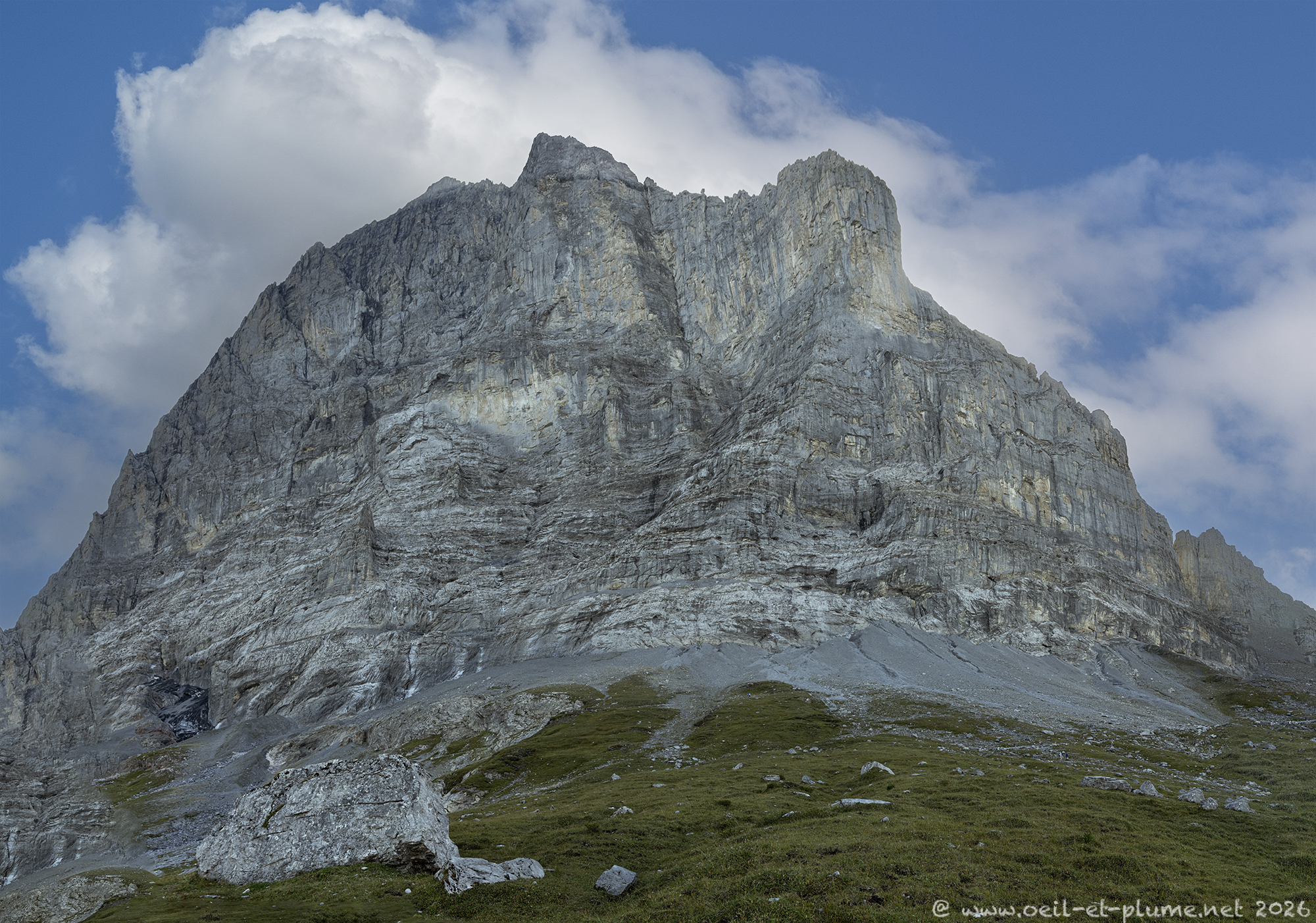
The path runs beneath the imposing north face of the Eiger, next to the Mönch and Jungfrau. The triad of some of the biggest north faces in the Alps form an formidable mineral wall overlooking the valleys of Lauterbrunnen and Grindelwald. I feel so insignificant in front of those natural giants, but so happy to stand alongside them.
Epilogue
One might conclude that the Aletsch Rollibock is merely an old legend, unsupported by empirical evidence and devoid of contemporary relevance. The tale portrays the Rollibock as the guardian of the Aletsch Glacier, defending it against human interference and harm, and as a creature capable of retaliating against those who venture too far.
Yet the concern and the underlying logic of the tale remain remarkably pertinent today. Natural hazards affecting communities in the Alps are being compounded by climate change, human activity, and other factors. Running into a chapel in response will unlikely suffice to redress the situation.
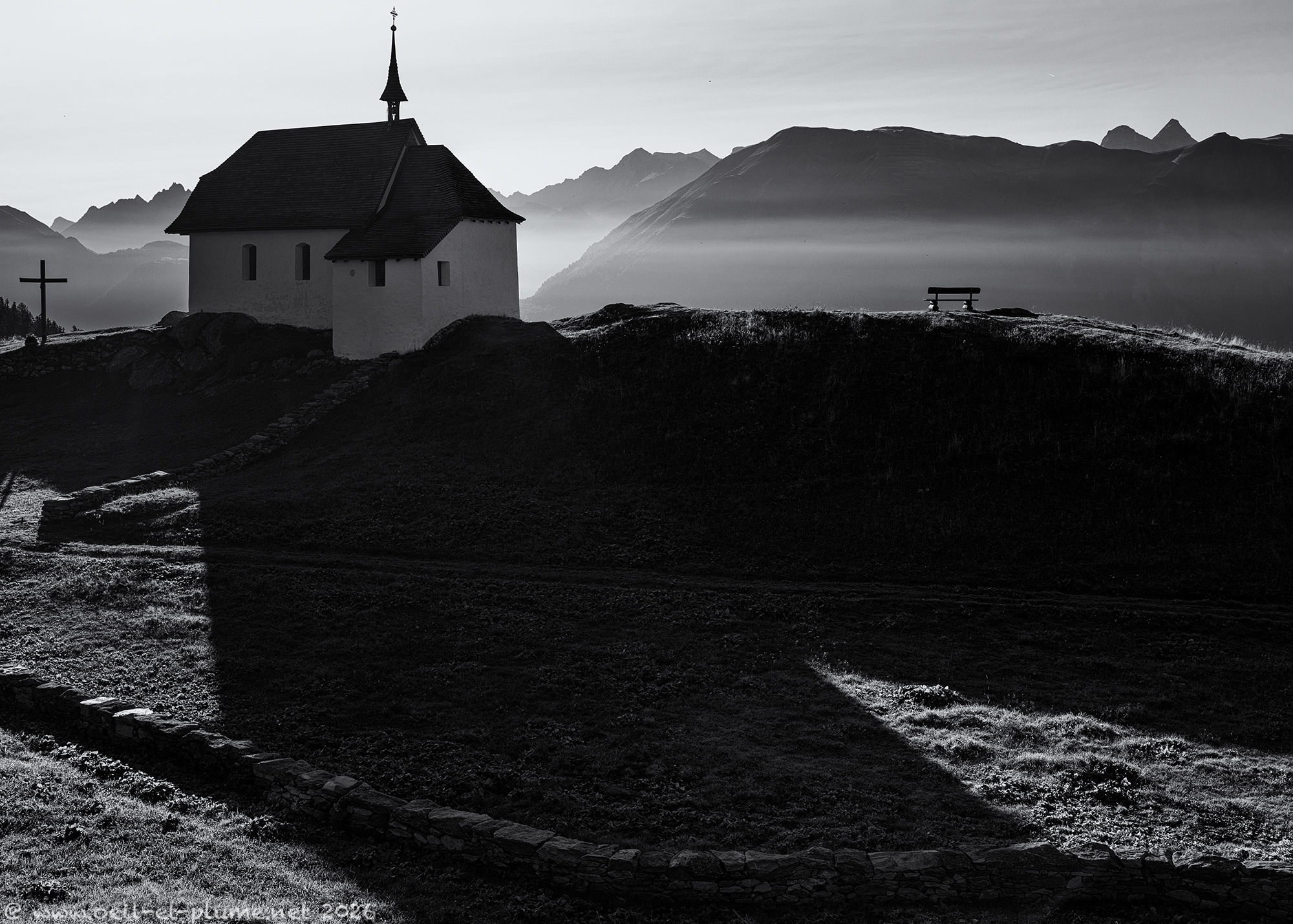
Interestingly, the perception of the Rollibock has evolved over time. Once a dangerous demon, the mythical creature has largely shed its fearsome reputation and become something of a mascot for the Aletsch Arena. Perhaps the Rollibock and humankind are now ready to join forces. That would be a good beginning—but there is still much more to be done.
According to climate and glacier specialists, Switzerland experienced in 2026 its warmest and driest summer since systematic meteorological measurements began in 1864. Swiss glaciers lost more than five percent of their total mass in 2026 alone, and around twenty percent over the last five years. In 2026, the Aletsch Glacier lost as much as six metres in thickness, although 2022 was even more severe. Some projections based on recent trends suggest that the Aletsch Glacier could disappear by the end of the 21th century.
A vast body of ice, the Aletsch Glacier is not merely a monument to the Alpine landscape. It is also one of Switzerland’s great natural reservoirs of freshwater. Like the Amazon rainforest, often described as one of the planet’s great lungs, the Aletsch Glacier forms part of a life-sustaining system whose influence extends far beyond its frozen boundaries. It embodies a powerful paradox: what appears eternal is, in fact, fragile. What seems immovable is already disappearing.
It is urgent for us to join hand with the Aletsch Rollibock – and act.
Cheers,

Annexes
Main references
- Willy-Frantz Kurth (dir.): Rollibock – Zorn der Natur open-air play based on a text written by Hubert Teler, and performed in Fiesch in 2024 : Aletsch Arena; open-air play trailer; open-air play movie.
- Der Rollibock vom Grossen Aletschgletscher, Bergwelten, 2017.
- Thierry Basset: Monstres et légendes, Chap. 2, podcast, Radio Télévision Suisse francophone, 2017.
- The two pictures of the Rollibock presented above are screen-shots of the video footages available on Aletsch Arena and Bergwelten websites.
- Various written ressources of the CREALP (Centre de recherche sur l’environnement alpin).
The Aletsch Rollibock legend in more details
The legend of the fearsome Rollibock is one of the oldest tales in Valais. Should one fear this strange dweller of the ice?
The Rollibock is described as a large buck with long horns and fiery eyes; furthermore, his entire body is draped in shards of ice that create a terrifying clanging sound as he charges wildly about. He rarely leaves the eternal ice of the Great Aletsch Glacier—his home—doing so only when someone incurs his wrath. Here is the story of how that came to pass:
Long ago, a wild hunter from Fieschertal set out to collect crystals near the Märjelensee lake on the Great Aletsch Glacier. He found a great many of them near the Eggishorn. He filled his pockets with the gems, but in his greed, he destroyed many of them, leaving a trail of shattered stones in his wake.
Towards evening, ravenously hungry, he returned to the Märjelensee, where he had left his weapon and his pack of provisions. Yet the moment he touched the bread, it turned to stone. Cursing, he dropped it, but as soon as it hit the ground, it reverted to its original form. Angrily, the hunter flung his provisions far away and sought a place to spend the night among the Fiescherhörner peaks.
The next morning, the hunter set out to hunt. He soon spotted a magnificent buck and shot it. While dressing the animal, he noticed a chamois standing nearby, grieving over its kid, which had a broken leg. The hunter’s predatory instinct seized him once more; he shot the mother and then mercilessly killed the defenseless kid as well. Then dark clouds covered the sky, and a biting storm swept across the landscape. The poacher shouldered his trophies and set off once more toward the Märjelensee, where the icy waters were dammed up, stretching all the way to the Great Aletsch Glacier.
A ferryman—a little old man with a long gray beard—was waiting there; he beckoned the hunter to step into his boat so he could ferry him to the safety of the Great Aletsch Glacier’s shore. The hunter gratefully accepted the offer. Yet the old man did not steer toward the safe shore; instead, he headed straight into the glacier itself. The hunter demanded that the ferryman turn back immediately, but the storm was raging so fiercely and the rain pouring down so heavily that he could not even hear his own voice.
When the boat reached the glacier, the ferryman laid down his oar, straightened up, and—growing rapidly—suddenly towered like a giant. He had taken on the form of a buck with great horns and fiery eyes; his entire body was hung not with fur, but with icicles that created a terrifying, chiming sound. With a deeply sorrowful expression, the Rollibock gazed at the hunter and spoke in a resounding voice: “Why do you destroy my realm? What have I done to you? You may have whatever you need, but why do you destroy my rock and kill my children?” Seized by fear, the hunter fell silent; at the same time, he was overcome with shame for his actions. Then the glacier opened up, and the boat sank into the icy waters of the Märjelensee.
The next morning, the storm bells rang out in the valley: “The Märjelensee has burst its banks!” Meadows and fields lay flooded and buried under deep debris. The hunter was never seen again. Yet, in stormy weather, shepherds near the Märjelensee would sometimes report sighting a man clad in old-fashioned attire, carrying a weapon and a provision bag. He is said to be still searching for a ferryman to take him to the safety of the glacier’s shore.
The Rollibock itself is a terrifying and powerful spirit. Only the brave dared to challenge or mock it. But then, it would suddenly break loose, emerging from the Great Aletsch Glacier with a thunderous roar, leaving even the swiftest runner little chance of escape. Salvation was found only by those who could reach a chapel or a blessed house in time; anyone caught by the creature before then was crushed to death.
Towards evening, ravenously hungry, he returned to the Märjelensee, where he had left his weapon and his pack of provisions. Yet the moment he touched the bread, it turned to stone. Cursing, he dropped it, but as soon as it hit the ground, it reverted to its original form. Angrily, the hunter flung his provisions far away and sought a place to spend the night among the Fiescherhörner peaks.
The next morning, the hunter set out to hunt. He soon spotted a magnificent buck and shot it. While dressing the animal, he noticed a chamois standing nearby, grieving over its kid, which had a broken leg. The hunter’s predatory instinct seized him once more; he shot the mother and then mercilessly killed the defenseless kid as well. Then dark clouds covered the sky, and a biting storm swept across the landscape. The poacher shouldered his trophies and set off once more toward the Märjelensee, where the icy waters were dammed up, stretching all the way to the Great Aletsch Glacier.
When the boat reached the glacier, the ferryman laid down his oar, straightened up, and—growing rapidly—suddenly towered like a giant. He had taken on the form of a buck with great horns and fiery eyes; his entire body was hung not with fur, but with icicles that created a terrifying, chiming sound. With a deeply sorrowful expression, the Rollibock gazed at the hunter and spoke in a resounding voice: “Why do you destroy my realm? What have I done to you? You may have whatever you need, but why do you destroy my rock and kill my children?” Seized by fear, the hunter fell silent; at the same time, he was overcome with shame for his actions. Then the glacier opened up, and the boat sank into the icy waters of the Märjelensee.
The next morning, the storm bells rang out in the valley: “The Märjelensee has burst its banks!” Meadows and fields lay flooded and buried under deep debris. The hunter was never seen again. Yet, in stormy weather, shepherds near the Märjelensee would sometimes report sighting a man clad in old-fashioned attire, carrying a weapon and a provision bag. He is said to be still searching for a ferryman to take him to the safety of the glacier’s shore.
The Rollibock itself is a terrifying and powerful spirit. Only the brave dared to challenge or mock it. But then, it would suddenly break loose, emerging from the Great Aletsch Glacier with a thunderous roar, leaving even the swiftest runner little chance of escape. Salvation was found only by those who could reach a chapel or a blessed house in time; anyone caught by the creature before then was crushed to death.
Sources: Aletsch Arena; Bergwelten