You may remember my interest in the dahu and the vouivre — two mythical creatures said to inhabit the Swiss Alps. During my recent visit to the Baltschieder Valley in the Haut-Valais, I heard about another strange creature, known locally as the “Rollibock”, and said to lurk within the Aletsch Glacier. Despite the frightening stories surrounding this dangerous beast, I decided to visit the Aletsch Glacier area to learn more about it — and, why not, perhaps even meet the creature itself.
The Rollibock
According to local legend, a demon in the shape of a gigantic, wild and terrifying buck lives in the Aletsch Glacier. Its body is covered not with fur, but with icicles, apart from its blazing eyes. When the Rollibock moves, the shards of ice covering its body create a terrifying, chiming sound.
Guardian of the Aletsch Glacier, the Rollibock is keen to ensure its serenity of the wild and pristine mountain area. It is said to leave its icy lair only when it feels provoked or angered by humans. When enraged, the demon unleashes natural disasters, destroys man-made structures, and kills the people who triggered its anger. The only way for humans to escape its wrath is to take refuge in a chapel.
Modern glaciology has something to add to the story. During the last Ice Age, around 10,000 years ago, the Aletsch Glacier expanded enormously. Its lower tongue reached all the way down to the Rhône Valley, at an altitude of around 680 metres. Since then, the glacier has retreated considerably, although not at a steady pace. There have been periods of renewed advance triggered by heavy snowfall and prolonged cold temperatures such as during the Little Ice Age from the 14th to the mid-19th century. The most recent major growth of the Aletsch Glacier occurred in the 1860s.
By the middle of the 19th century, the Aletsch Glacier was therefore much larger and more extensive than it is today. Its enormous mass of ice could retain large quantities of meltwater in certain locations, notably in the side valley of Märjelen near the Eggishorn.
Periodically, the water accumulated in Märjelen broke through the natural ice barrier. The floodwater then forced its way through and beneath the glacier, rushing down towards lower elevations and inundating large areas in the Rhône Valley.
At the time, there was no scientific understanding of the processes behind these devastating and unpredictable floods. For the local population, there was a much more tangible explanation: a malevolent demon lurking within the glacier. They called him the Rollibock.
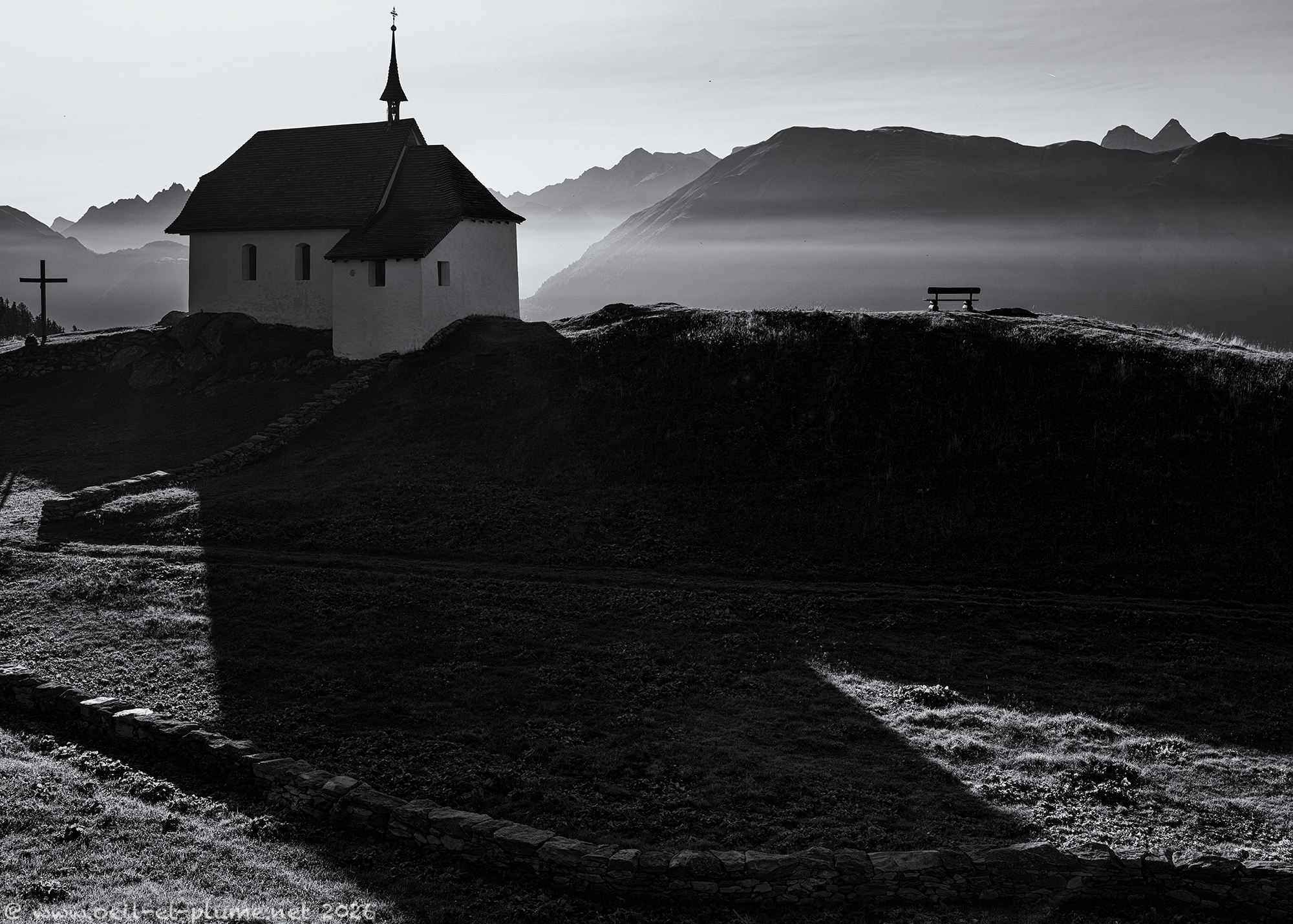
In my first visit to the Aletsch area, I come across an exquisite chapel meditating in the early morning light in Bettmeralp village. Having identified one of the shelters used by the local population against the Rollibock, I pursue my quest closer to the glacier.
The Aletsch Glacier
I head to the Bettmerhorn area, from where one enjoy usually a clear panoramic view over the Aletsch Glacier, an ideal vantage point for my research. However, a thick fog obscures my view upon arrival. The atmosphere is surreal: I am walking in the clouds; the glacier is nowhere to be seen ; and the Rollibock maybe hiding nearby.
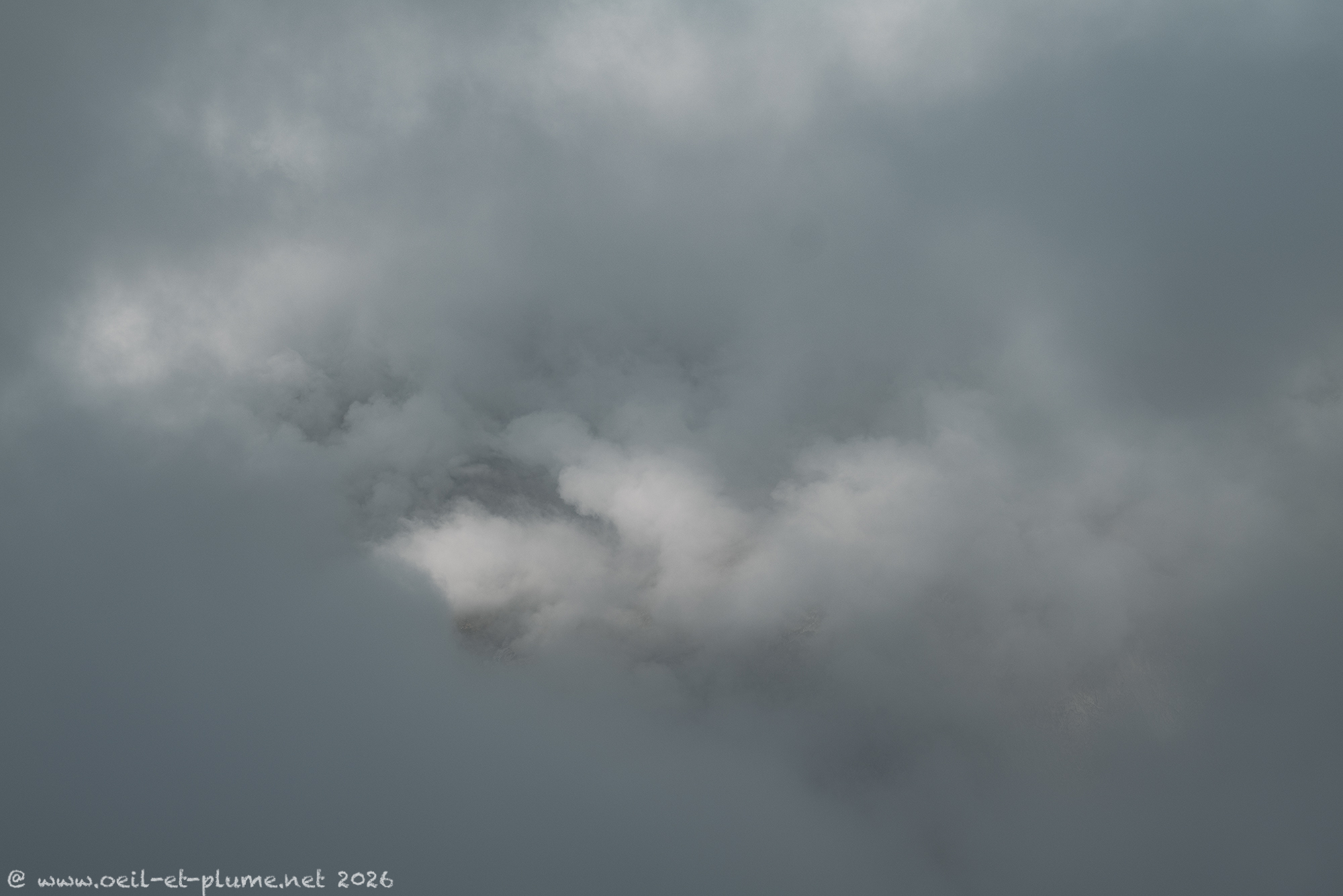
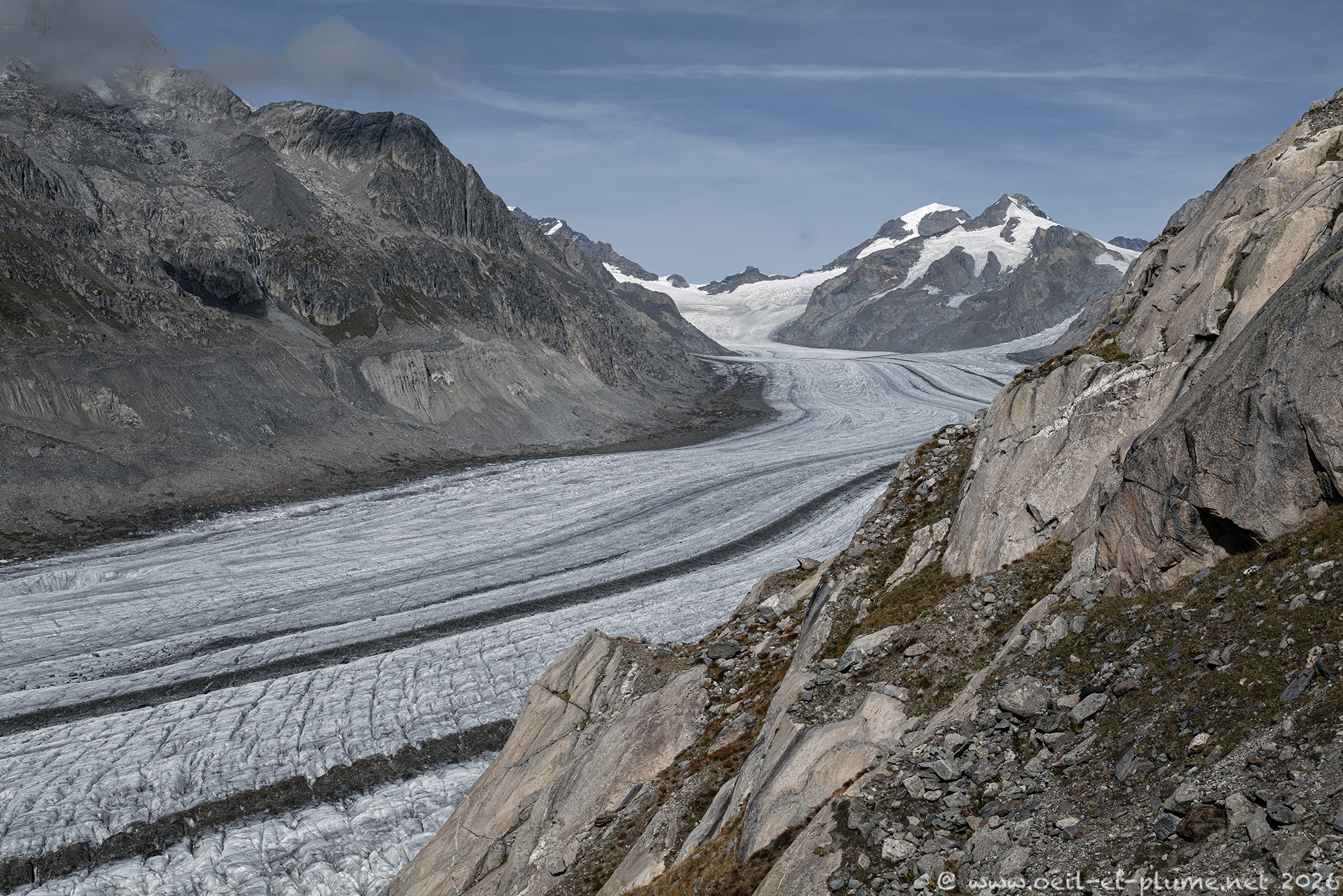
After a while, the fog clears gradually, unveiling the largest glacier in the Alps. The Aletsch Glacier is about 23 kilometres long and 1.5 kilometres wide, covering an area of more than 80 square kilometres. It is the largest glacier in the Alps. Its natural and cultural importance is such that it was designated a UNESCO World Heritage site in 2001.
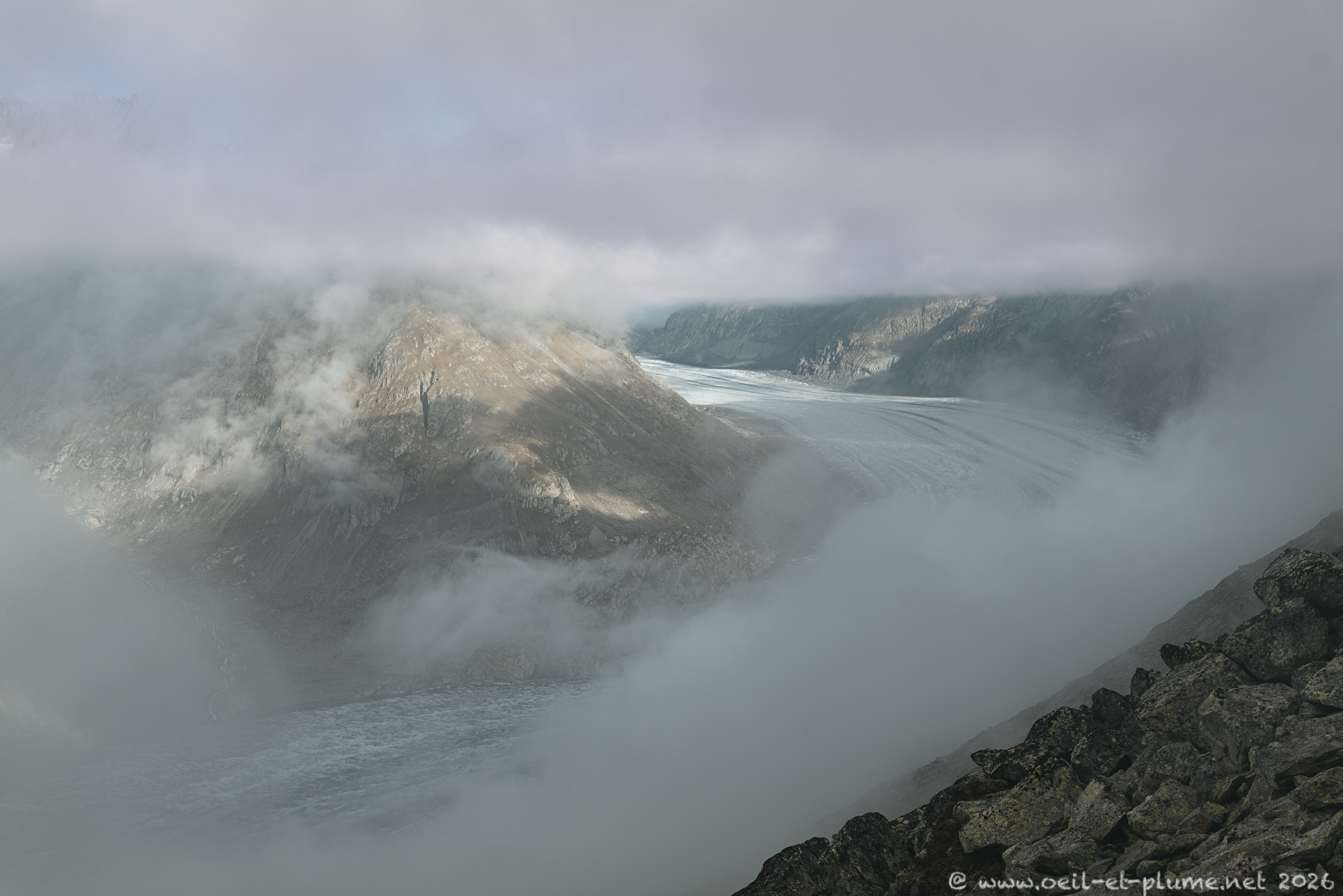
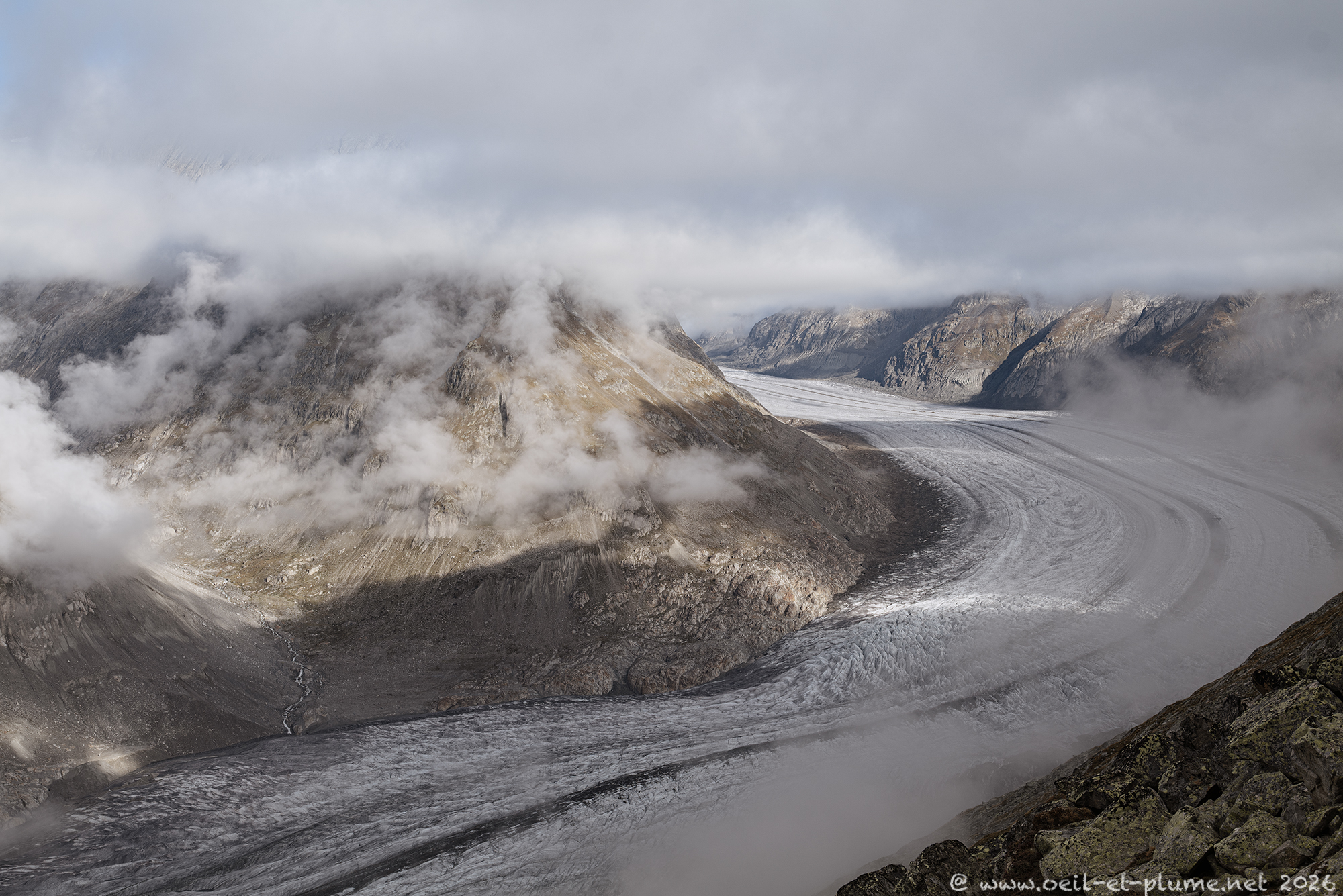
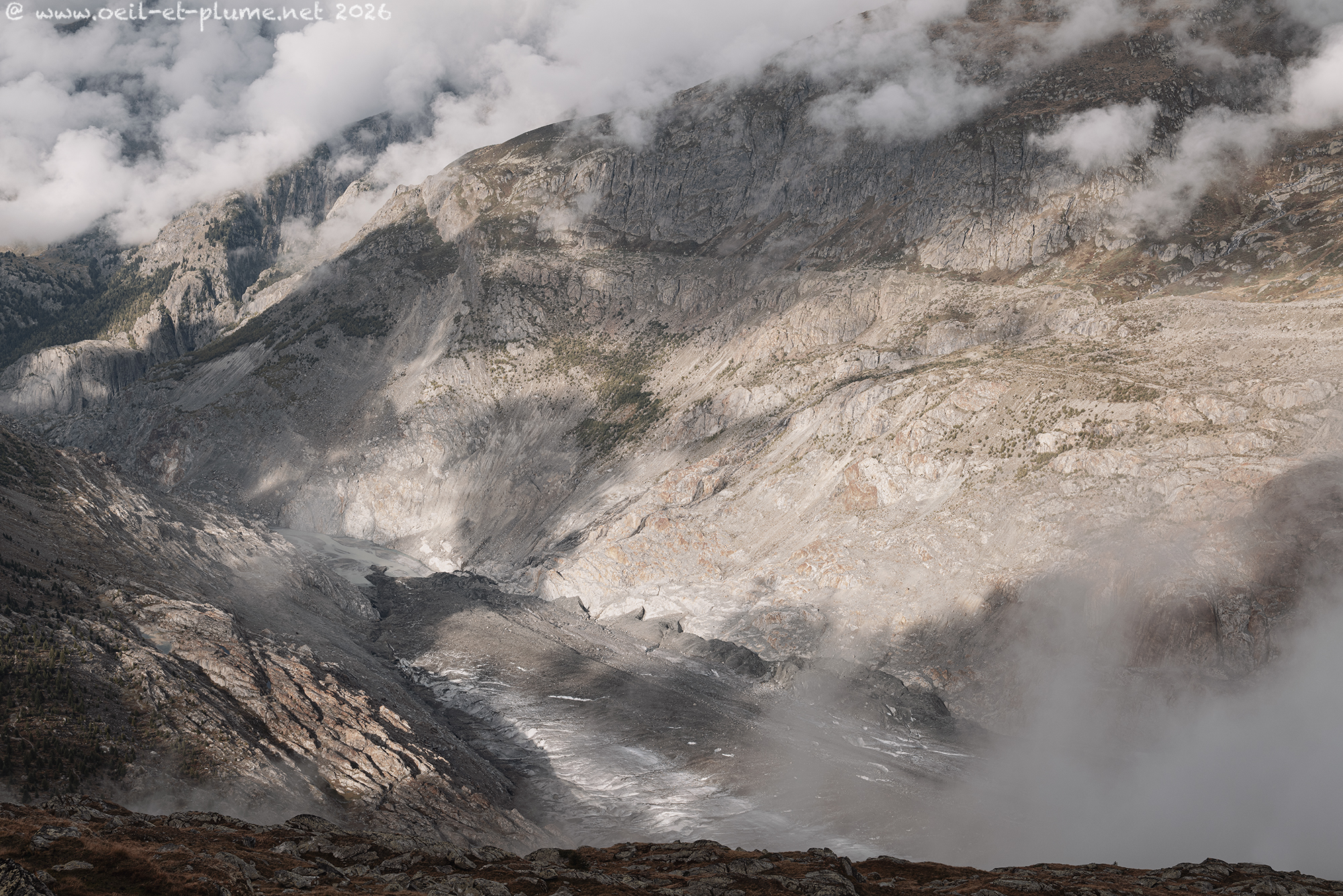
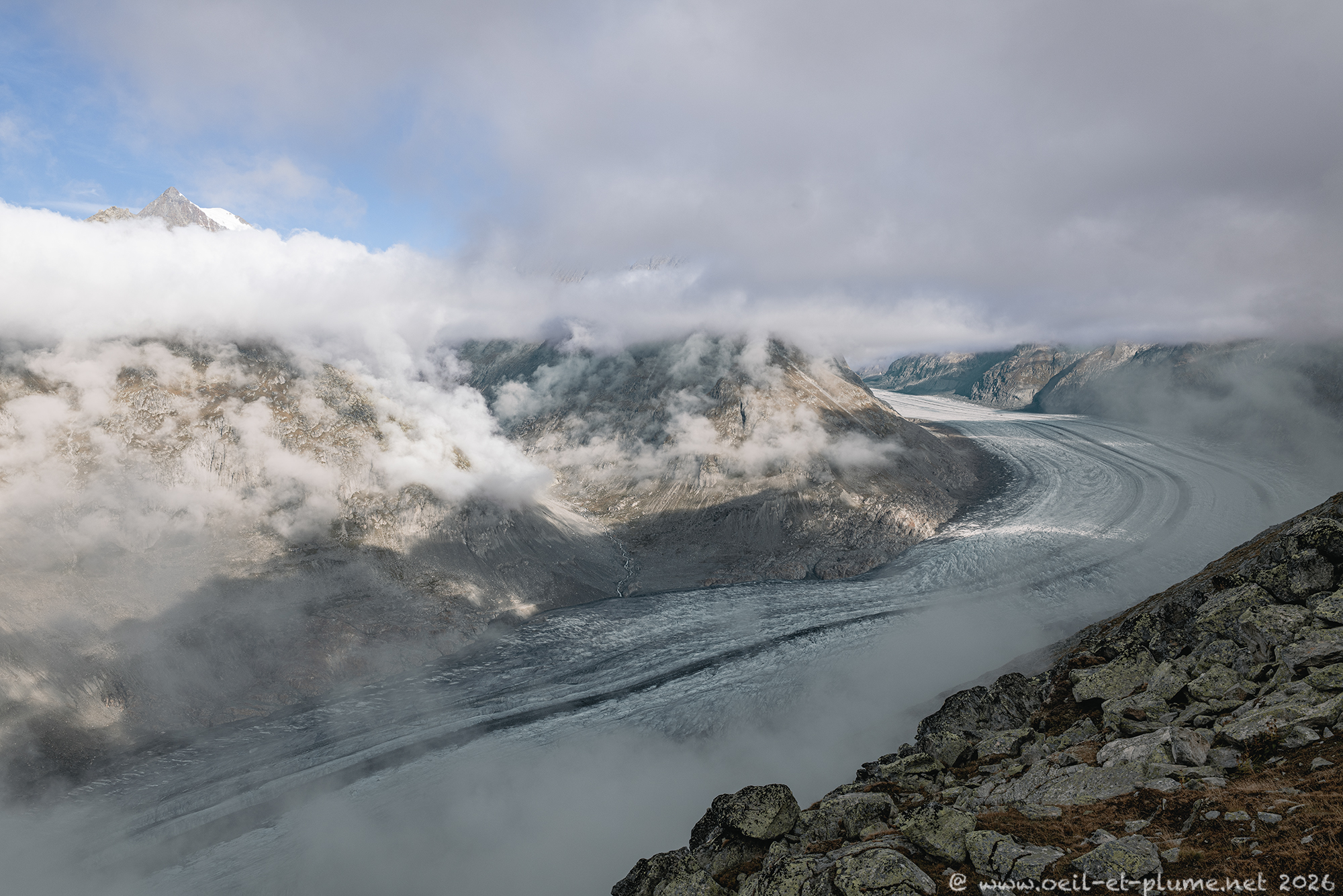
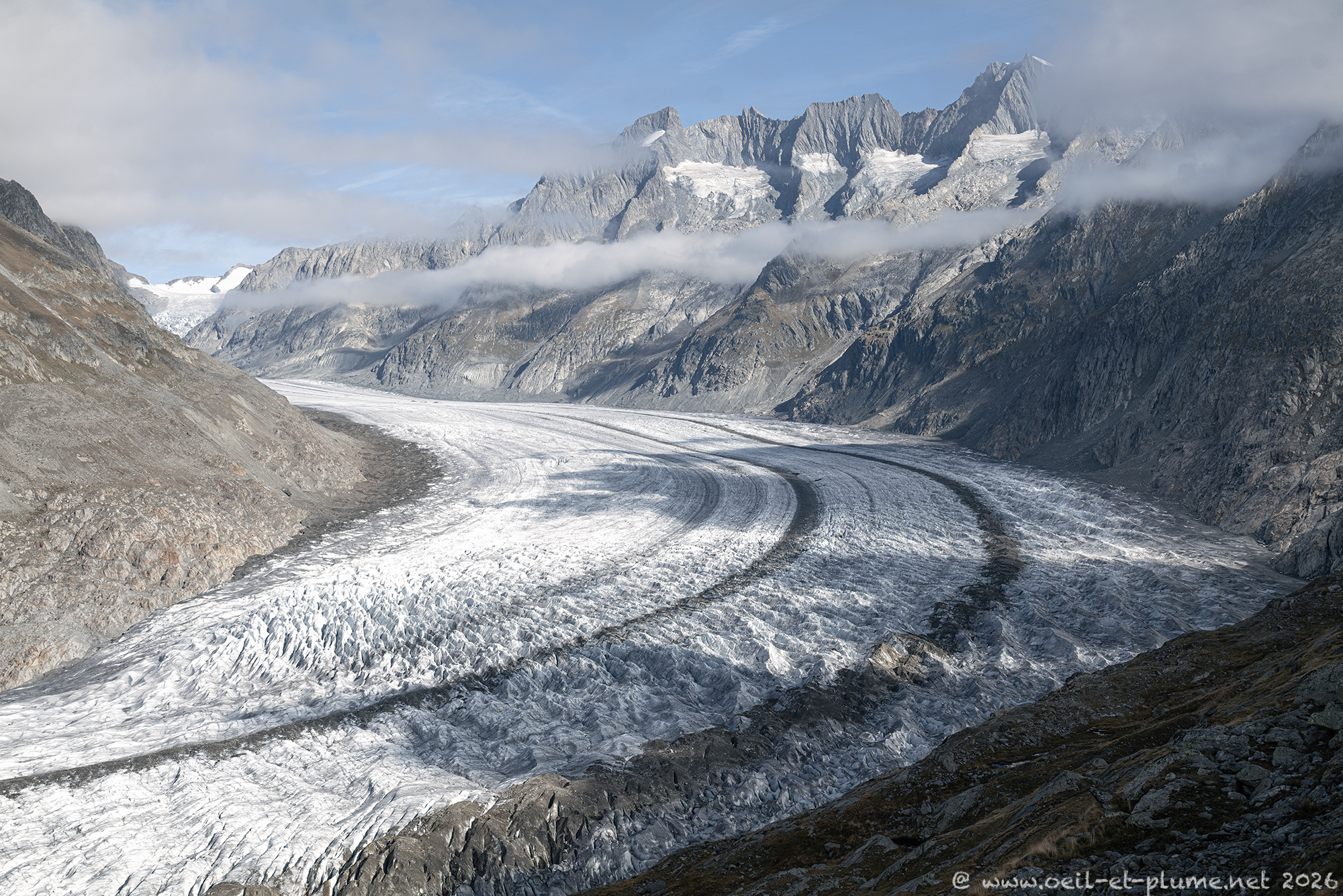
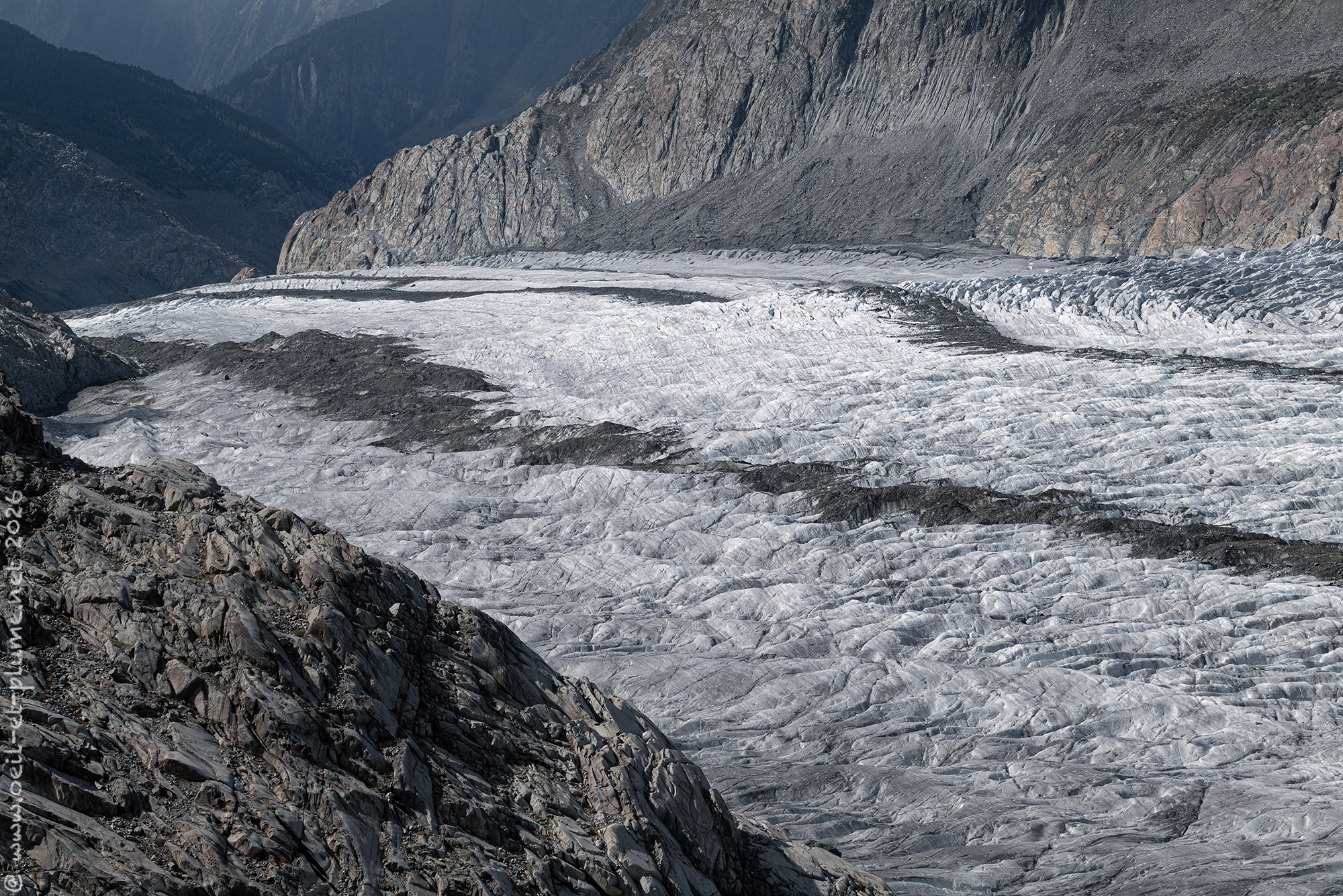
I set off on my trek along and above the glacier, keen to avoid stepping onto the ice and thereby disturbing the Rollibock. The view over the massive, tortuous expanse of ice is stunning.
Snowfall, as well as the melting and freezing process of the water have shaped the Aletsch Glacier over the course of millennia. It takes no less than ten years for a one-metre layer of snow to transform into just one centimetre of dense glacial ice. The scene evokes a profound sense of impermanence and the immense power of nature.
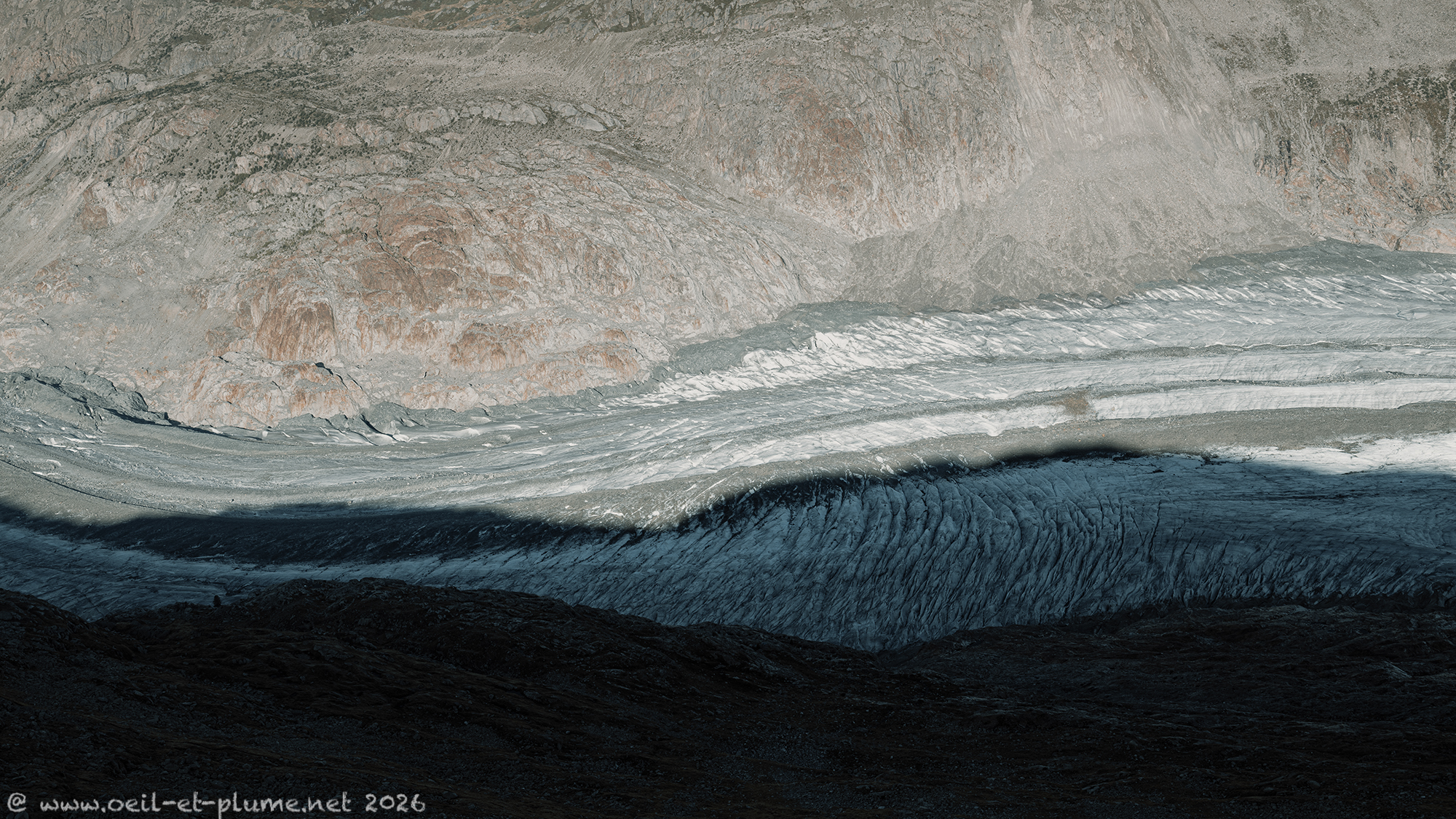
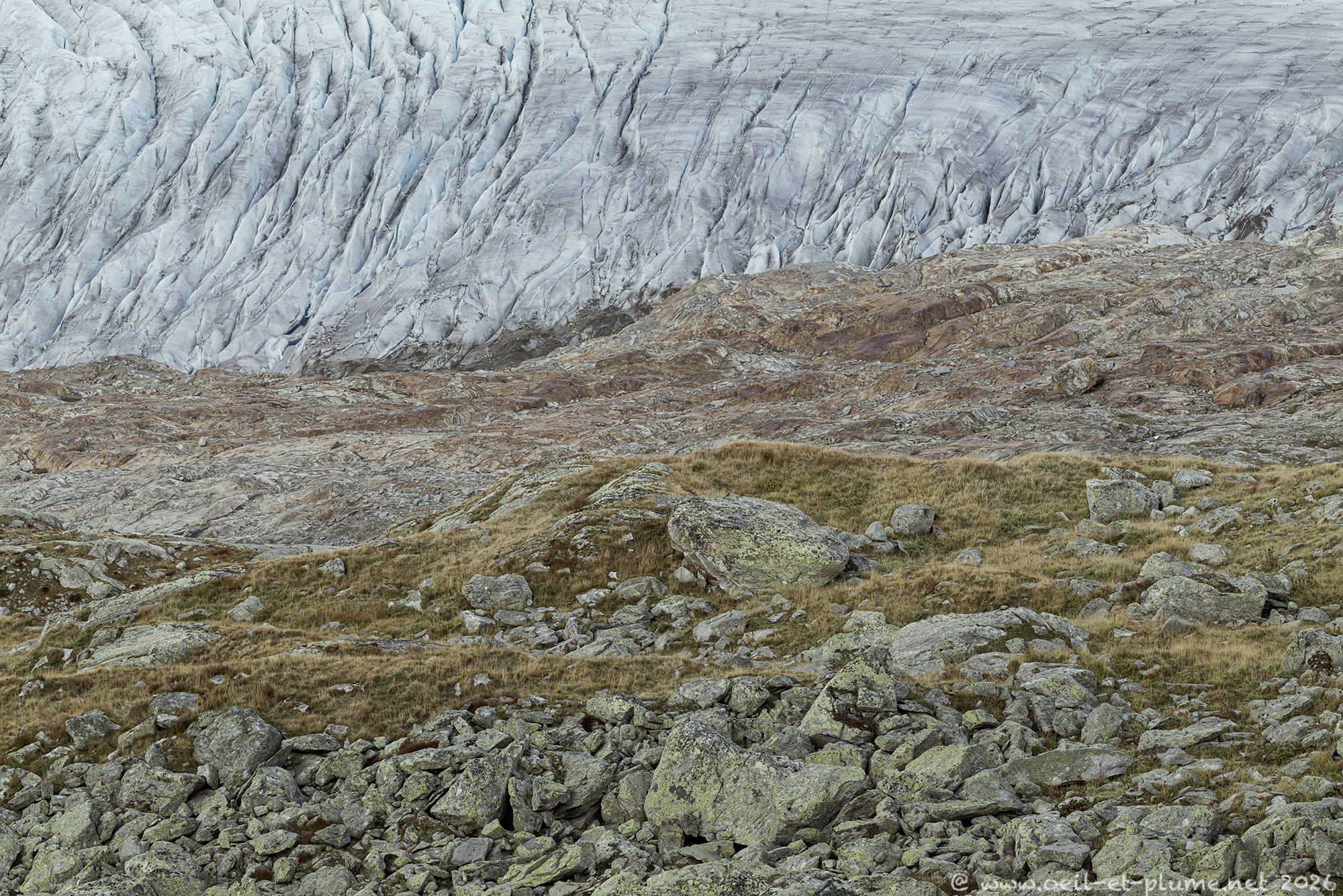
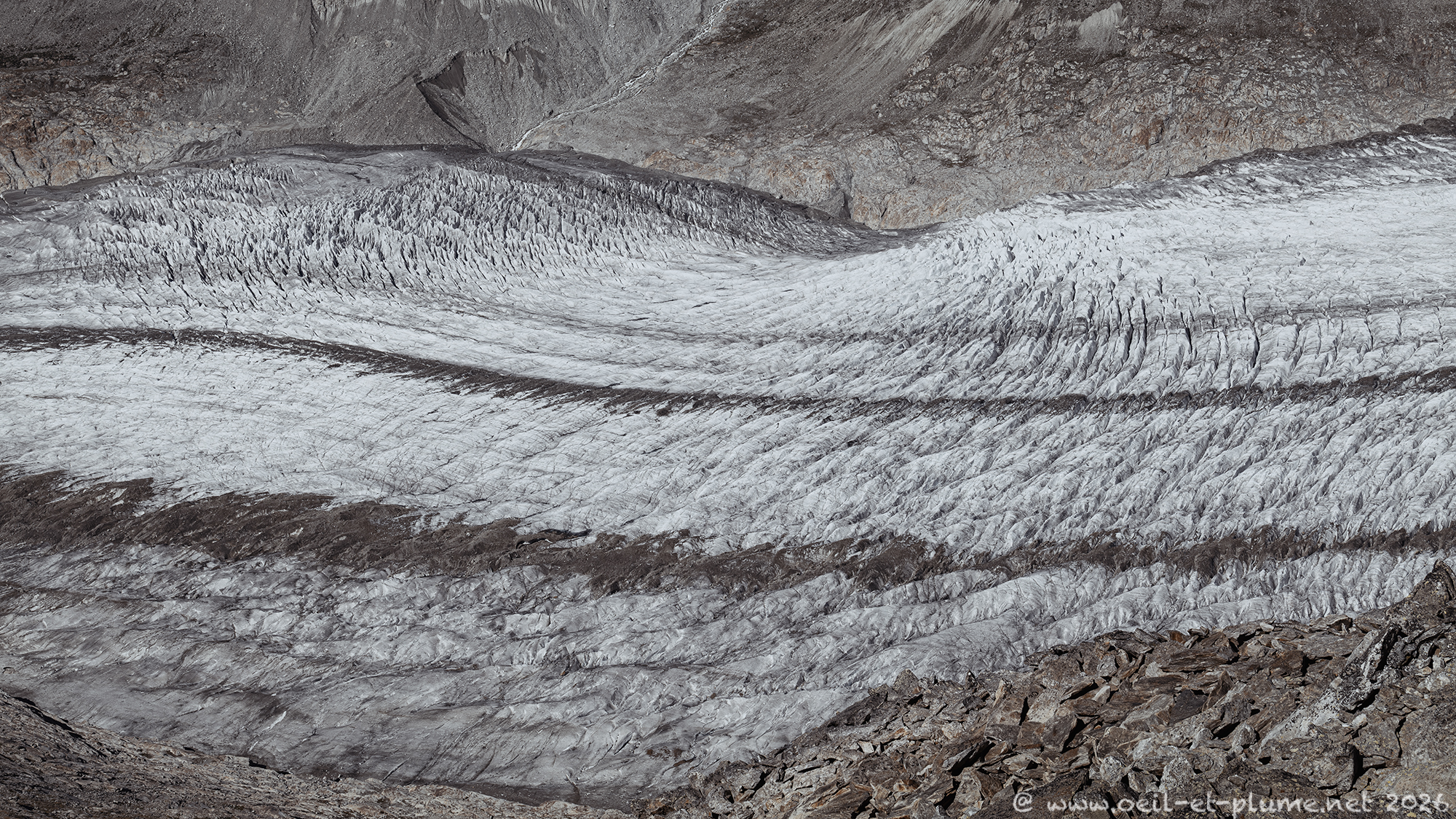
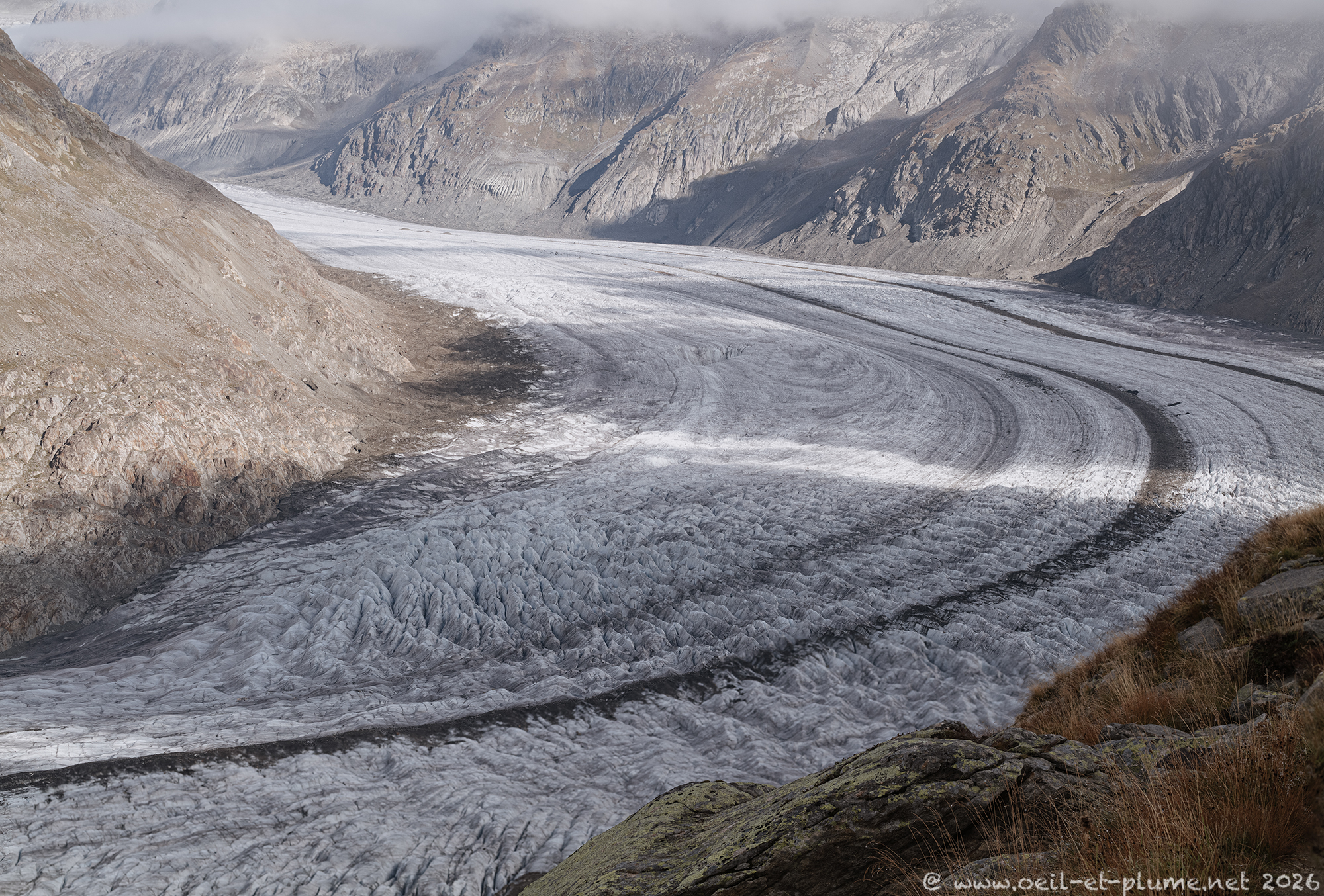
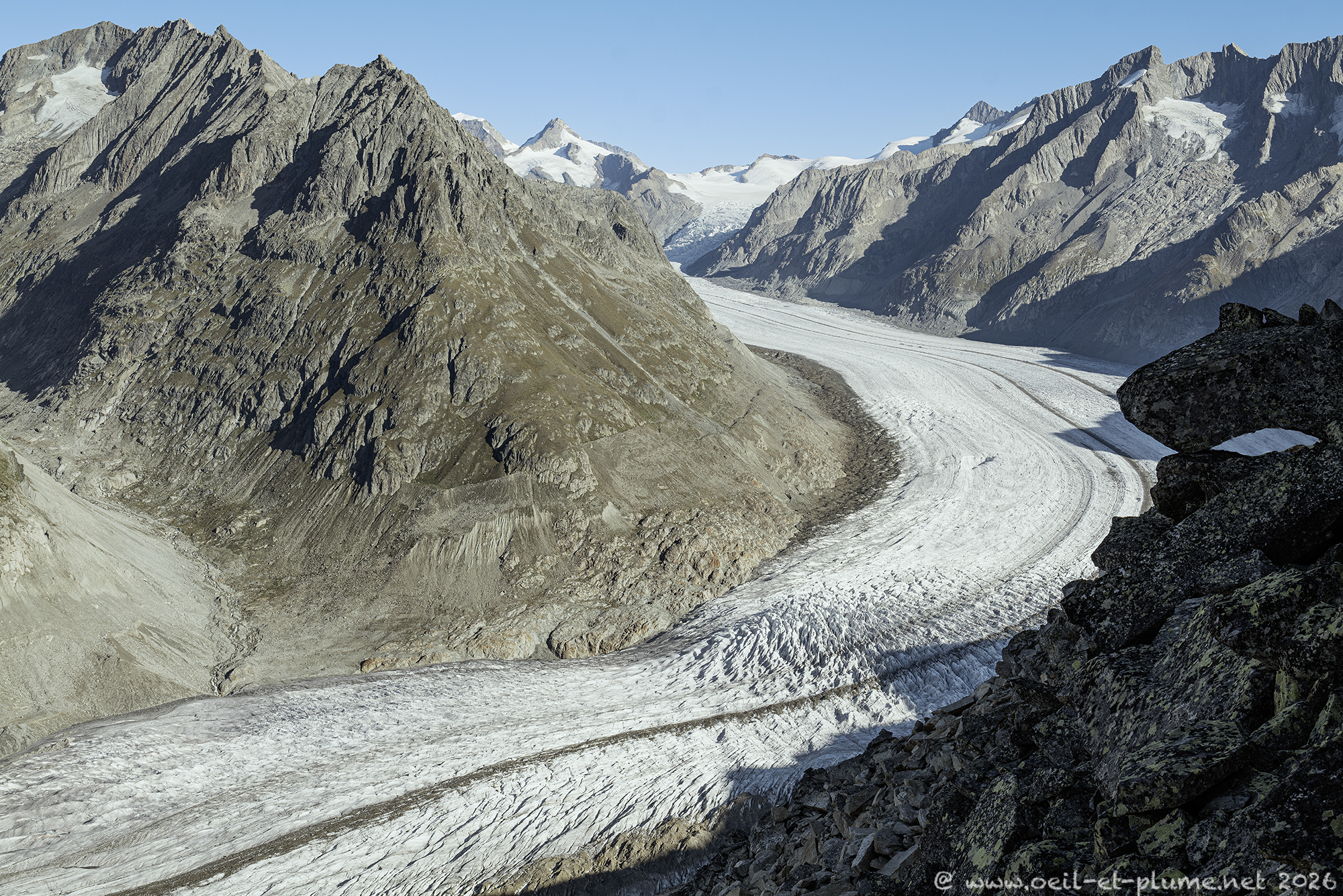
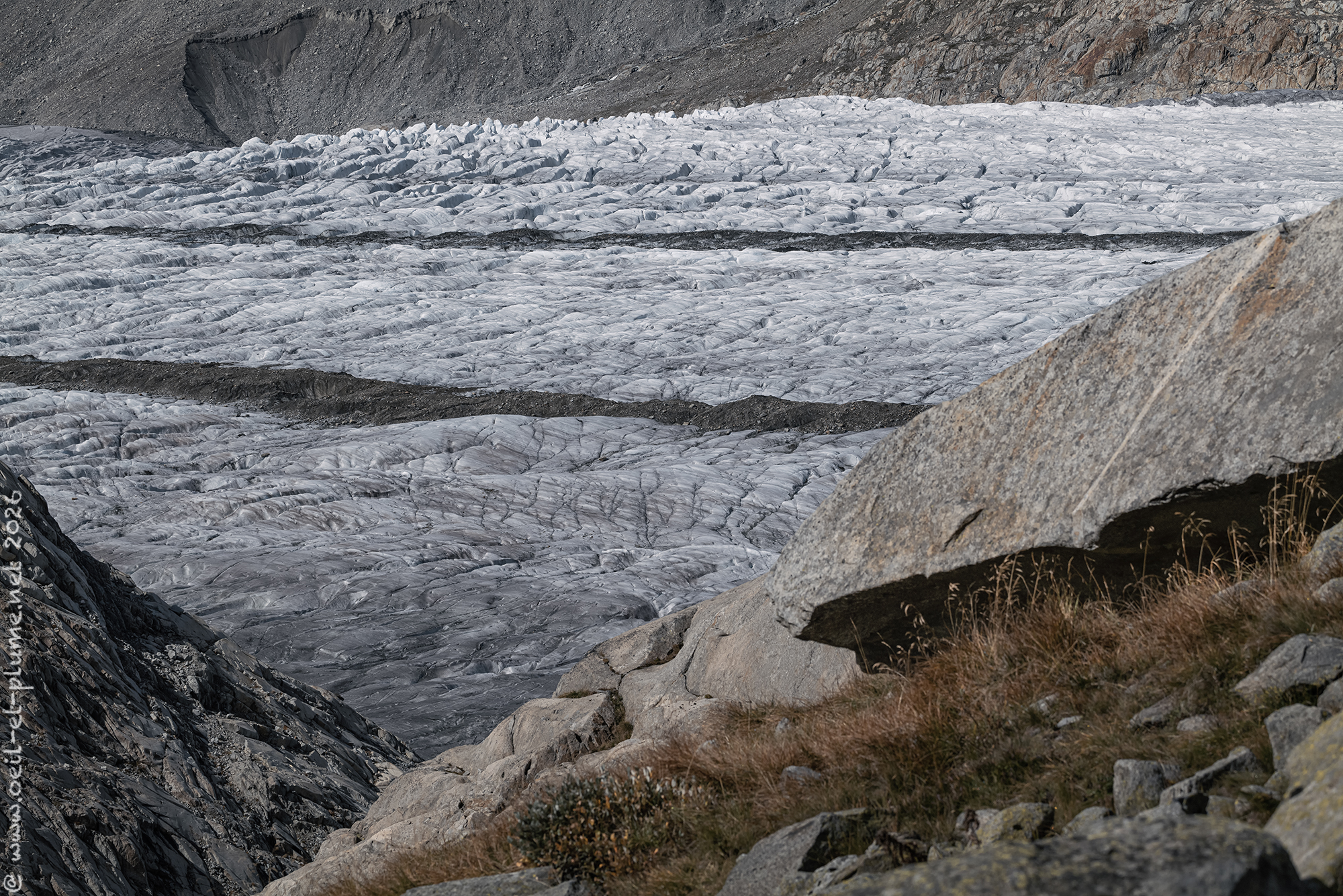
Such raw beauty is breathtaking, to the point of blurring both my vision and my thoughts. The tones, textures and shapes of the landscape constantly blend and morph, endlessly recomposing themselves into fascinating pictures. At times, for just a few seconds, I catch what looks like a pair of eyes staring back at me. But the vision is too ephemeral to orient valuably my quest to find the Rollibock. It must be another trick of the demon to thwart my search.
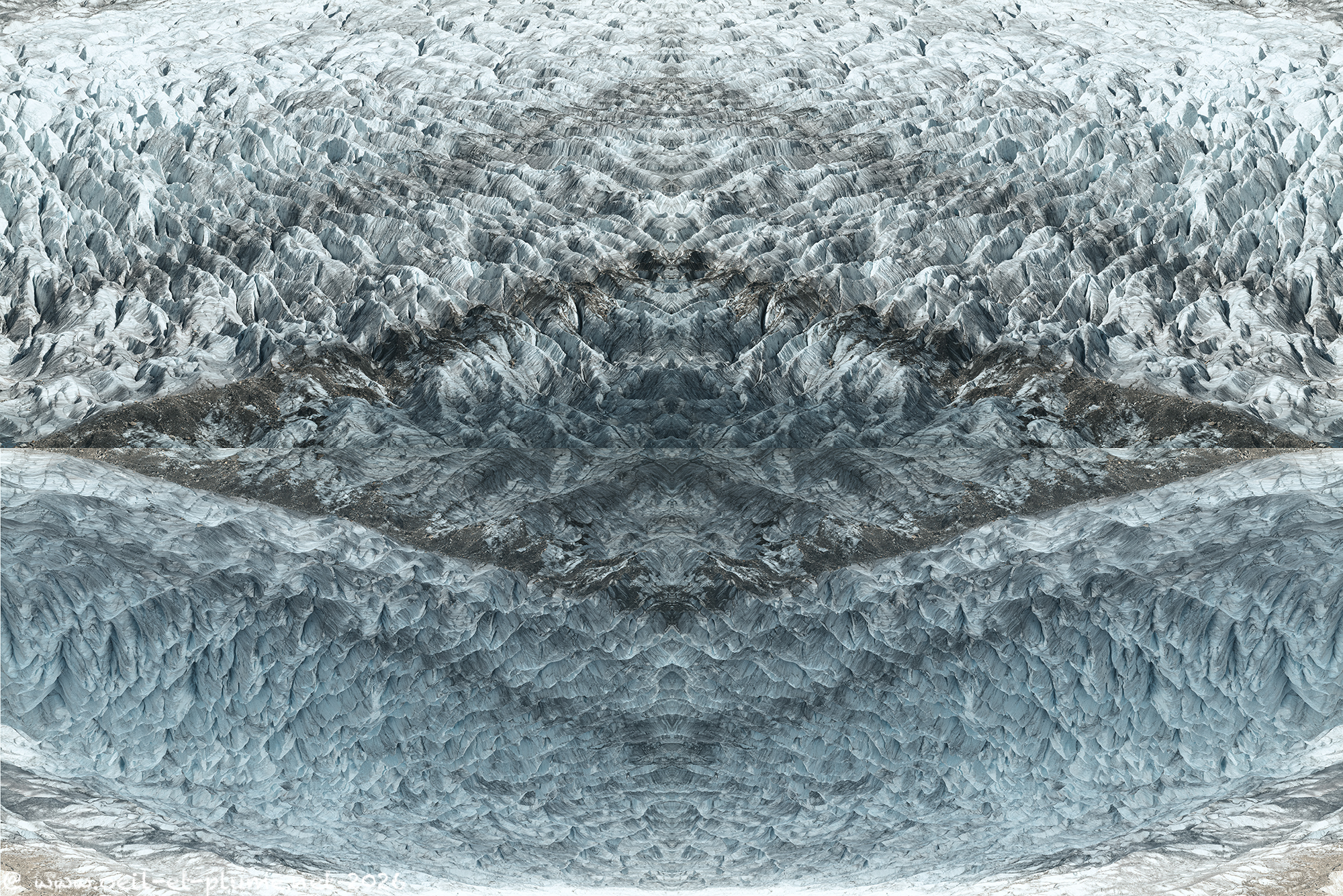
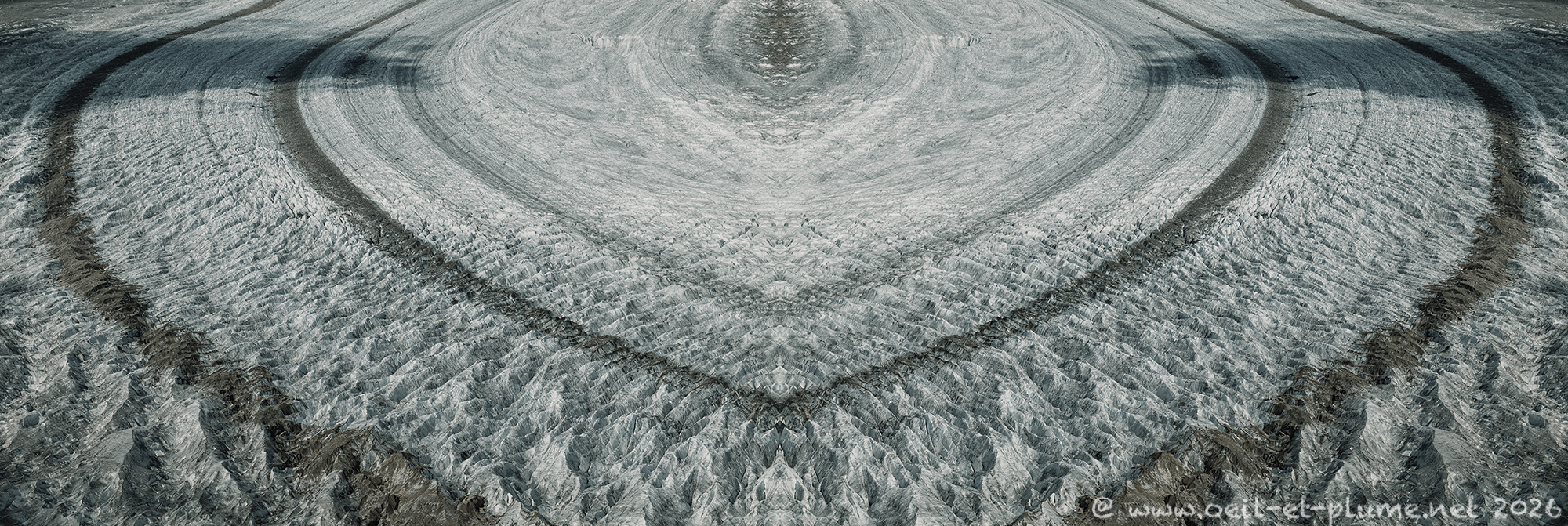
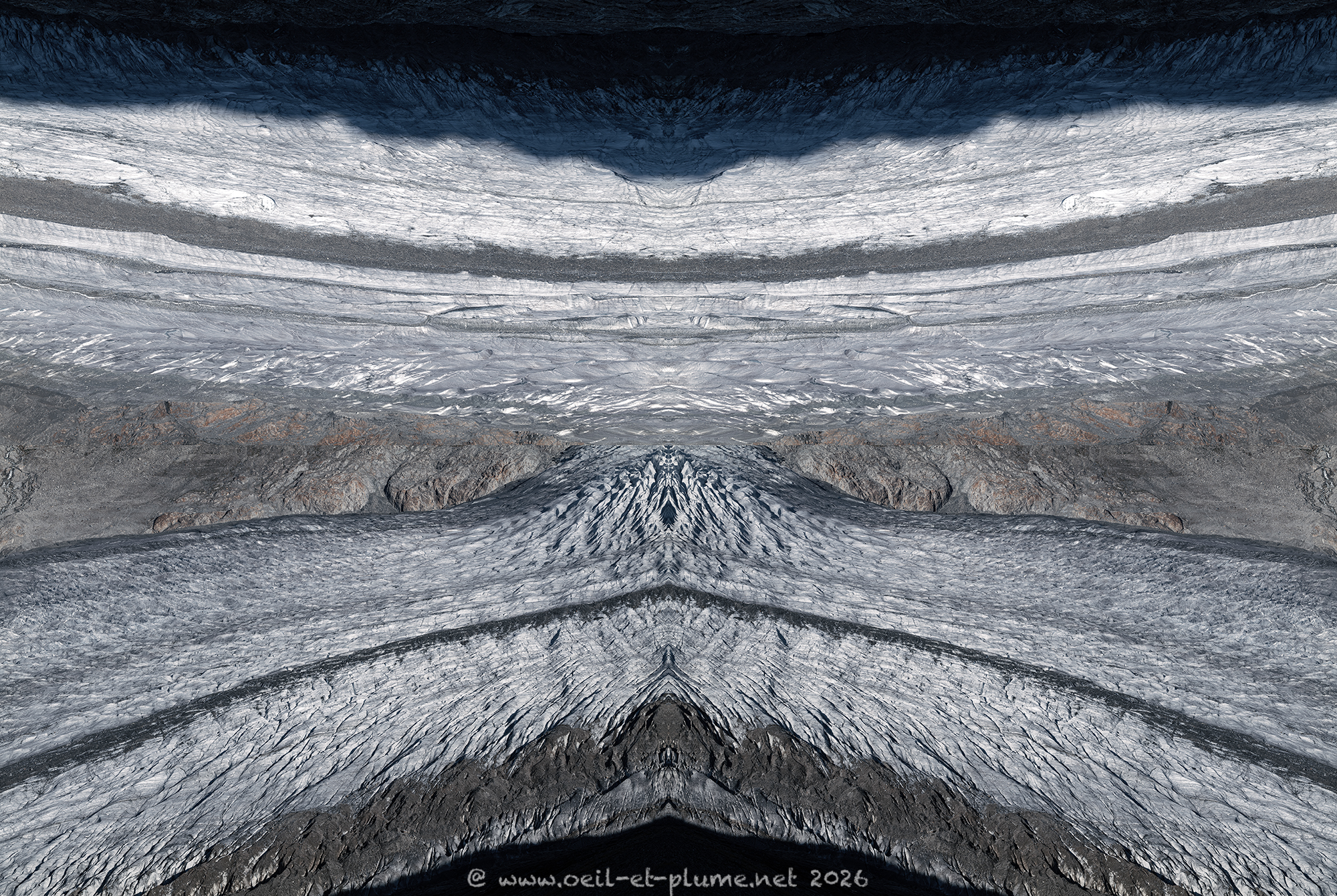
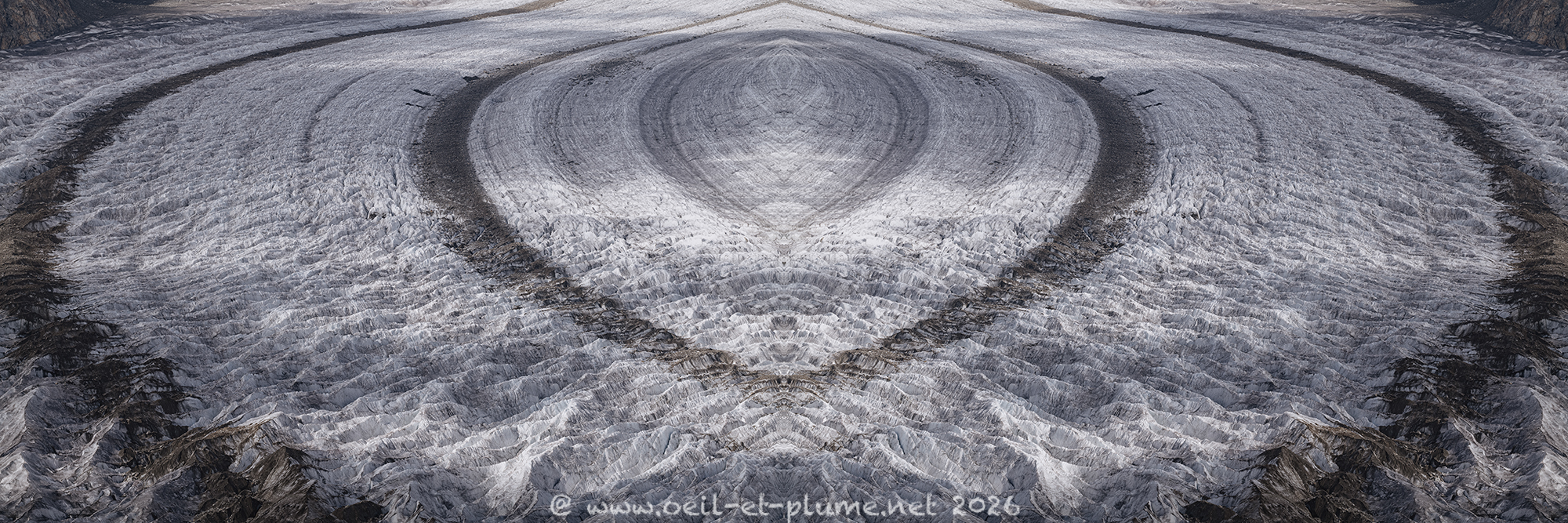
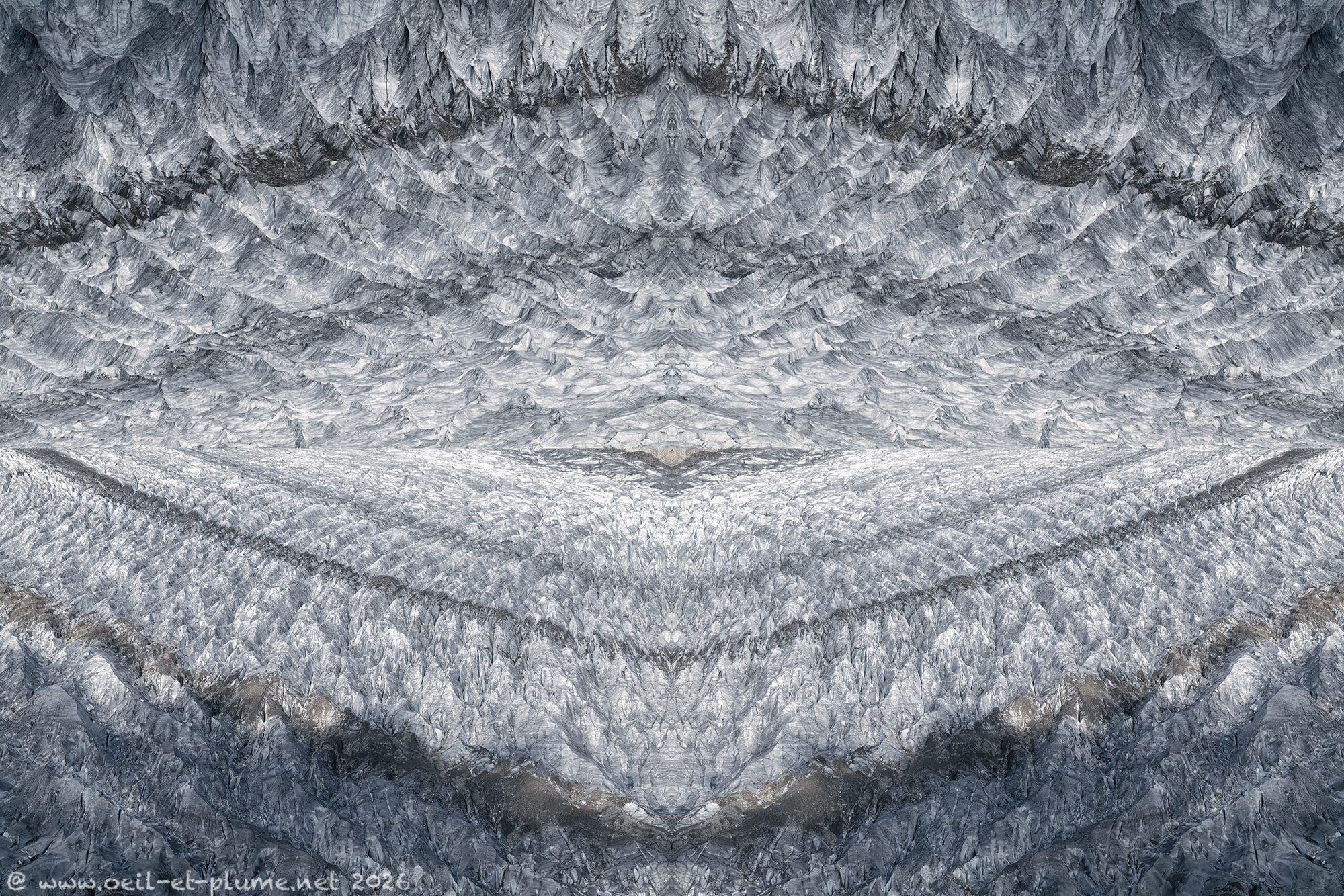
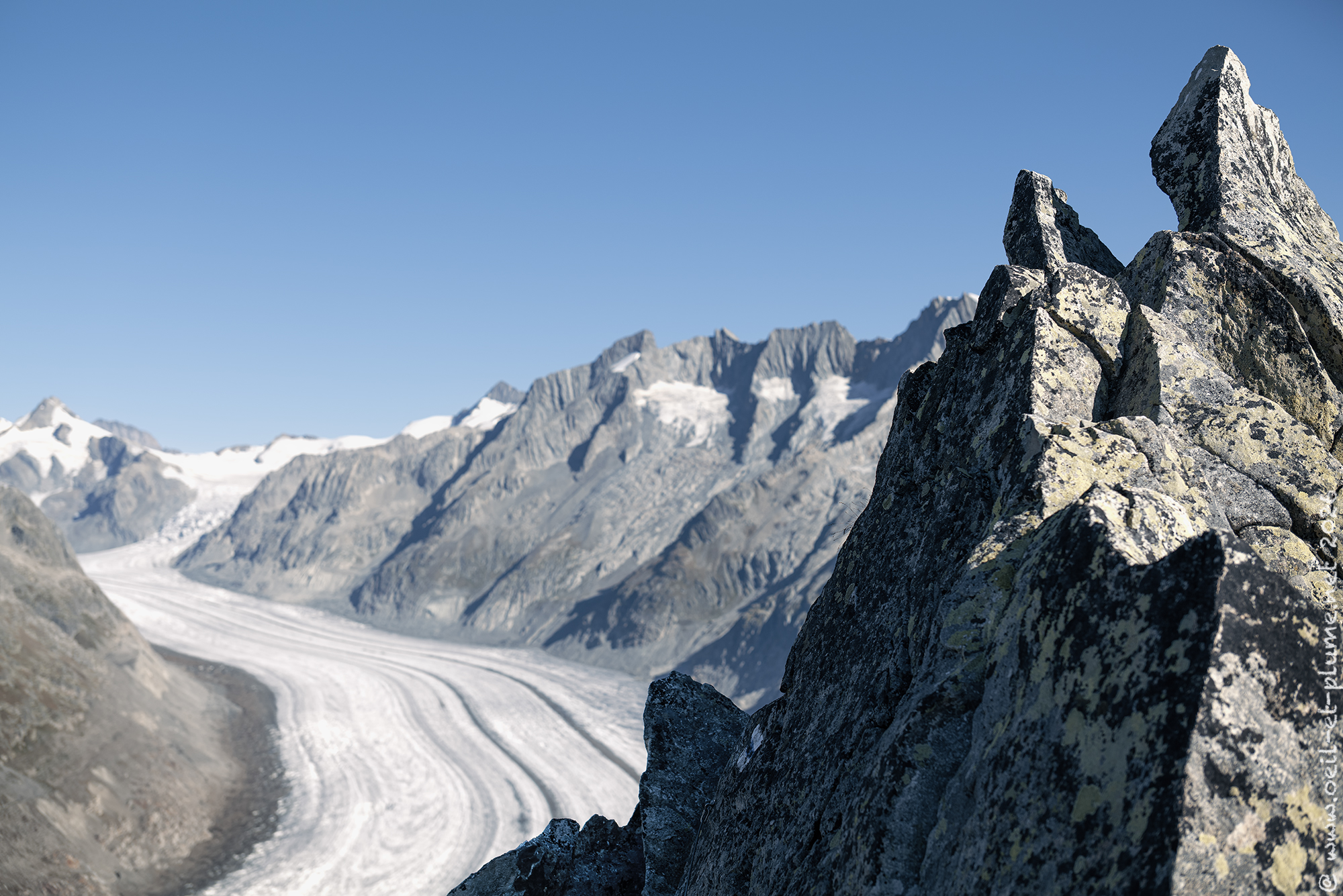
As I progress uphill, I slowly turn left alongside the vast glacial landscape. There, at last, the famous Konkordiaplatz comes into view—the cradle of the Aletsch Glacier, where four immense firn fields, those high-altitude worlds of snow and névé, converge and fuse into a single, monumental river of ice.
Farther downhill, the glacier stretches into the distance, carrying two long medial moraines like dark, delicate seams across its luminous surface. They trace the invisible boundaries where the three great firn fields meet, revealing the hidden architecture of the ice.
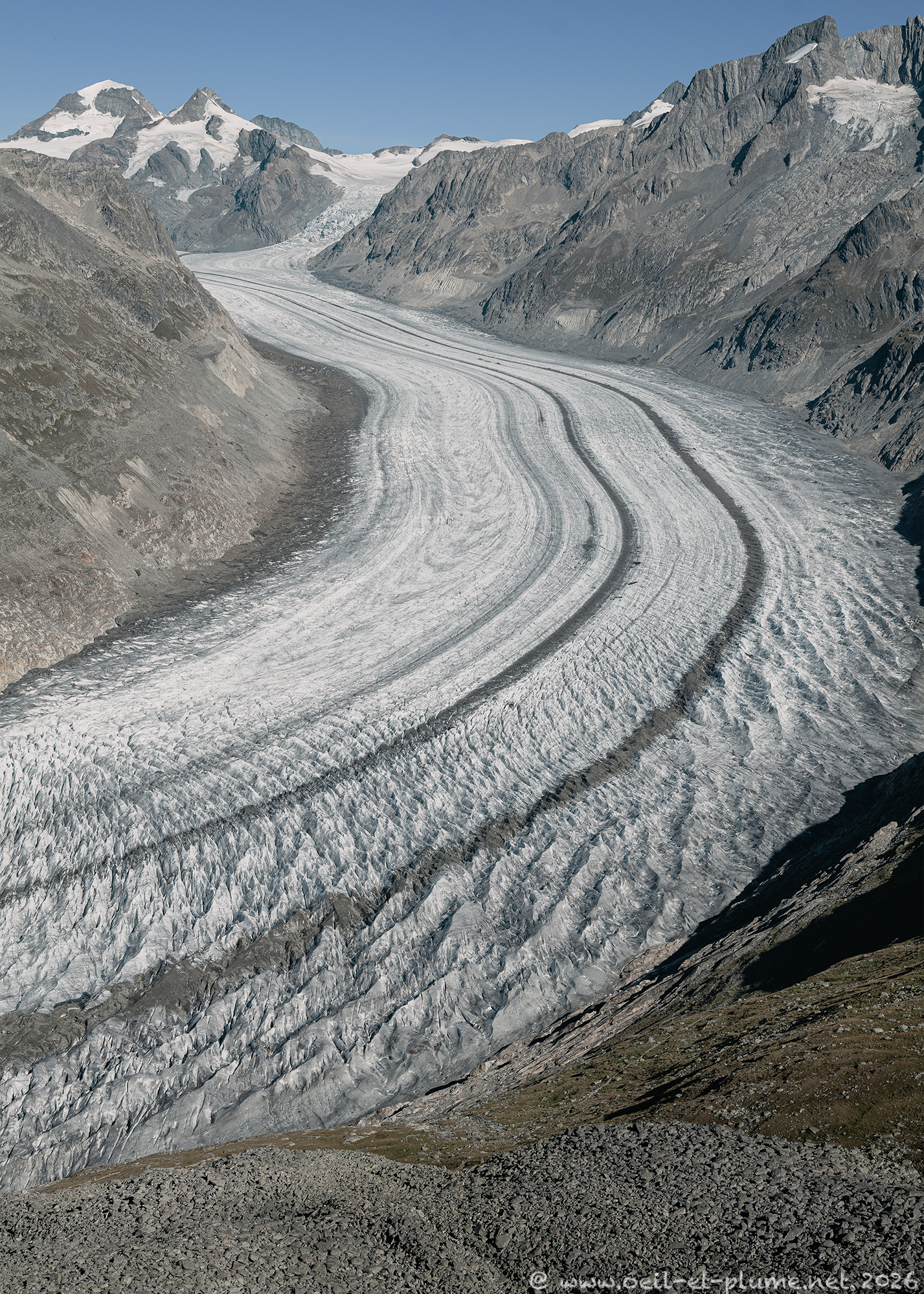
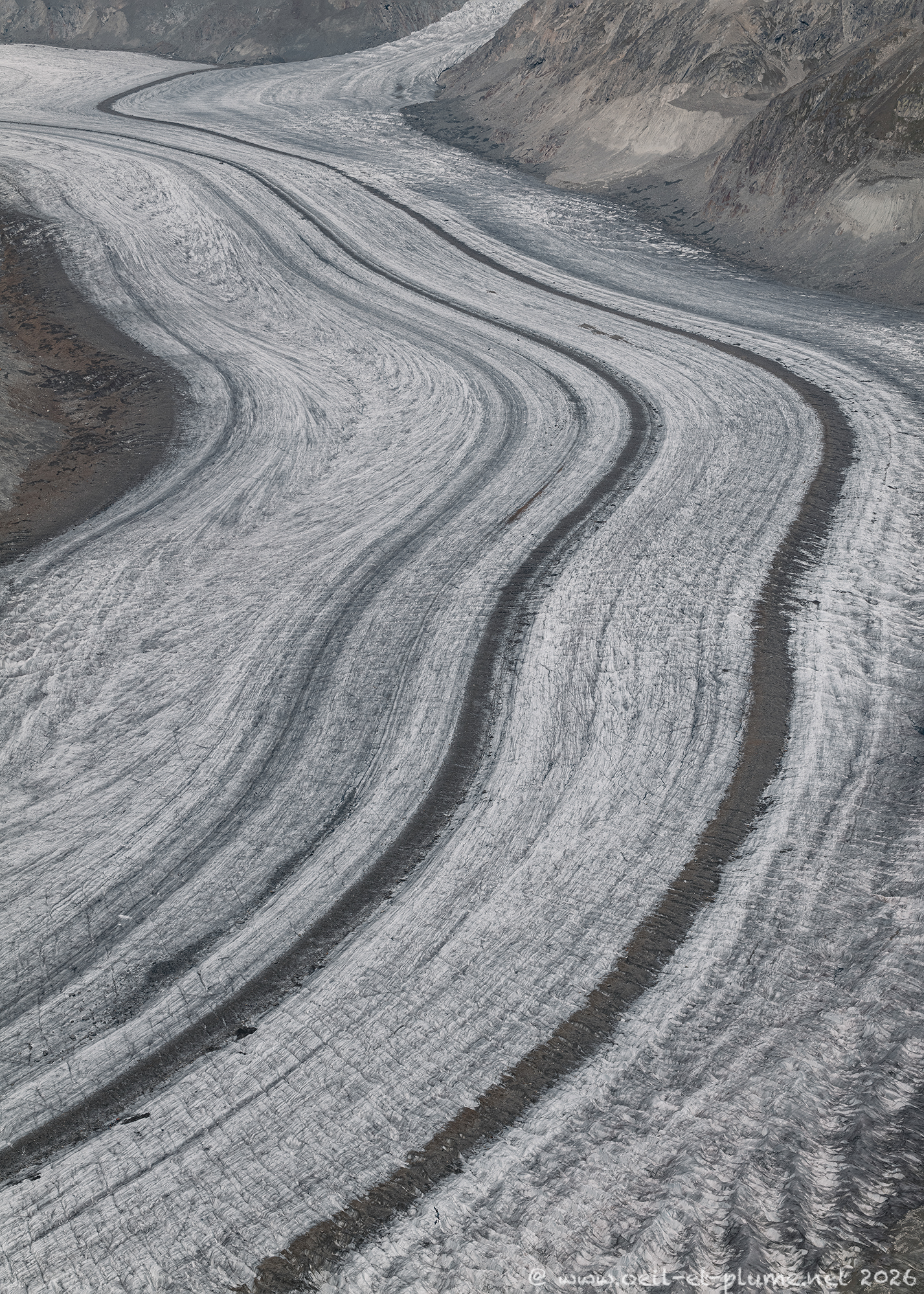
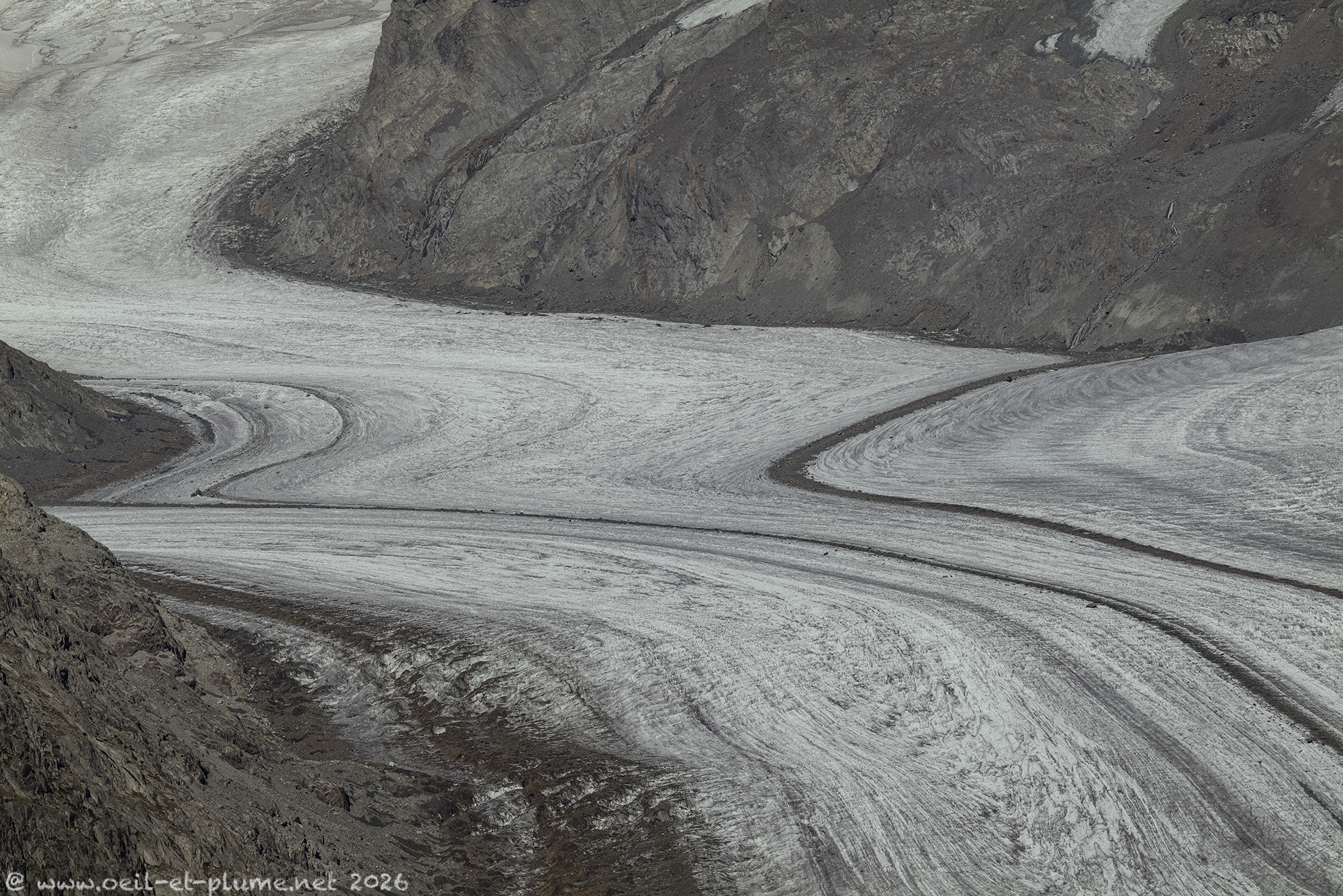
Yet the Aletsch Glacier aspires to more than sheer magnitude. It does not merely seek to be the largest glacier in Europe; it also ambitions to enchant. Its vastness is softened by the graceful curves of its silhouette, drawing the eye deeper into the frozen landscape. In its immense stillness, the glacier feels almost alive: ancient, massive, elegant, and irresistibly beautiful.
The stillness of the Aletsch Glacier is an illusion. Beneath its seemingly motionless surface, the immense body of ice is steadily flowing downhill in an almost imperceptible process. Yet the glacier does not move as one. Its pace varies across its vast expanse. From one section to another, the glacier accelerates and yields, adapting to the changing terrain beneath it. At Konkordiaplatz, the ice advances by as much as 220 metres a year, while around Bettmerhorn, its movement slows to roughly 80 metres annually.
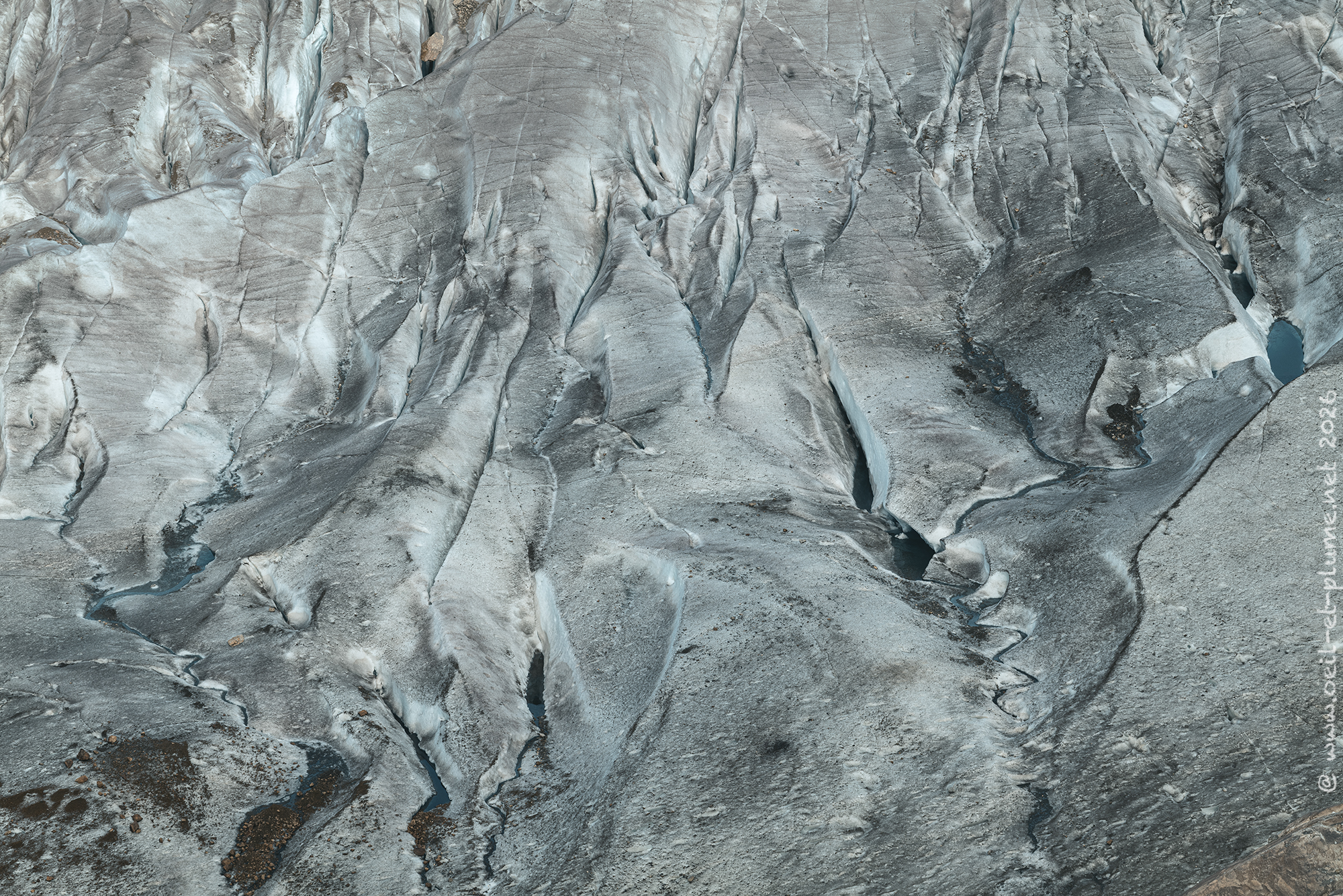
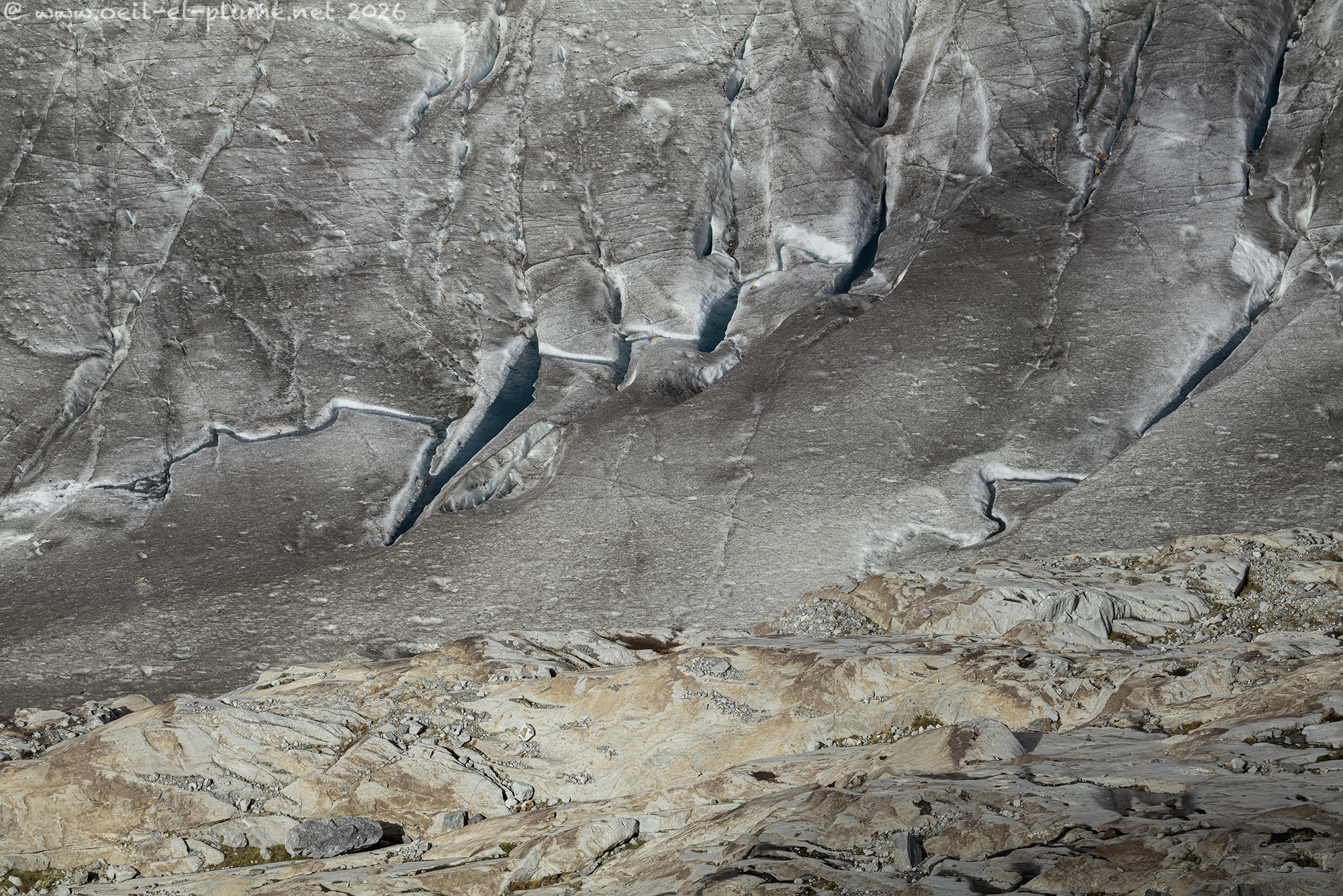
As the ice descends, it encounters differing degrees of frictional resistance. These opposing forces generate immense stresses and tensions within the glacier, causing the seemingly solid mass to fracture, buckle, and deform. Out of this invisible struggle emerges the glacier’s dramatic surface—a labyrinth of peaks, ridges, and deep crevasses, frozen expressions of a living landscape.
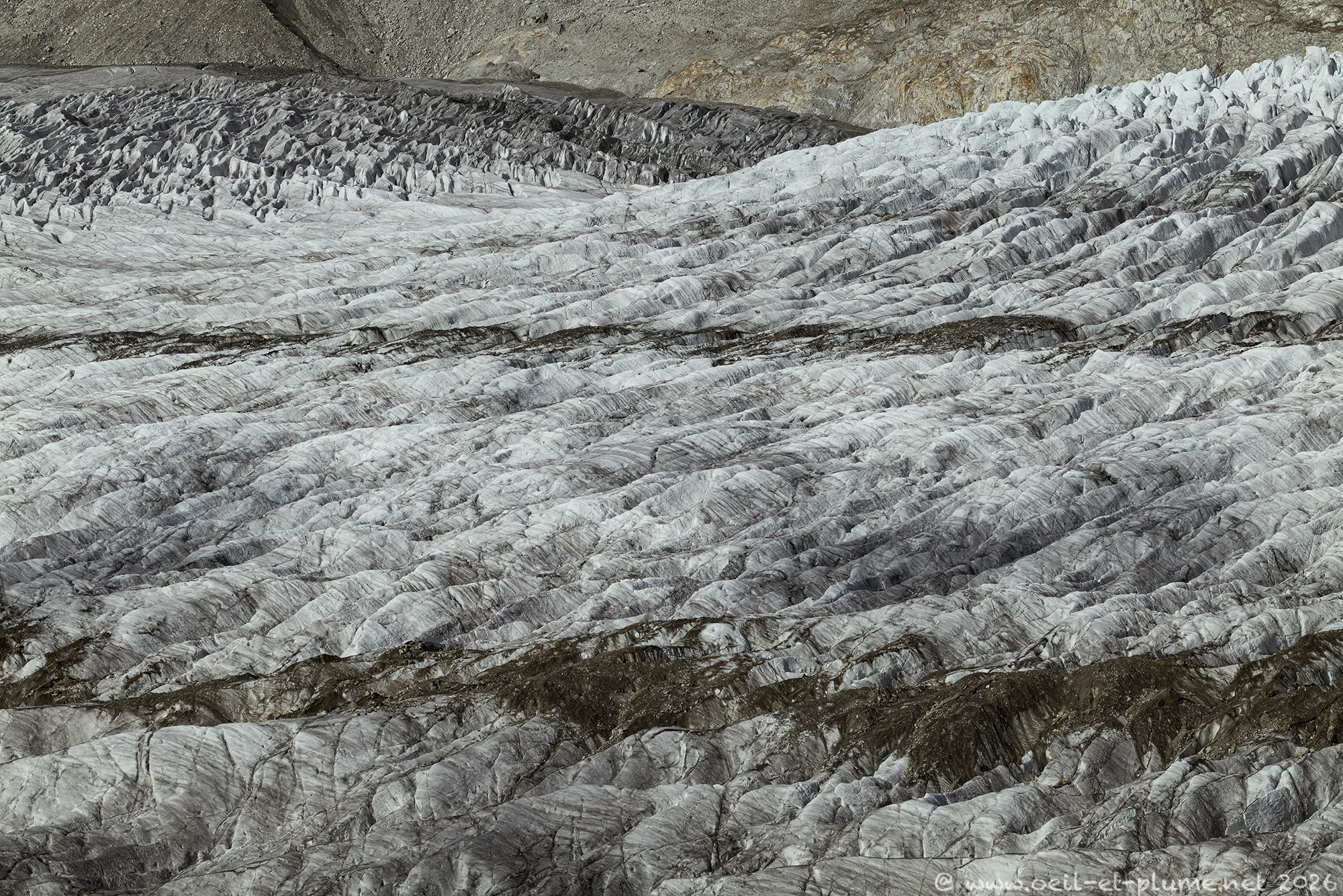
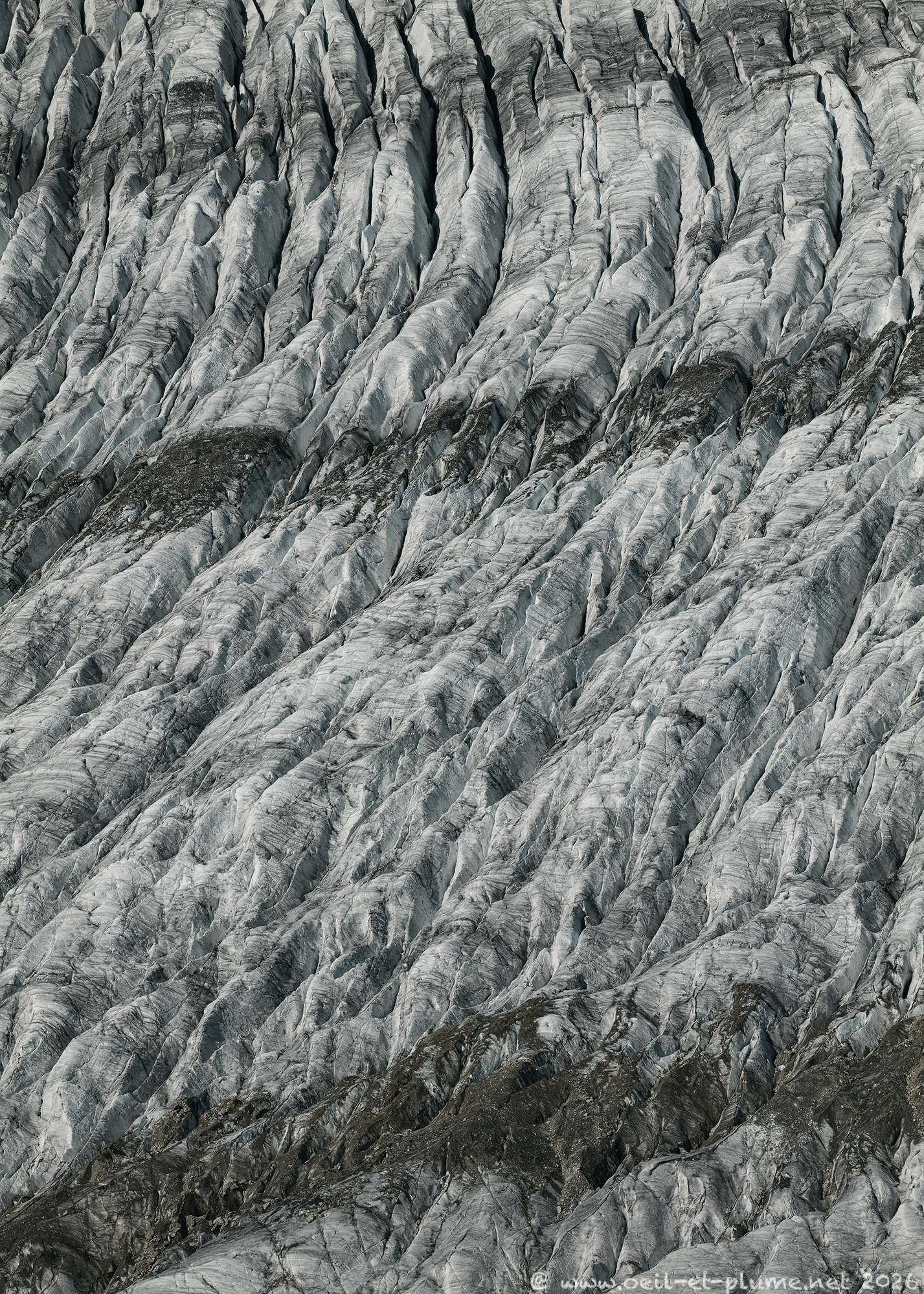
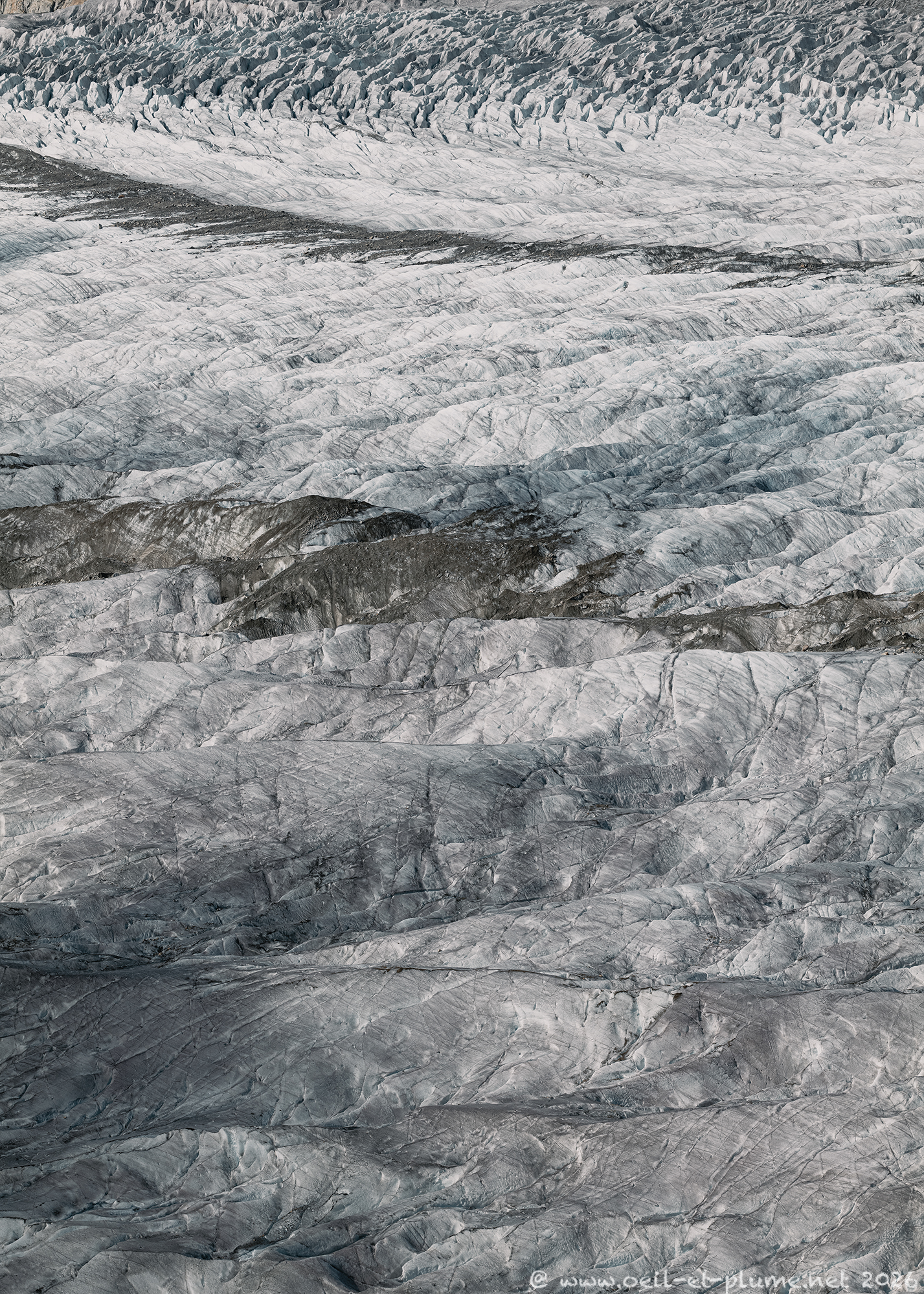
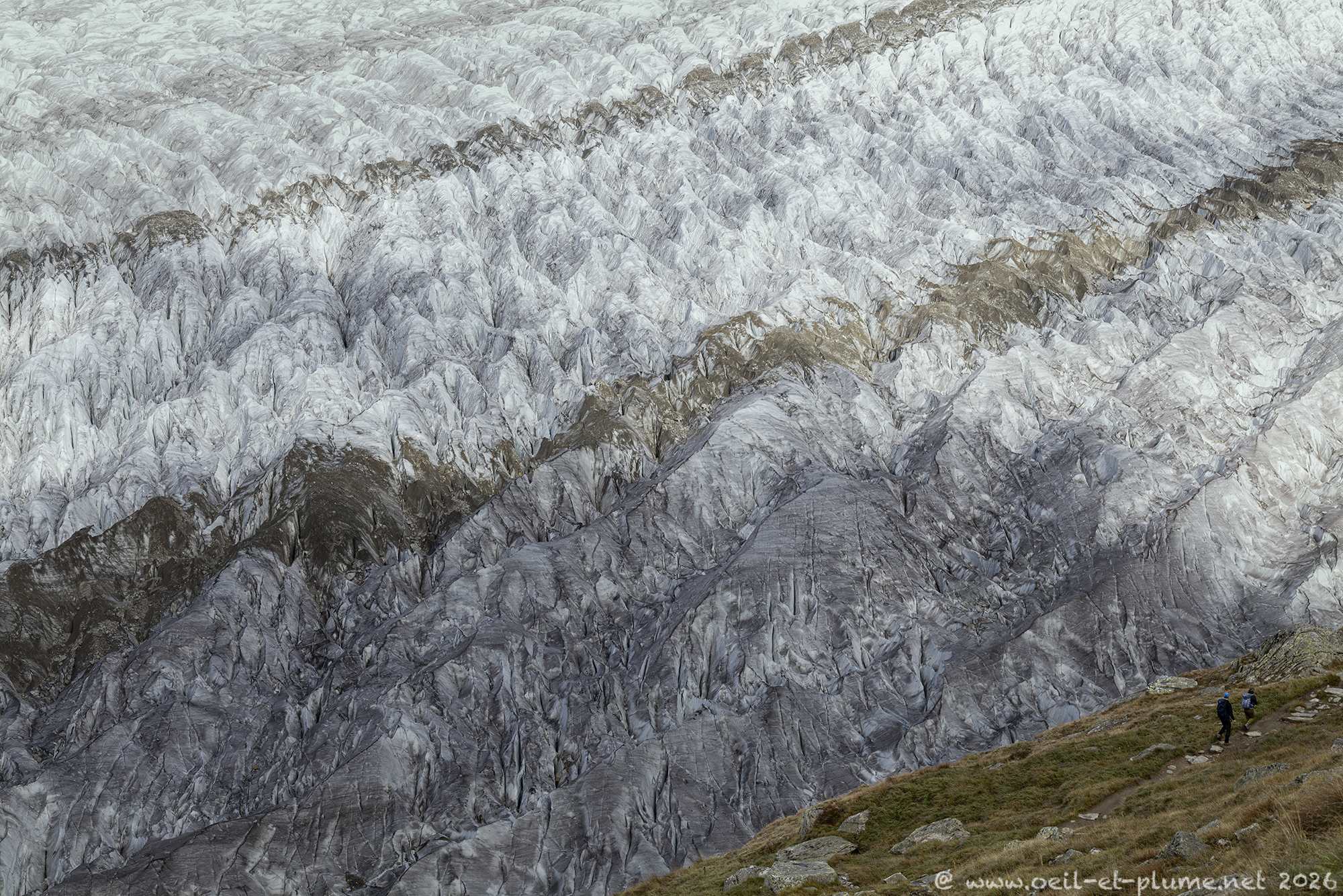
For human beings, to approach such a mighty giant is a lesson in humility—a reminder of our vulnerability and existential finitude, and a call to preserve our delicate relationship with Nature. Yet here again, the glacier’s apparent permanence is an illusion. Its very existence is increasingly threatened by climate change.
The Aletsch Glacier has been steadily receding since the Little Ice Age and particularly in recent decades due to global warming. Since 1870, it has lost more than three kilometres of its length and between 200 and 300 metres of thickness—amounting to roughly one-fifth of its total mass.
At Konkordiaplatz, the three great firn fields are compressed between the mountain ranges on either side, piling layer upon layer in a geological depression. Here, recent scientific measurements have revealed an ice thickness of more than 900 metres. In turn, the lower part of the Aletsch glacier is made of a much thinner layer of ice; it is also where most of the melting occurs.
Back to the Rollibock
I was so emotionnally captivated by the raw beauty of the Aletsch Glacier that I almost forgot about my search for the Rollibock. The demon-beast was nowhere to be seen along my long trek. Perhaps, being a creature fond of cold and ice, it too has felt the effects of climate change and now retreats deeper into the shrinking ice fields, away from human eyes.
Whatever became of the Rollibock, my journey through this pristine landscape had already proved wonderfully rewarding. The glacier had offered something far more tangible than the creature I had come to find: a sense of awe, solitude, and intimate proximity to a world both magnificent and vulnerable.
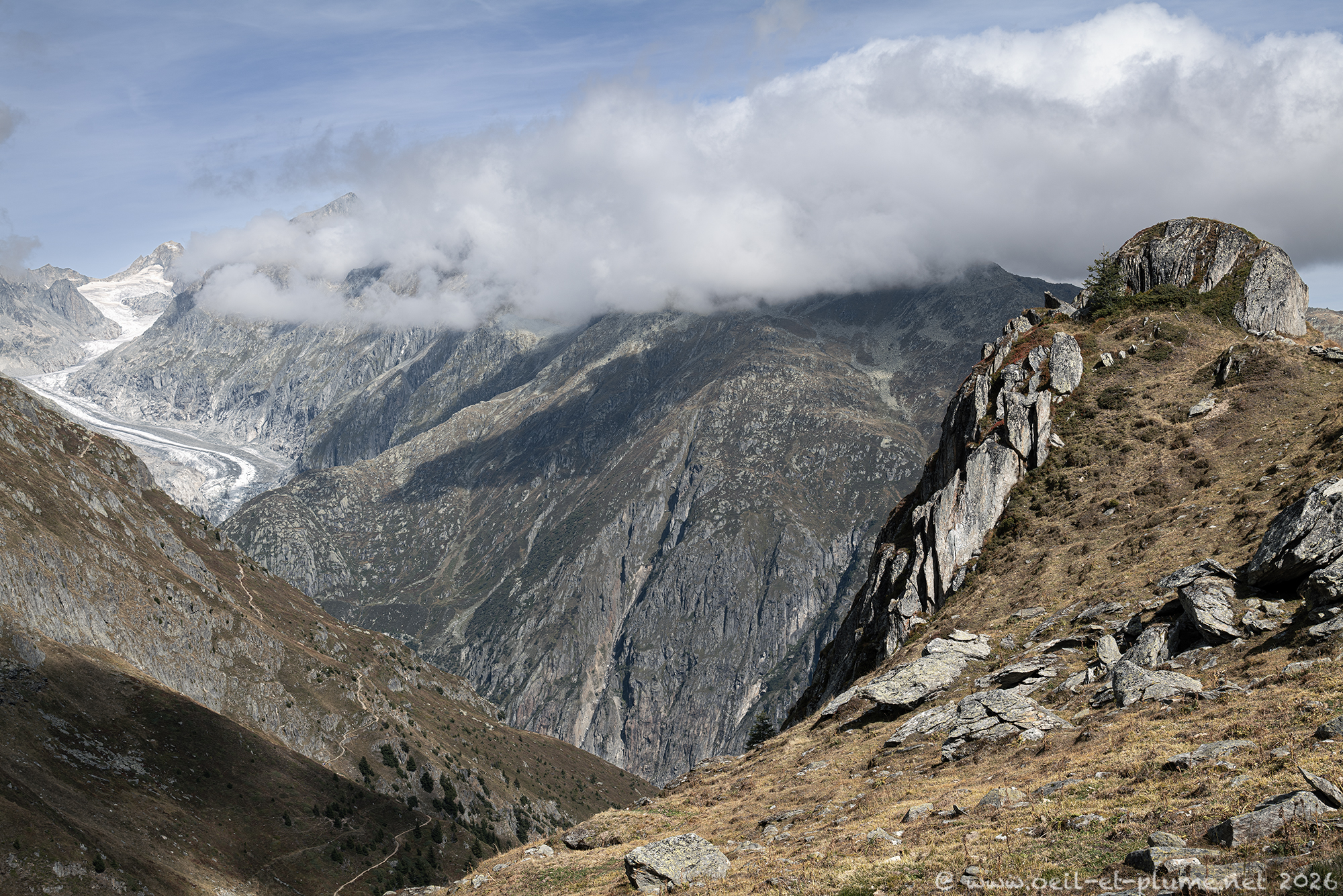
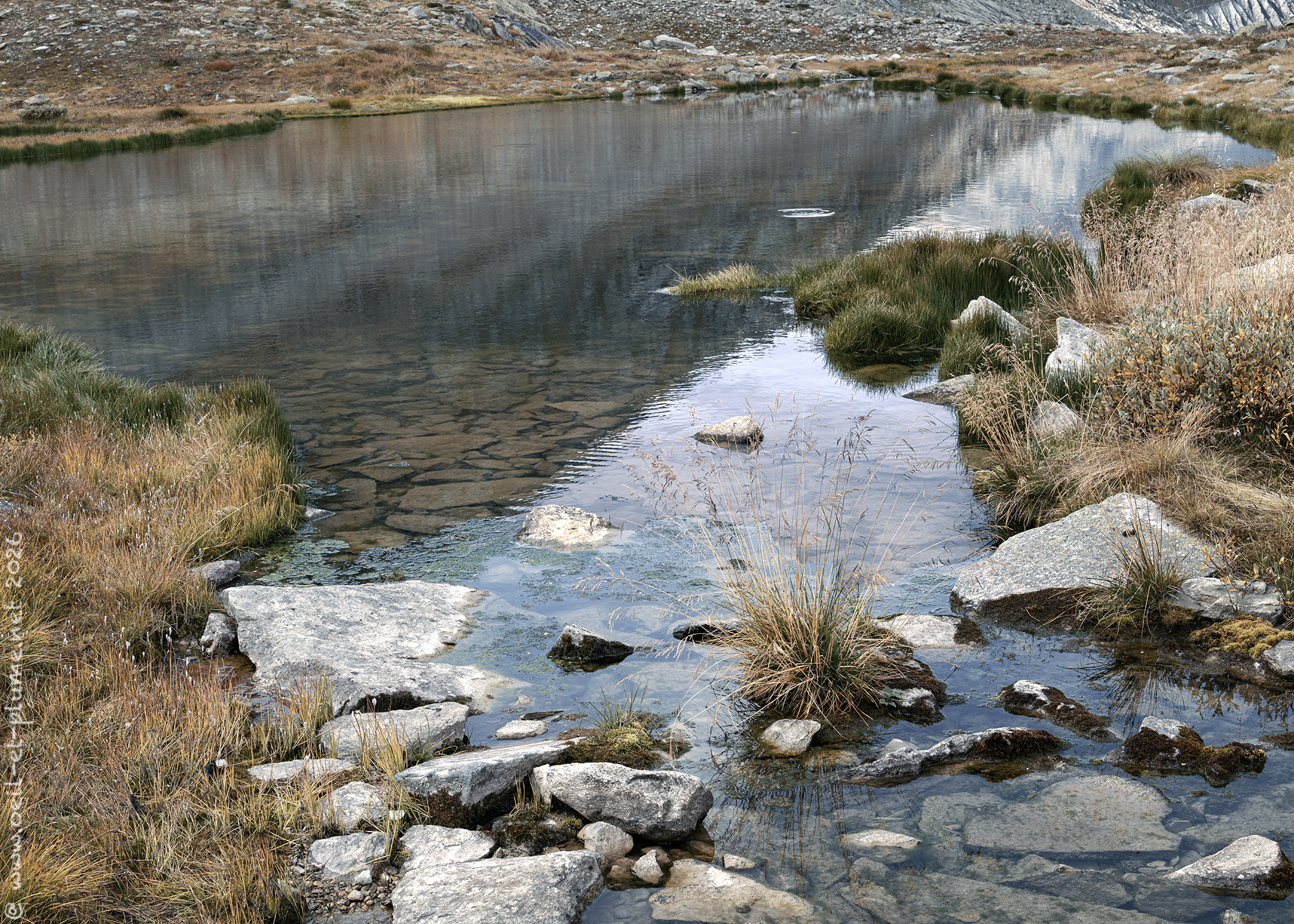
I continue my walk towards Märjelen Lake, a quiet remnant of the much larger glacial lake that once occupied this valley. As explained earlier, this has been a large body of water: in 1878, the lake stretched for more than 1,700 metres in length and around 500 metres in width. Today, only a modest pond remains—an almost melancholy trace of the vast waters that once lay beneath the shadow of the glacier.
Farther down the valley, I come upon a cluster of old stone buildings, some of them partially destroyed by a rockslide. To me, the explanation is obvious: this can only be the work of the Rollibock.
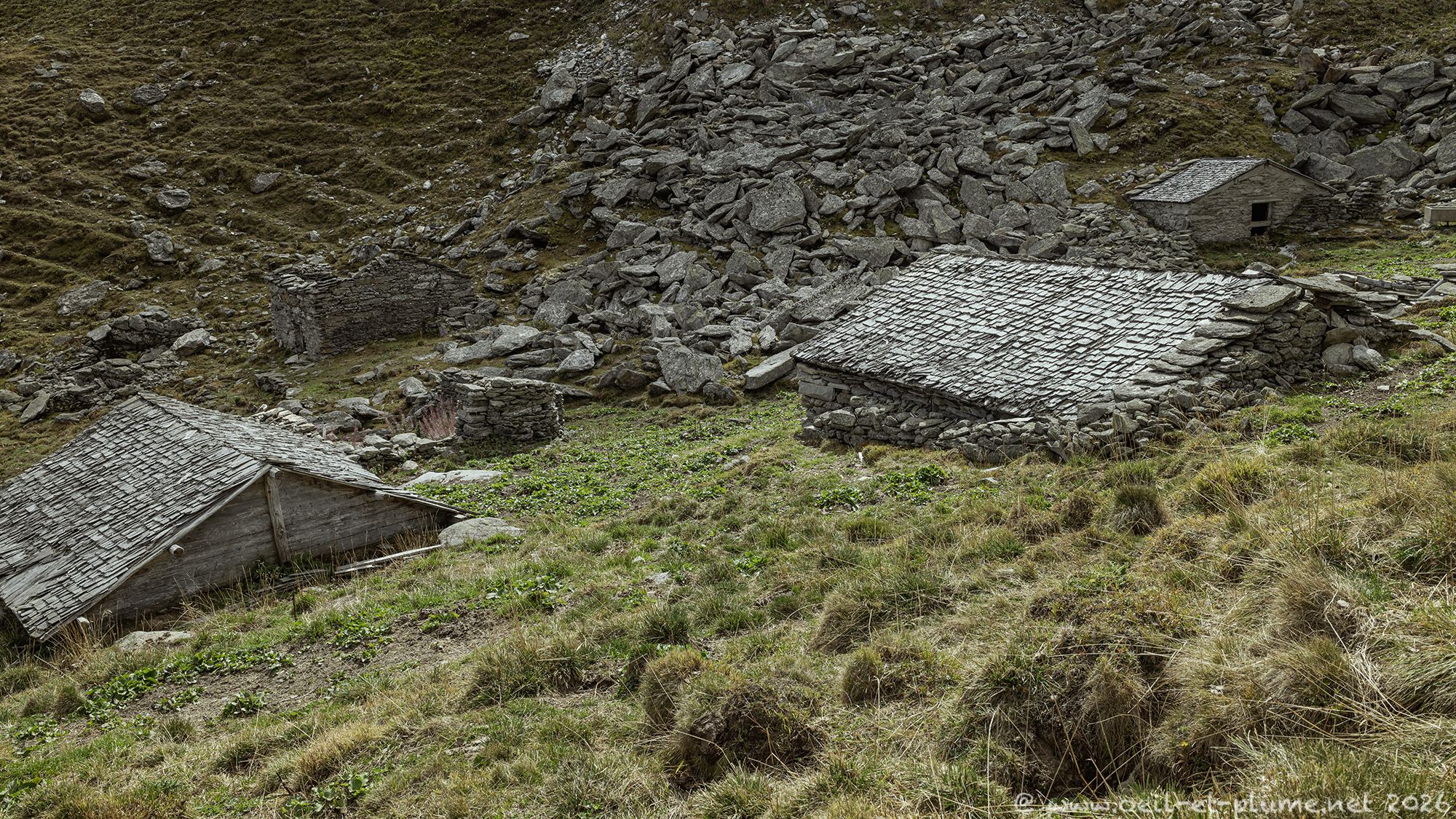
The irritable and vindictive beast must have descended upon the valley a long time ago, unleashing its fury upon the mountainside and driving the inhabitants from the area. The shattered stones and scarred slopes seem to bear witness to its wrath. Perhaps, after all, I had not been so far from the elusive creature as I thought.
A chat with a pair of marmots living nearby confirm my intuition: the Rollibock did indeed come here and wreak havoc some time ago.
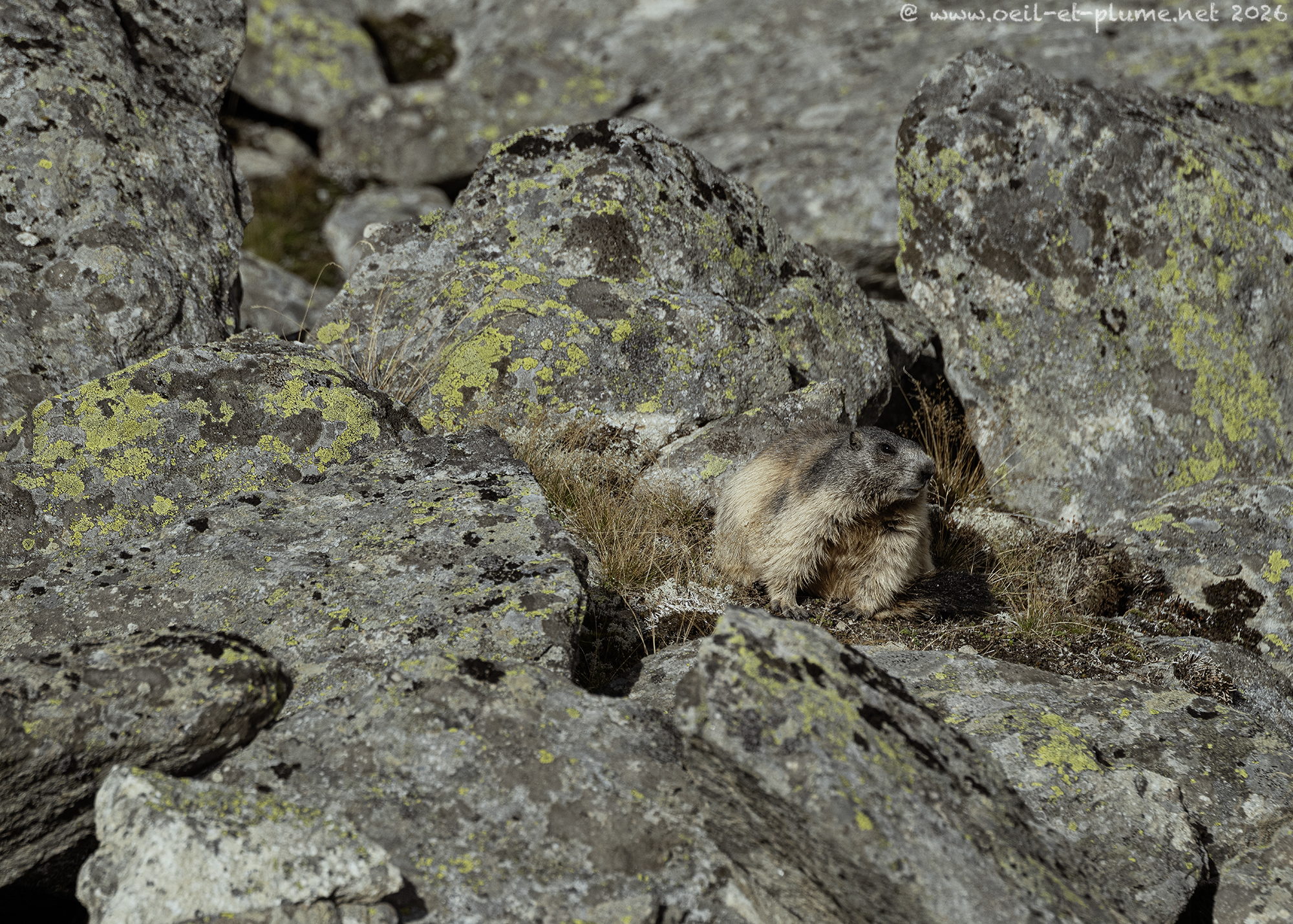
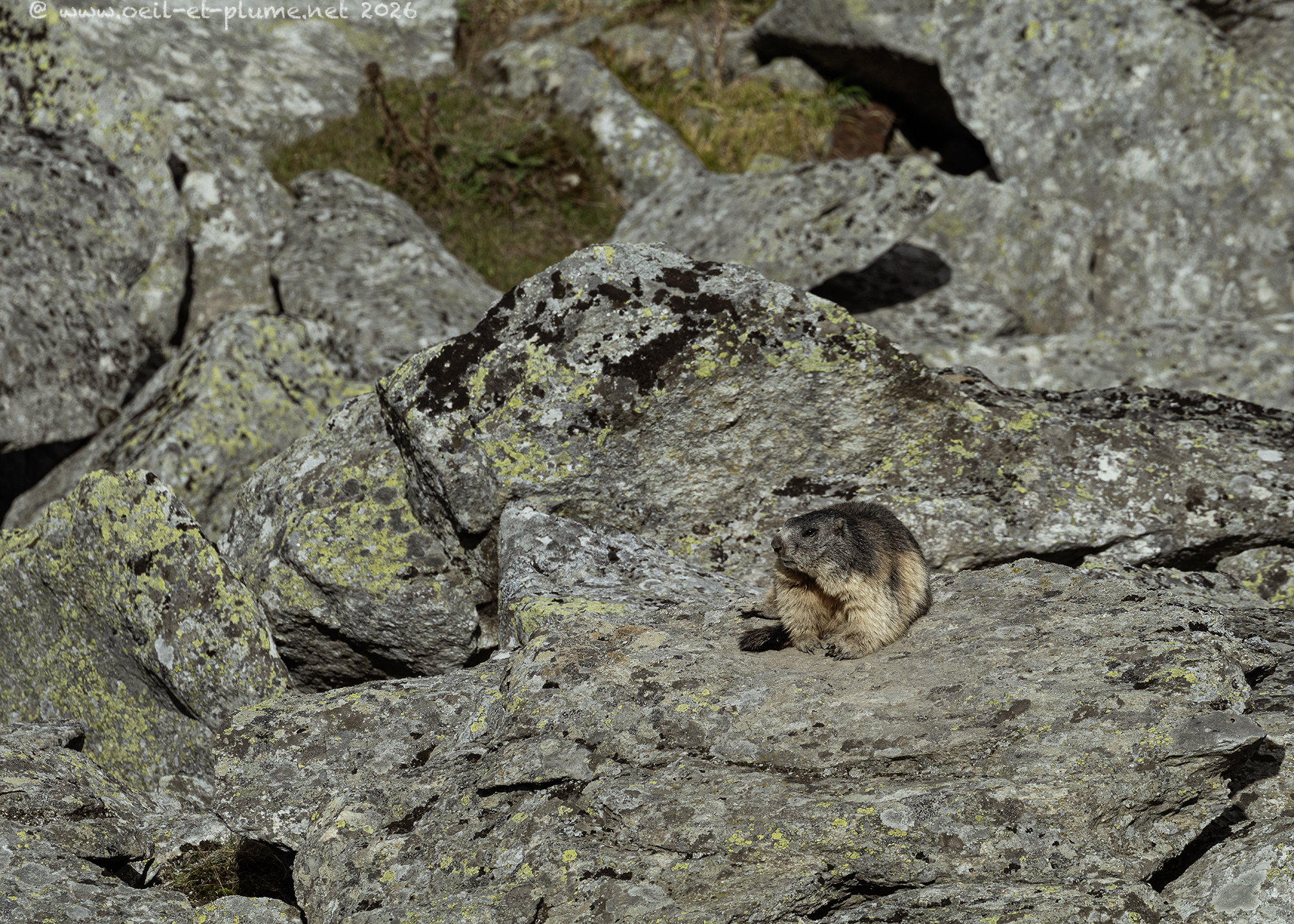
When I ask about the beast’s current whereabouts, the more talkative of the two answers with an air of deliberate mystery while pursuing its morning grooming: “I cannot say for sure, but I would not be surprised if the bock had gone closer to the Jungfrau.”
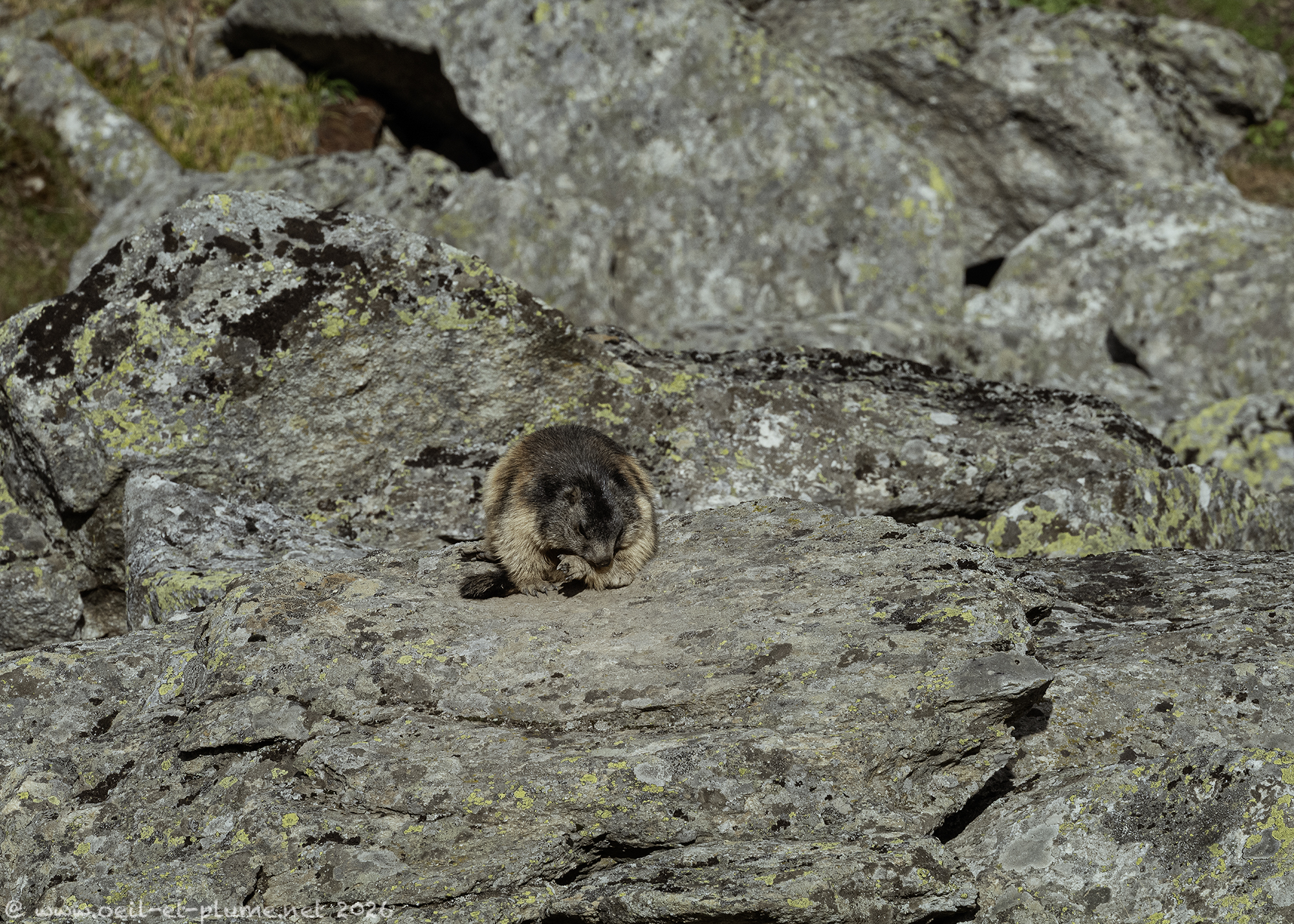
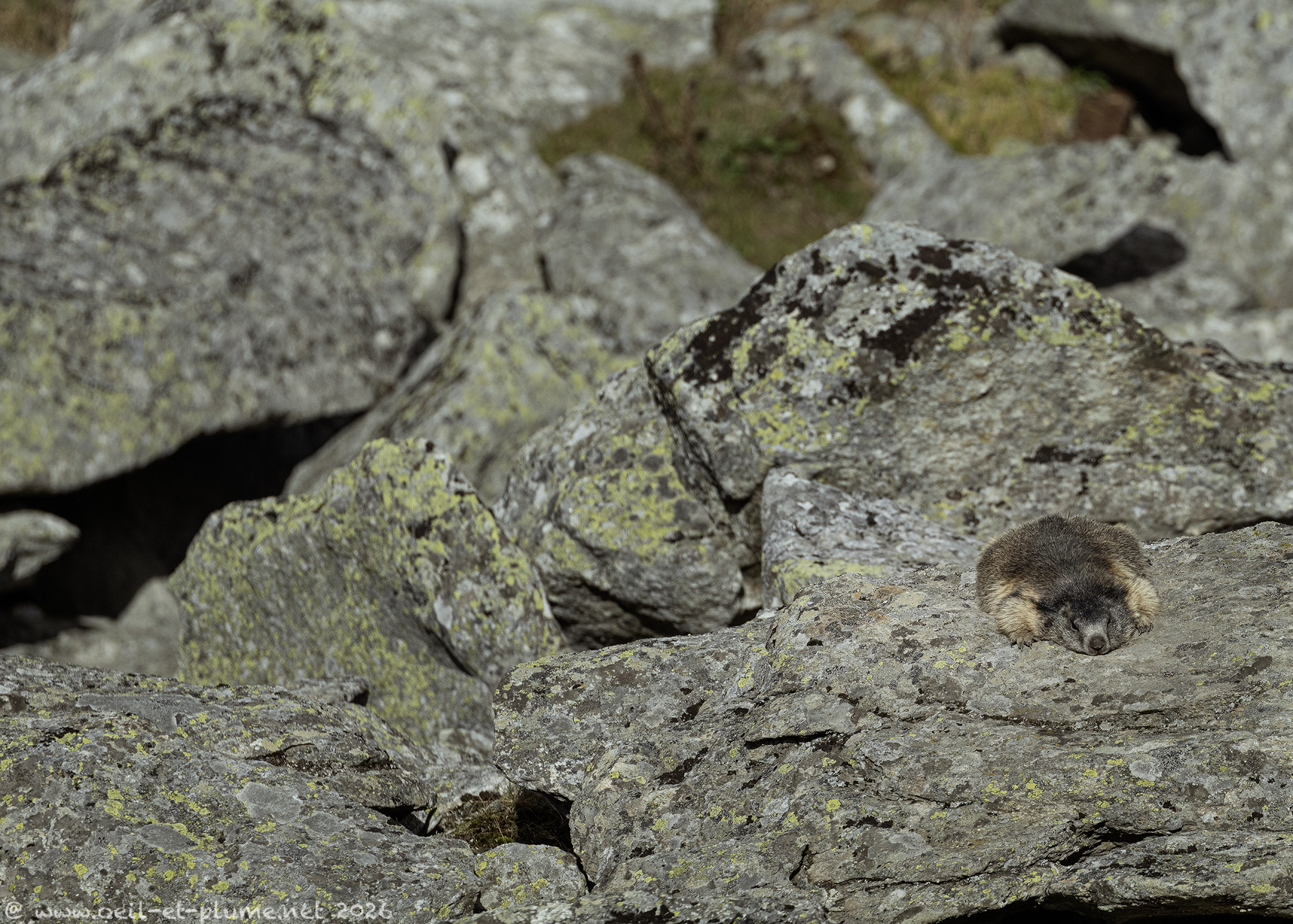
The marmot then falls silent and sleepy, leaving me to wonder whether its words are merely speculation or whether these small inhabitants of the mountains know more about the Rollibock than they wish to reveal.
Anyway, my decision is taken: I will continue my search in the upper part of the Aletsch Glacier – close to the mythical Jungfrau, Mönch and Eiger mountains.
Continues here.
Cheers,